
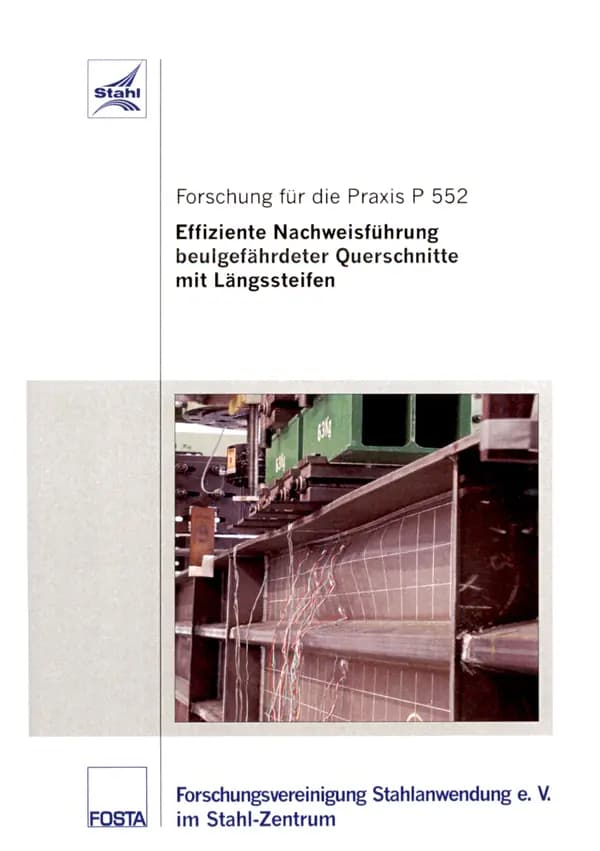
P 552 - Efficient verification of buckling-prone cross-sections with longitudinal stiffeners
Nowadays, welded cross-sections in modern steel and composite bridge construction are optimised in terms of efficient production. If stiffeners cannot be completely dispensed with, an attempt is at least made to …
Content
- Authors
- U. Kuhlmann, M. Seitz
- Publication
- 2004
Nowadays, welded cross-sections in modern steel and composite bridge construction are optimised in terms of efficient production. If stiffeners cannot be completely dispensed with, an attempt is at least made to minimise the number of stiffeners, for example by using closed longitudinal stiffener cross-sections. However, the current regulations for the design of longitudinally stiffened structures at risk of buckling, both in DIN 18800, Part 3 and in ENV 1993-1-5, are predominantly based on tests with a large number of open longitudinal stiffener cross-sections with low torsional stiffness. As a result, the load increases possible by using closed longitudinal stiffener cross-sections cannot be utilised. cross-sections cannot be utilised.
Show full description
In order to be able to utilise these economic advantages for longitudinally stiffened plate girders, experimental and theoretical investigations were carried out as part of this research project. to further develop the existing design rules for transverse force application and shear load-bearing capacity. In contrast to known investigations, the focus of the work was on cross-sections with few longitudinal stiffeners. cross-sections with few longitudinal stiffeners, whereby closed stiffener cross-sections were used in accordance with standard construction practice. Seven tests were carried out on large-scale beams to determine the bearing loads of the transverse load application in order to be able to analyse the influence of the longitudinal stiffener arrangement, the number of longitudinal stiffeners and a simultaneously acting moment and shear force load. As could be shown with the tests, the use of closed longitudinal stiffener cross-sections enables a significant increase in the load-bearing capacity of the transverse load application. The test recalculation using the finite element method showed very good agreement with the results of the experimental investigations, so that these experimental investigations form a basis for further numerical investigations. On the basis of extensive numerical investigations, a modification of the existing regulations to take into account the buckling bar-like behaviour was proposed in order to enable an accurate determination of the load-bearing capacity of the transverse load application. As part of the investigations into the shear load-bearing capacity of longitudinally stiffened beams, four tests were carried out on large-scale beams and the dimensions of the closed longitudinal stiffener cross-sections were varied for different longitudinal stiffener arrangements. In a supplementary parameter study on the influence of the cross-sectional dimensions of the longitudinal stiffeners, it was shown that the reduction of the stiffener moments of inertia required when determining the shear load-bearing capacities in accordance with ENV 1993-1-5 is not necessary for the closed longitudinal stiffener cross-sections investigated here. The conclusion of the research project is that the use of closed longitudinal stiffener cross-sections for longitudinally stiffened plate girders enables a significant increase in the load-bearing capacities, which can be made accessible to design practice through consistent further development of the existing design regulations.
Zum Zoomen hovern
€40.00excl. VAT
Payment by card (Stripe) or invoice (DE, AT, CH). Download link by email: automatically after ordering by card, after order approval for invoice (valid for 30 days). Terms
P 552 - Efficient verification of buckling-prone cross-sections with longitudinal stiffeners—
€40.00