
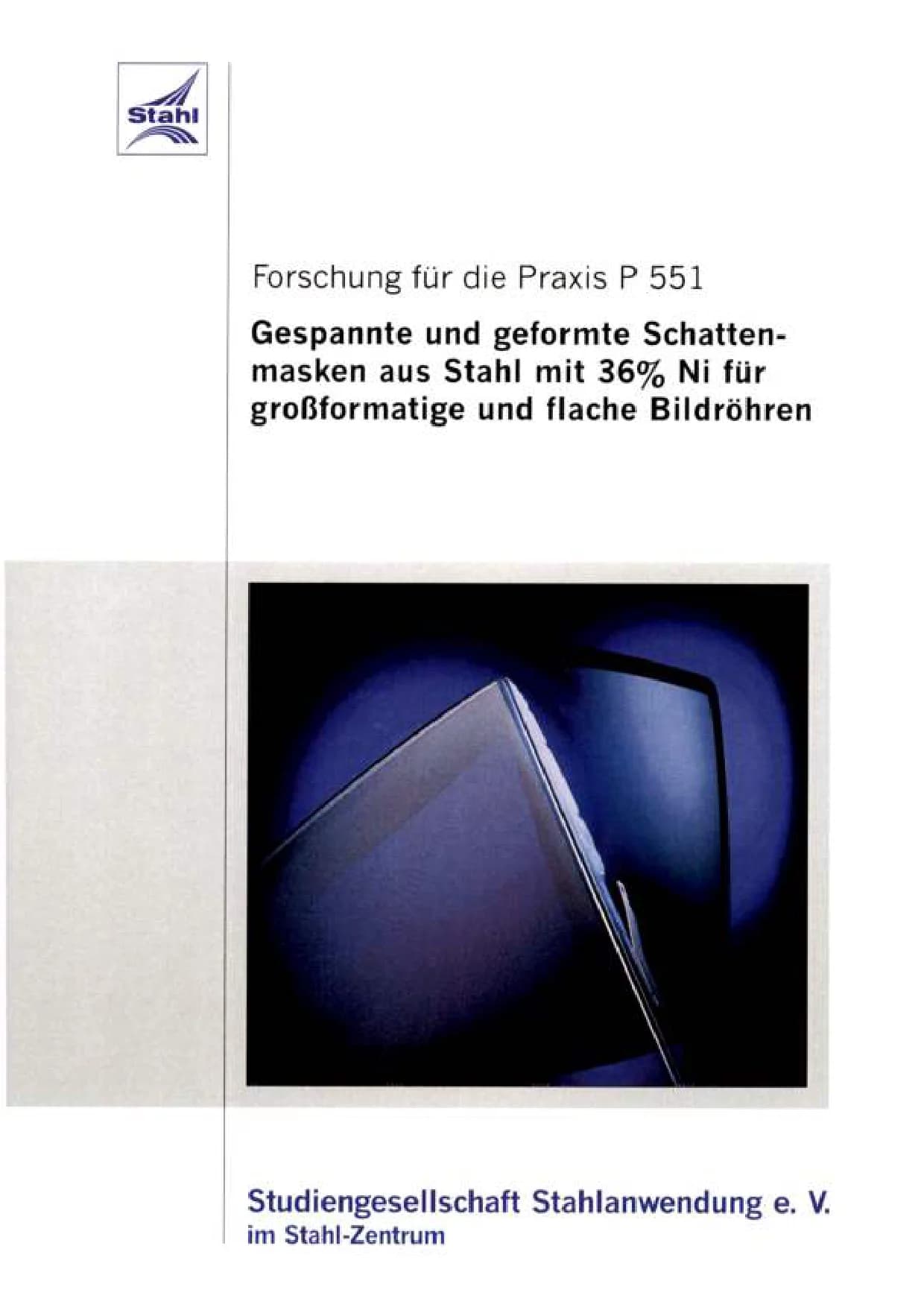
P 551 - Stretched and moulded shadow masks made of steel with 36% Ni for large-format and flat picture tubes
Modern televisions are being developed with ever larger and flatter screens for design reasons and to improve viewing comfort. In this context, the classic electron beam picture tube is exposed to increased competitive …
Content
- Publication
- 2003
- Authors
- Dr T. Myslowicki, Prof. Dr W. Bleck, Dr rer.nat. B. Gehrmann
Modern televisions are being developed with ever larger and flatter screens for design reasons and to improve viewing comfort. In this context, the classic electron beam picture tube is exposed to increased competitive pressure from new systems. Despite its high weight and relatively large depth, the electron beam picture tube still has a very high share of the TV market. This is due to the price advantage and qualitative advantages over plasma or liquid crystal technology. The development of HDTV (High Definition Television), which currently realises the highest picture quality, will point the way to the future use of electron beam picture tubes.
Show full description
Steel has been widely used in television sets since the development of picture tubes began and has established itself as the ideal material for key components such as the shadow mask. The task of the shadow mask is to focus the electron beam on the screen, to remove locally generated heat and to shield the earth's magnetic field; it is crucial for the quality of picture reproduction. The qualitative development of televisions has led to the increasing use of iron-nickel materials with a mass fraction of approx. 36% Ni (so-called Invar steel) for shadow masks. Compared to unalloyed steels, these materials show almost no thermal expansion in the technologically important range between 20 and 100°C. This prevents the holes etched into the shadow mask from shifting relative to the image-generating light spots due to heating by the electron beams and ensures high image quality. Steel is indispensable for this high-tech application to satisfy the highest demands on image quality. The requirements for the shadow mask material have increased significantly. In the research project carried out, a product and process development for shadow masks made of Invar steel was carried out in collaboration with steel manufacturers, processors, etching companies and picture tube manufacturers with the aim of fulfilling the future requirement profile for large-format, flat shadow masks. The first step was therefore to evaluate the most important influencing variables in the complicated process chain of steel manufacturer and picture tube producer. Alloy optimisation was carried out using laboratory melts. Important production parameters were varied and evaluated in relation to the relevant properties of the shadow masks. Based on a fundamental understanding of the key production parameters that directly influence product quality as well as metal-physical analyses, the material and the production process were defined for each of the two types of picture tube, TRUE FLAT and REAL FLAT. Compared to the Asian competition, a material was developed that offers a considerable price advantage with the same technological properties due to the alloy concept that was found. STUDIENGESELLSCHAFT STAHLANWENDUNG e. V.
Zum Zoomen hovern
€30.00excl. VAT
Payment by card (Stripe) or invoice (DE, AT, CH). Download link by email: automatically after ordering by card, after order approval for invoice (valid for 30 days). Terms
P 551 - Stretched and moulded shadow masks made of steel with 36% Ni for large-format and flat picture tubes—
€30.00