Components with good mechanical properties can be produced relatively cost-effectively in large quantities using the forging manufacturing process. Nevertheless, this manufacturing process is also subject to the …
Components with good mechanical properties can be produced relatively cost-effectively in large quantities using the forging manufacturing process. Nevertheless, this manufacturing process is also subject to the economic pressure of a large number of competing processes. This is because, apart from the quality of the component, costs are the decisive factor for the customer when placing production orders. It is therefore important to pursue the goal of producing high-quality components even more cost-effectively. In order to improve the economic boundary conditions, the reduction of forming force and input mass is particularly suitable in the forging process, as these factors are ultimately reflected to a large extent in the overall costs of the components.
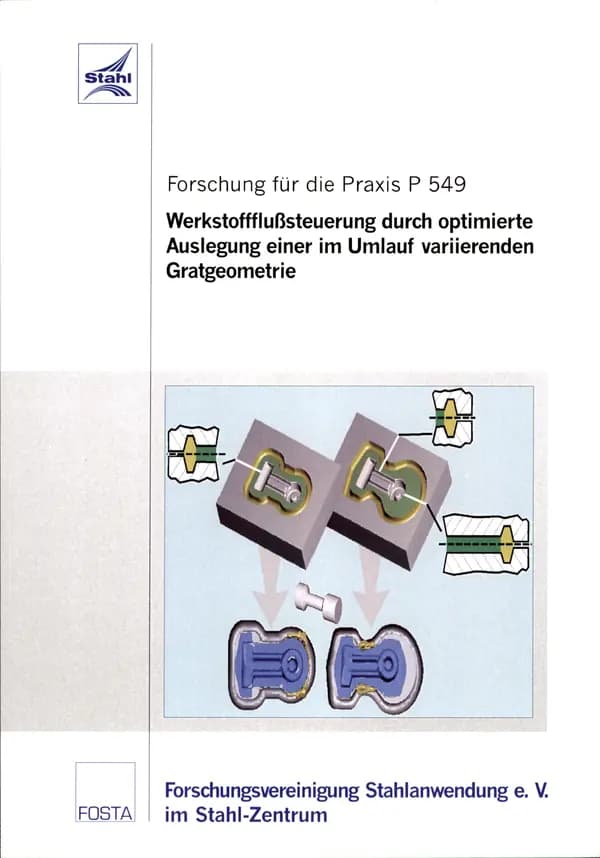
Although the precision forging process makes it possible to produce forged parts without excess material, this is difficult to realise for many components. Due to the combination of technological and economic factors, the majority of forged components are produced with excess material. This excess material must flow between the moulding dies via the so-called flash path. The design of the shape of this flash path has a significant influence on the tool stress, the flow behaviour within the engraving and the required excess material. As the flow behaviour of complex forged parts is not constant, it is advisable to design the flash path variably according to the flow conditions. At present, the design is mainly based on individual empirical values. Systematic design methods and solutions to support the design process within CAD systems do not yet exist. As part of this project, various methods for designing variable burr geometries were developed. In order to compensate for the higher design effort of variable burr geometries modelling concepts were also developed in various CAD systems to simplify and partially automate the design of burr paths. To verify the positive effects of variable flash paths on the insertion mass or forming force, variable flash paths for forging tools were designed iteratively, checked with the aid of FEM simulation (finite element method) and the analysed improvements verified by means of test forging operations. RESEARCH ASSOCIATION FOR STAHLANWENDUNG e.V.
Payment by card (Stripe) or invoice (DE, AT, CH). Download link by email: automatically after ordering by card, after order approval for invoice (valid for 30 days). Terms
Machine-translated title and description. The document itself is in German.
Digital download
Other parts and editions as well as neighbouring documents of the same series.

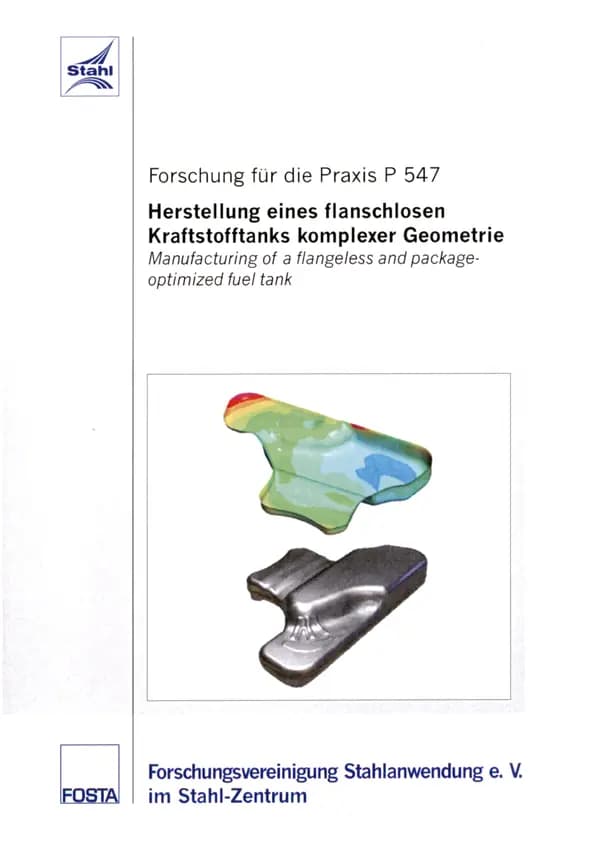
P 547 - Manufacture of a flangeless fuel tank with complex geometry The aim of the research project was the production of a package-optimised fuel tank made of steel. This was based on the results of research project P 410 "Production of a fuel tank with complex geometry made of steel using hydroforming". The package optimisation aimed for in this research project was achieved by designing the tank as a flangeless (laser) welded tank using forming and joining technology. A major problem in the production of a flangeless tank made of stainless steel is the uneven, moulding-related spring-up and spring-back, particularly in the frame areas. This makes the positioning and orientation of the tank halves required for joining very difficult. In this project, the residual stress state in the formed sheet metal half-shells was therefore first analysed using the drill hole method and the disassembly method. From this, design and tooling measures (increasing the rigidity through appropriate embossing) were derived in order to minimise the forming-related springback. In the field of joining technology, a special welding process (based on the use of a special robot head) and a corresponding clamping device were developed and realised, which was able to achieve precise trimming and joining. However, it turned out that the shape deviations caused by springback could not be fully compensated for by increasing the rigidity and by the clamping technology used. For this reason, the tank half-shells were ultimately successfully joined using piece-by-piece laser welding and manual TIG welding. Finally, the manufactured tanks were subjected to component tests in accordance with the VW factory standard. The knowledge gained can initially make the manufacture of modern tank systems with complex geometries from steel materials considerably easier. In addition, the findings can also be transferred to other potential areas of application, for example in rail and aircraft construction, apparatus engineering, sanitary engineering or the household appliance industry. Authors: M. Kleiner, W. Homberg, A. Wellendorf, M. Gösling, F. Trösken, F. Behr, T. Langhammer Publication: 2006
available anytime
€20.00
excl. VAT

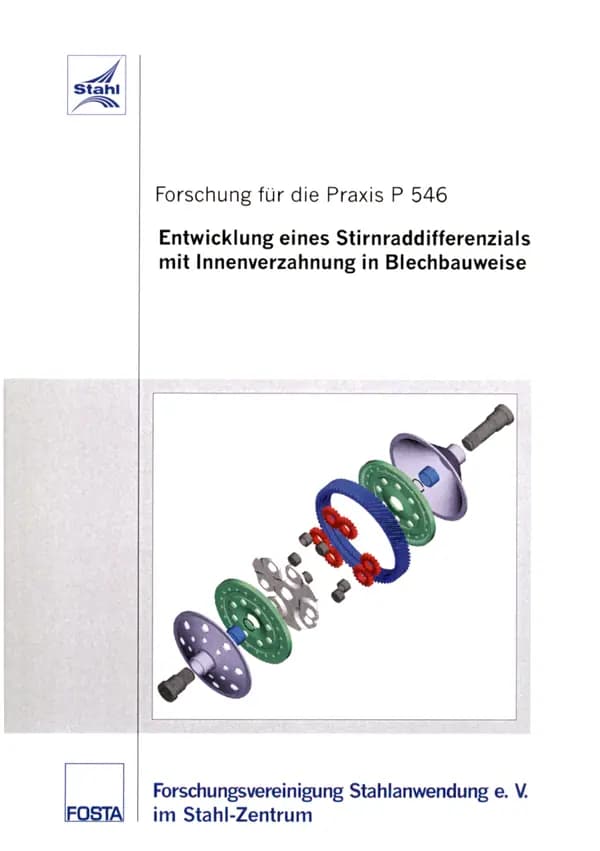
P 546 - Development of a spur gear differential with internal gearing in sheet metal construction The most common type of axle differential for vehicles to date is the bevel gear differential. With this differential, the torque is transmitted over a relatively small diameter with correspondingly high component stresses. In order to increase the load-bearing capacity, the bevel gears are sometimes made from materials with particularly high strength. The high axial forces from the bevel gear teeth also require a solid and heavy cast housing. As part of the research project, a spur gear differential with internal gearing was developed and investigated as an alternative to the bevel gear differential. In this type of differential, the torque is transmitted over a relatively large diameter. This results in relatively small gear forces with correspondingly low component stresses. This type of differential therefore allows either a higher transmissible torque with the same installation space requirement, or a lower installation space requirement and lower weight with the same transmissible torque as a comparable bevel gear differential. Prototypes were produced with the same load capacity and a more compact and lighter design compared to a reference bevel gear differential. A total of four prototypes were built for testing. Two of these were designed as lightweight variants with a sheet metal web. These variants are around 17% lighter than the bevel gear differential. For the tests on the basic operating behaviour of the spur gear differential, two further differentials with a solid web were built, which are still around 4% lighter than the reference differential. The investigations into the function of the differential show a locking value curve that increases with the load. The differential behaves symmetrically in left and right curves. The measured blocking values are between 13% and 18%. In contrast, the locking value on the reference differential remains constant at approx. 9% as the load increases. The locking value behaviour of the spur gear differential can be assessed as favourable for the driving behaviour based on the test bench tests. The tests on the load-bearing capacity of the differential revealed an insufficient scuffing load-bearing capacity of the planetary bearing, which could not be eliminated within the scope of the project. As the bearing of the bevel gears in the reference differential functions with a similarly high load, it is assumed that the problems in the spur gear differential can be solved. Authors: B. R. Höhn, K. Michaelis, M. Heizenröther Publication: 2005
available anytime
€20.00
excl. VAT

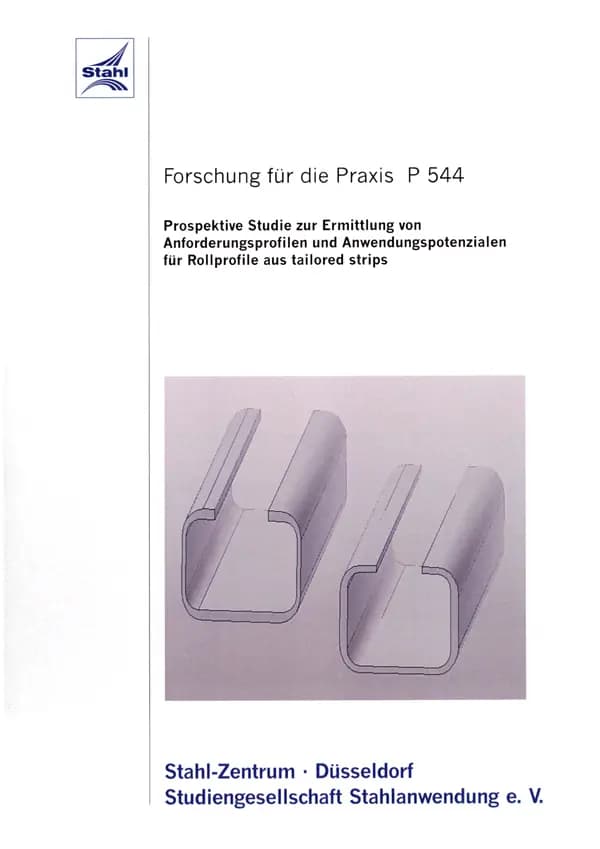
P 544 - Prospective study to determine requirement profiles and application potentials for roll profiles from tailored strips Due to their wide range of shapes and economic manufacturability, rolled steel profiles have established themselves as construction elements in a wide variety of industries. Currently, only strip steel of uniform thickness is processed for this purpose. Expanding the process by processing tailored strips - strips of different thicknesses welded together - could make rolled profiles even more attractive for existing and new applications. Ideally, profile cross-sections could be produced that are individually adapted to the load of the components manufactured from them. The aim of this study was to find out what requirements such profiles should fulfil and what possible applications they have. The investigations focussed on the technological and economic aspects of various processes for manufacturing profiles. Extrusion moulding and roll forming were examined in detail. In general, technical constraints limit the use of steel compared to aluminium for the production of extruded profiles with thin-walled segments. However, it is clear that rolled profiles made from tailored strips could compensate for the design deficits of rolled profiles made from conventional steel strip compared to extruded aluminium profiles. This opens up new areas of application. Roll-formed profiles are already ideally suited for effective and economical lightweight fabric construction when high-strength steel grades are used. In addition, roll-formed profiles, whose thickness can be varied across the cross-section, open up innovative design and application possibilities for steel in lightweight moulded construction. Data research, user surveys and product analyses have shown that load-adapted, lightweight rolled profiles made from tailored strips have very good potential applications, particularly in road and rail vehicle construction, and have met with great interest from manufacturers. STUDIENGESELLSCHAFT STAHLANWENDUNG e.V. Publication: 2002 Authors: Dipl.-Ing. A. Istrate, Prof. Dr.-Ing. P. Groche
available anytime
€20.00
excl. VAT

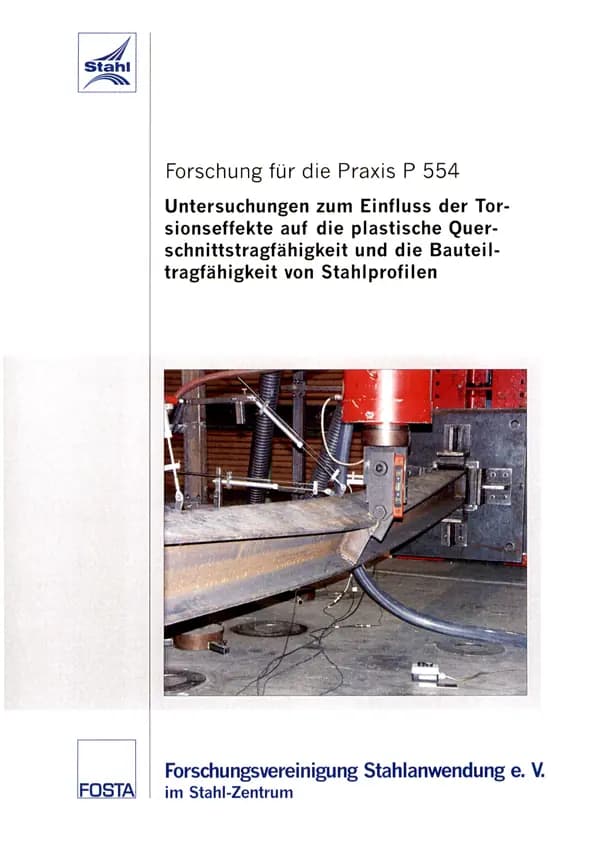
P 554 - Investigations into the influence of torsional effects on the plastic cross-sectional load-bearing capacity and the component load-bearing capacity of steel profiles The research project deals with the influence of torsional effects on the cross-sectional and component load-bearing capacity of steel profiles. For this purpose, the limit load-bearing capacity of compressed and stability-endangered profiles was determined by systematic investigations. The experimental part of the project comprised tests on the cross-sectional load-bearing capacity of rolled sections subjected to bending and torsion, as well as component tests of beams subjected to bending torsion with and without axial compressive force. Furthermore, medium to high slenderness columns were tested under eccentric loading. Frequently used profile types from the IPE, UPE and HEB series were utilised. The theoretical part of the project confirmed the plausibility of the measurement results by means of numerical recalculations. In particular, the load-bearing capacity-reducing influence of component imperfections and residual stresses was demonstrated. The effects of redistribution of internal forces in the ultimate limit states with and without stability failure were analysed. Based on the numerical models calibrated with the tests, simulations were carried out for other load types, slendernesses and other parameters that were not covered by the test programme. Finally, engineering models were developed whose usability could be confirmed with the help of the experimental and numerical database. The applicability of the so-called partial internal forces method (TSV) was demonstrated for the verification of the cross-section load-bearing capacity for internal forces determined by elastic calculation (elastic-plastic method, Eurocode 3). Two alternative engineering formulae were developed for the verification of component load-bearing capacity, which could be used to supplement the existing verification options in Eurocode 3 so that torsion can also be taken into account. Authors: G. Sedlacek, H. Stangenberg, J. Lindner, T. Glitsch, R. Kindmann, C. Wolf Publication: 2004
available anytime
€70.00
excl. VAT
Payment by card (Stripe) or invoice (DE, AT, CH). Download link by email: automatically after ordering by card, after order approval for invoice (valid for 30 days). Terms