
FOSTA
The aim of the research project P523/A160 Establishment and operation of a centre for metallic construction methods - zmb of the Forschungsvereinigung Stahlanwendung e.V. (FOSTA) and the Forschungsvereinigung der …
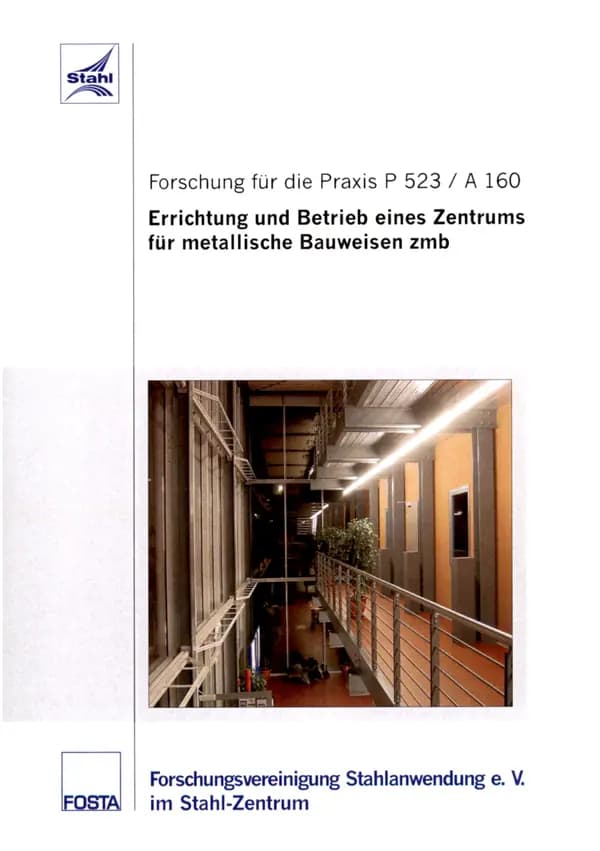
The aim of the research project P523/A160 Establishment and operation of a centre for metallic construction methods - zmb of the Forschungsvereinigung Stahlanwendung e.V. (FOSTA) and the Forschungsvereinigung der Arbeitsgemeinschaft der Eisen- und Metallverarbeitenden Industrie e.V. (AVIF) was to promote the initiative to intensify the interdisciplinary cooperation of 6 university institutes of the RWTH Aachen in the field of steel research and application. Suitable work opportunities were to be created for them in a centre, thus also providing the prerequisites for a joint training, research and development operation. As the new zmb building itself was to be a demonstration object for new construction methods in steel, the planning, development and approval of this construction method and the execution had to be carried out and synchronised in such a way that the desired solution was ultimately achieved in technical, scheduling and financial terms.
The report describes the special features of the planning and development, shows how the co-operation between the participating university institutes works and presents the first successes of the joint training, information and research and development activities. RESEARCH ASSOCIATION STAHLANWENDUNG e.V.
Machine-translated title and description. The document itself is in German.
Payment by card (Stripe) or invoice (DE, AT, CH). Download link by email: automatically after ordering by card, after order approval for invoice (valid for 30 days). Terms
Digital download
Other parts and editions as well as neighbouring documents of the same series.
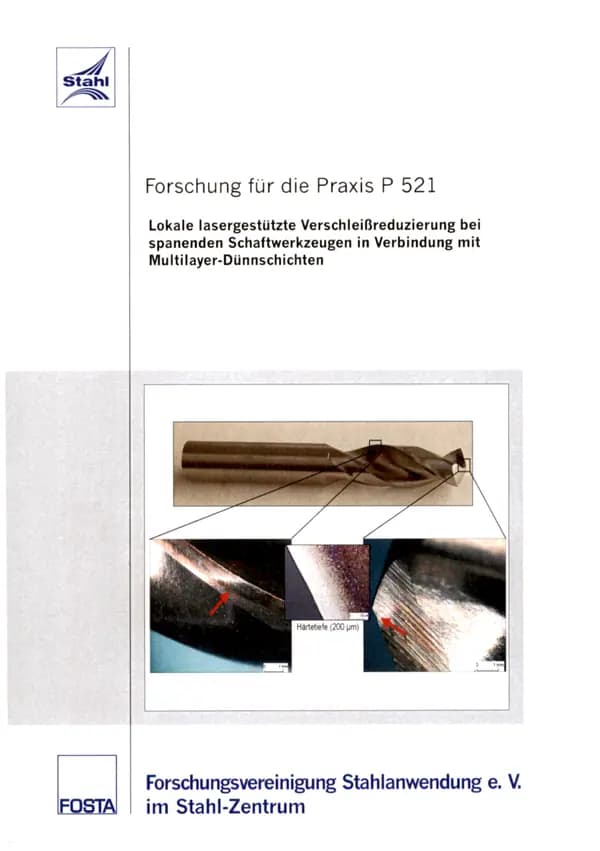
P 521 - Local laser-assisted wear reduction in cutting shank tools in conjunction with multilayer thin films The wear of the functional surfaces of cutting tools in machine, plant and vehicle construction causes enormous costs every year, with drilling operations accounting for approx. 35% of the costs. The aim of this research project was to improve the cutting properties of high-speed steel shank tools by means of local laser-assisted edge zone treatment in conjunction with multilayer hard material coatings, thereby bringing them into line with those of carbide tools. The investigations showed that laser beam hardening, alloying and dispersion increases the hardness of the edge zones of shank tools using the examples of twist drills and taps without impairing the ductility of the tool core. However, laser-hardened cutting edges (>68 HRC) cannot absorb cracks originating from the ceramic thin layers, so that cutting edge areas break out and accelerated wear occurs. In machining tests, cutting edges alloyed or dispersed with tungsten carbide/cobalt (WC/Co) exhibit small breakouts at an early stage, which lead to accelerated wear during the drilling process. This is caused by excessively large hard material particles in the available filler material and the microstructure produced, as well as the edge rounding of the carbide-like cutting edges not being optimised. The aim of equalising the tool life and cutting performance of high-speed steel shank tools with carbide tools could not be achieved within the scope of these investigations. RESEARCH ASSOCIATION FOR STAHLANWENDUNG e.V. Publication: 2005 Authors: Prof. Dr.-lng. Dr.-lng. E.h. mult. Dr med. h.c. H. Haferkamp, Dr J. Bunte, Dr H. Becker. Bunte, Dr H. Becker
available anytime
€20.00
excl. VAT
P 520 - Status report on research and application of active media-based sheet metal forming The forming of metals with the aid of fluids has opened up new technical possibilities for steel applications. With the help of powerful simulation tools high-precision control and regulation systems and modern machine tools, a wide range of applications have now become possible. Internal high pressure forming (IHU), for example, has already become very important, particularly in the automotive industry for the production of exhaust elements and chassis components as well as in sanitary, pipeline and plant construction. In this process, mainly tubular semi-finished products or profiles are formed by applying pressure from the inside to the outside against a forming tool (see status report P 305 Possibilities and limits of forming steel materials with hydraulic active media [LIC96] of the Studiengesellschaft Stahlanwendung e.V., Düsseldorf). Düsseldorf). Again in the form of a status report, the work presented here focusses on the status and development trends of technologies for active media-based sheet metal forming. In addition, research institutions and focal points as well as the results of an intensive literature and patent search are presented. Furthermore, based on a survey of users and machine manufacturers, the acceptance achieved to date and the foreseeable development of this promising technology are outlined. This paper summarises the technical information currently available on the processes of active media-based sheet metal forming. It is therefore a valuable source of information for interested processors and users with a new impetus for the transfer of knowledge in this segment of sheet metal forming. Large, but especially small and medium-sized companies are thus given decision-making aids for the utilisation of this innovative and modern production technology as well as an opportunity to make better use of the technological knowledge and facilities of research institutes and to strengthen their competitive positions. STUDIENGESELLSCHAFT STAHLANWENDUNG e.V. Publication: 2001 Authors: Prof. Dr.-Ing. M. Kleiner, Dr.-Ing. W. Homberg, Dipl.-Ing. Ch. Klimmek, Dr.rer.nat. H. Matter
available anytime
€40.00
excl. VAT
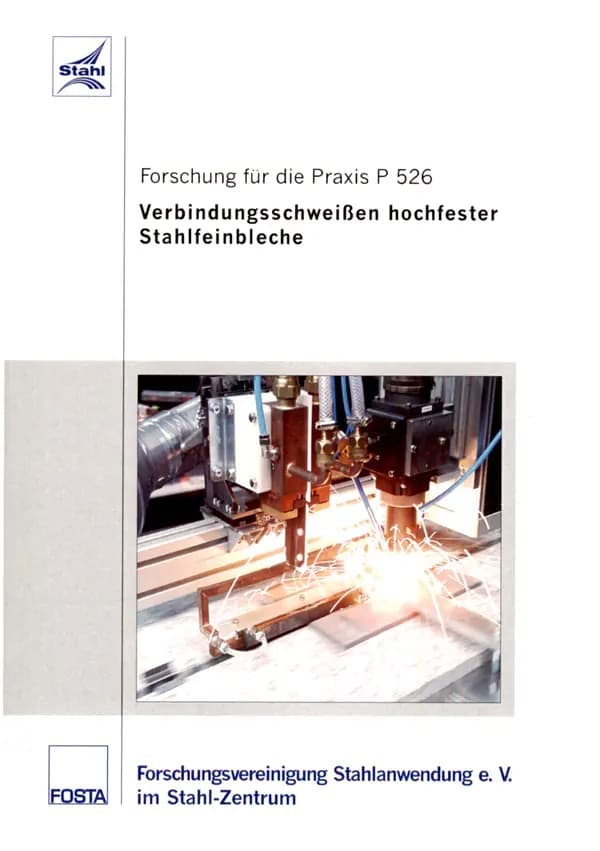
P 526 - Joint welding of high-strength sheet steel for car body construction In the context of lightweight automotive construction, high-strength steel materials are increasingly being used in the structure and outer skin. The integration of formed components made of high-strength steel grades into the car body is not yet possible in some cases in terms of welding technology, as the high carbon equivalents of the materials lead to significant seam hardening. The aim of the project was to develop and qualify a laser beam fusion welding process for joining high-strength steel sheets in car body construction. The seam hardening resulting from the high carbon equivalent and the high cooling rate was to be reduced by localised seam post-heating integrated into the process as far as possible in order to increase the energy absorption capacity of the joint. While the volume output of heat treatment processes with microplasma torches or diode lasers is limited by the melting of the workpiece surface, the energy input in inductive heat treatment takes place via the material volume. For this reason, an induction system was used for process-integrated heat treatment. Based on the investigations, a significant increase in seam ductility could be demonstrated for this process in some cases, depending on the material. RESEARCH ASSOCIATION FOR STAHLANWENDUNG e.V. Publication: 2004 Authors: Prof. Dr.-Ing. Dr.-Ing. E.h. mult. Dr med. h.c. H. Haferkamp, Dr.-Ing. Bunte, Dr.-Ing. P. Cordini
available anytime
€30.00
excl. VAT
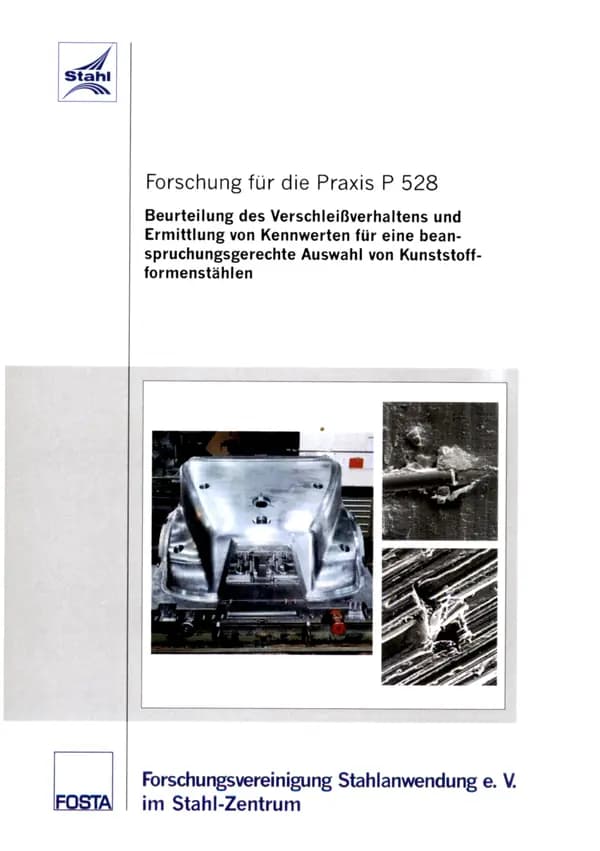
P 528 - Assessment of wear behaviour and determination of characteristic values for the selection of plastic mould steels suitable for stresses The stress-appropriate selection and thus the justified use of materials is based on knowledge of the stresses and stress resistance. Despite the great economic importance of the use of tool steels for plastic moulds for injection and compression moulding of plastic parts, where different tribological systems combined with corrosion and temperature stresses are effective, there is a great lack of knowledge in this area. A prerequisite for the safe use of materials are easily determined, reliable and stress-relevant characteristic values to describe the wear properties for the various stresses that occur during the processing of plastics. In close co-operation with steel manufacturers, manufacturers of different coating systems, representatives of the plastics processing industry, the chemical industry and two research institutes, characteristic values were developed using mechanism-oriented model testing equipment that describe a wide range of stresses. The use of such tribological test chains allows an evaluation of the material behaviour under different stresses. For the user, this makes it possible to analyse the material behaviour under changing stress conditions and to derive limit values for the selection of suitable steels. The material manufacturer is provided with a method for fast and cost-effective evaluation of known or newly developed materials. The characteristic values were compared with system-related test results. The influence of temperature on the wear behaviour of tool steels, which was previously only insufficiently known, was investigated in a heatable test rig under abrasive stress and corresponding characteristic values were also developed. An existing computer-aided database system for tribological parameters was expanded and adapted to the database systems commonly used today. The characteristic values developed were integrated into the system. The system allows an evaluation of the wear behaviour in a wide range of stresses. The database developed is partly a component of the first expansion stage of the StahlDat materials and steel database (www.stahldat.de) made available on the Internet by the VDEh Steel Institute. The availability of information is often the decisive criterion for selection in the increasingly fierce competition between materials. The results of the research project eliminate an information deficit and provide valuable information for material optimisation and future material developments. Authors: J. Kurzynski, T. Ümit, M. Pohl, M. Mola, R. Höhner Publication: 2006
available anytime
€30.00
excl. VAT
Payment by card (Stripe) or invoice (DE, AT, CH). Download link by email: automatically after ordering by card, after order approval for invoice (valid for 30 days). Terms