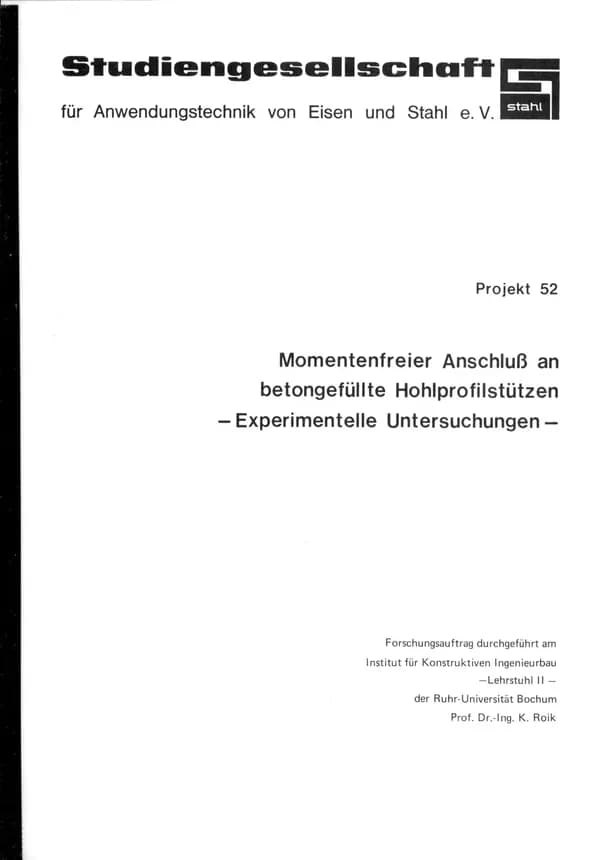
Extensive research is being carried out internationally in the field of composite columns. In Germany, the Studiengesellschaft für Anwendungstechnik von Eisen und Stahl e.V. (Study Society for Application Technology of …
Extensive research is being carried out internationally in the field of composite columns. In Germany, the Studiengesellschaft für Anwendungstechnik von Eisen und Stahl e.V. (Study Society for Application Technology of Iron and Steel) initiated a wide-ranging investigation as early as 1974, which covered load-bearing capacity, construction and fire issues for various types of cross-section - concrete-filled hollow sections, hot-rolled I-sections with concrete encasement and concreted C-sections. Using the test results and their evaluation, as well as on the basis of extensive literature in this field, a draft was produced on the subject of "Regulations for composite columns", to which Prof. Dr.-Ing. Roik, Ruhr University Bochum, made a significant contribution.
Hollow sections with concrete filling have the great advantage that formwork work can be omitted. In addition, they have advantages from an architectural point of view and can - if certain conditions are met - fully fulfil the requirements of fire protection when unprotected on the outside. This paper reports on tests and constructive solutions for beam connections to hollow section composite columns, which have already been used several times in practice. We would like to take this opportunity to thank Prof.Dr.-Ing. K. Roik and his colleagues for their work. We would also like to thank the "Composite Columns" working group of the Studiengesellschaft für Anwendungstechnik von Eisen und Stahl e.V. for their encouragement, preparation and supervision of this research project. STUDIENGESELLSCHAFT FÜR ANWENDUNGSTECHNIK VON EISEN UND STAHL e.V.
Machine-translated title and description. The document itself is in German.
Payment by card (Stripe) or invoice (DE, AT, CH). Download link by email: automatically after ordering by card, after order approval for invoice (valid for 30 days). Terms
Digital download
Other parts and editions as well as neighbouring documents of the same series.

P 26 - Investigations into the applicability of stud welding for weather-resistant and high-strength structural steels Stud welding has proven to be an economical joining method in many branches of industry and especially in the construction industry. In structural steelwork and bridge construction, stud welding is used in composite structures to fasten headed stud dowels, which are used to absorb the shear forces between steel and concrete. Up to now, mainly the structural steels St 37 and St 52 have been used. The demands of steel construction for materials with improved corrosion and increased strength properties have led to the development of weather-resistant and higher-strength fine-grain structural steels. These steels make it possible to fully utilise the advantages of lightweight construction - weight saving and wall thickness reduction - if the problems of joining technology can be solved. As there was insufficient experience of stud welding of weather-resistant and high-strength fine-grain structural steels, the present research work was carried out by Prof. Dr.-Ing. F. Eichhorn, Institute for Welding Manufacturing Processes (ISF) at the TH Aachen and Dipl.-Ing. H.W. Langenbahn, also ISF, on behalf of the Studiengesellschaft für Anwendungstechnik von Eisen und Stahl e.V. and with financial support from the Arbeitsgemeinschaft Industrieller Forschungsvereinigungen (AIF) e.V., Cologne. The tests proved that with careful welding preparation and selection of suitable welding parameters - despite high hardness in the heat-affected zone of the stud weld - no failure of the welded joints occurred under static load. The positive results encourage further work in this area in order to provide comprehensive proof of the usability of stud welding for such steel materials in the construction industry. In this context, reference should be made to the new projects P 79 "Investigations into reducing the susceptibility to defects in drawn arc stud welding" and P 80 "Investigations into the applicability of drawn arc stud welding in the welding of galvanised steel sheets", which were commissioned by the Studiengesellschaft from the SLV Munich and the TH Aachen and are currently being carried out. STUDIENGESELLSCHAFT FÜR ANWENDUNGSTECHNIK VON EISEN UND STAHL e.V. Publication: 1979 Authors: Prof. Dr.-Ing. F. Eichhorn
available anytime
€20.00
excl. VAT

P 11 - Investigations on connections of closed and open profiles made of high-strength steels Extensive theoretical and practical investigations in Germany and abroad over the last 15 years have shown that the load-bearing behaviour of hollow section structures cannot be described or calculated without further ado. The special problem of such constructions lies in the area of the connections and joints. Inhomogeneous stress states are effective in these node areas, which cannot be analysed using the elementary calculation approaches commonly used in steel construction. Instead, a differentiated approach is required. Intensive attention has been paid to this issue in recent years as part of various research programmes. An important result of this work is the draft standard DIN 18 808 ("Steel structures, structures made of hollow sections under predominantly static loading"), which describes the use of essential structural shapes of hollow sections made of St 37 and St 52 under predominantly static loading. The applicability of the DIN 18 808 standard to hollow section constructions made of high-strength fine-grain structural steels St E 460 and St E 690, as well as combinations of hollow sections with open rolled sections, was investigated for the first time as part of the present research programme in Karlsruhe. Connecting tests were also carried out on flat specimens in order to enable a relation to the DASt-Rioll, which is now available. In this programme, the vibration behaviour of cut edges and prestressed bonded connections in high-strength steel grades was also investigated. The component tests carried out on the various design forms, such as K-joints, T-joints, L-joints (i.e. rigid frame corners) and end plate connections, were intended to demonstrate for the first time the possible, fundamentally sensible application of these materials and also to clarify the orientation possibilities in accordance with the regulations of DIN 18 808. Due to the limited profile dimensions available, this could only be done in certain dimension ranges. As part of a research programme (P 71), again financially supported by the Arbeitsgemeinschaft Industieller Forschungsvereinigungen e.V. (AIF) and supervised by the Studiengesellschaft für Anwendungstechnik von Eisen und; Stahl e. V., additional static and dynamic tests were carried out with flat specimens and with nodal points made from hollow sections of the materials StE 460 and StE 690. In this respect, there is a direct connection between the present report and the final report on P 71 of the Studiengesellschaft. STUDIENGESELLSCHAFT FÜR ANWENDUNGSTECHNIK VON EISEN UND STAHL e.V. Publication: 1982 Authors: Prof. Dr.-Ing. F. Mang, Dipl.-Ing. Ö. Bucak, Dipl.-Ing. G. Steidl
available anytime
€30.00
excl. VAT

P 10 - Overview and analysis of construction systems on the market Publication: 1975 Authors: Prof. Dr.-Ing. H. Weber, Dr.-Ing. A. Eisenblätter, Dipl.-Ing. H. W. Strunck
available anytime
€50.00
excl. VAT

P 08.1 - Load-bearing behaviour of steel columns in combination with concrete (hollow sections) This paper contains the calculation and design of concrete-lined hollow section columns made of structural steel under compression and uniaxial bending. After a brief introduction, Section 2 summarises international research work in this field. In Section 3, a calculation programme is developed as an accurate numerical method. Section 4 contains interaction relations for the ultimate limit state for the whole range between centric compression and pure bending. Many results obtained with the described calculation programme and the interaction curves are compared with each other and with available test results; very good agreement can almost always be observed. Publication: 1975 Authors: Prof. Dr.-Ing. Roik, R. Bergmann, H. Bode, G. Wagenknecht
available anytime
€30.00
excl. VAT
Payment by card (Stripe) or invoice (DE, AT, CH). Download link by email: automatically after ordering by card, after order approval for invoice (valid for 30 days). Terms