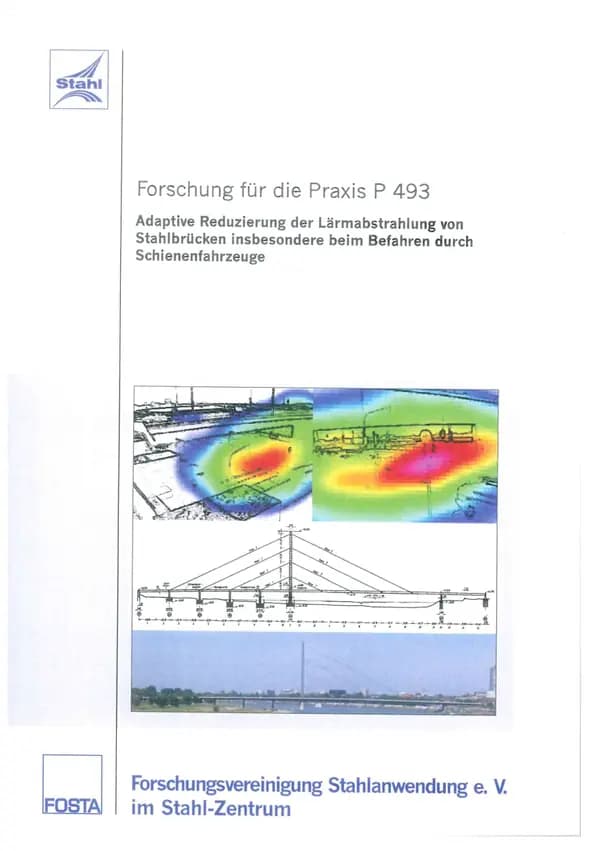
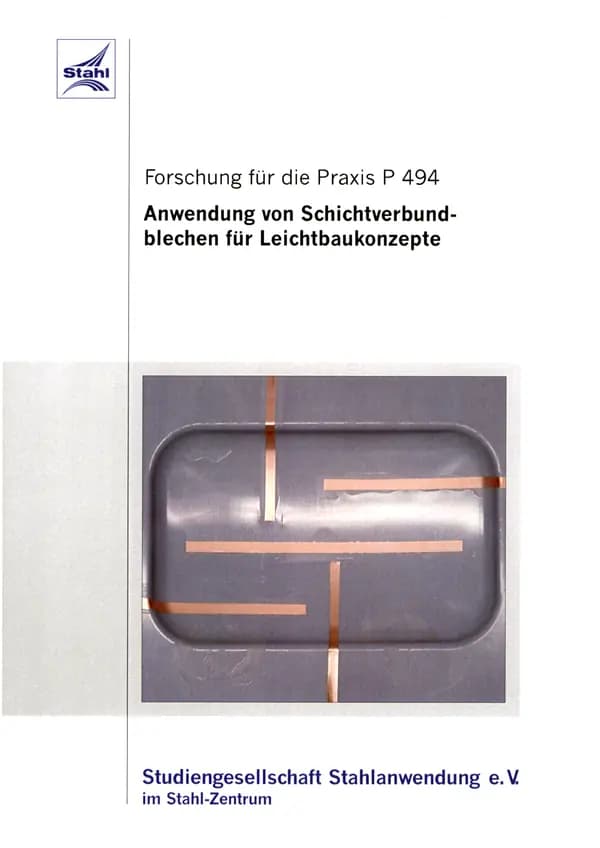
P 494 - Application of laminated composite sheets for lightweight construction concepts
The project Application of laminated composite sheets for lightweight construction concepts aims to make a contribution within the development trend of weight reduction, especially in the automotive industry, to save …
Content
- Authors
- R. Müller, J. Reichert, V. Thomas
- Publication
- 2003
The project Application of laminated composite sheets for lightweight construction concepts aims to make a contribution within the development trend of weight reduction, especially in the automotive industry, to save energy while at the same time increasing the demand for comfort and safety by integrating various functions into a basic component of a complex end product. basic component of a complex end product. To this end, electrical functions are to be integrated into the basic component of the body panel or into individual sheet steel-based elements in vehicle/appliance construction together with protective organic layers on high-strength steel.
Show full description
The aim is to create a formed composite sheet that fulfils supporting, protective, insulating and conductive functions in one component in a weight-saving manner. The technological basis is a steel sheet coated with EAA thermoplastic film in a continuous process, which is subjected to various model forming processes and is also used to accommodate copper foil conductor tracks in a joining process to form a three-layer composite. These two processes are carried out one after the other using two different technologies: 1. production of the three-layer composite at the end of the value chain, i.e. first forming of the EAA-coated steel sheet and subsequent embossing of a circuit of brittle electrolytic copper foil using MID technology. 2. production of the three-layer composite at the beginning of the value chain, i.e. first carrying out a hot stamping and bonding process with high-ductility copper foil conductor tracks on the polymer layer of the flat composite sheet and then joint forming of the three-layer composite. These laminated composite sheets are analysed with regard to the following properties: Mechanical-technological characteristics, layer thickness development, insulation of the plastic layer, adhesive strength of copper on polymer, solderability, thermal shock resistance, coefficient of friction in the strip tensile test, uniaxial ductility in the tensile test, forming limit change and formability in multi-axis model forming processes. The conclusion of the forming process is, on the one hand, the unrestricted formability of the two-layer composite sheet steel base / EAA plastic layer until the steel base material breaks - on the other hand, the limited formability of a three-layer material composite sheet steel / polymer layer / copper foil tyre without the use of additional lubricant within THE limits set by the elongation at break of the copper foil under multi-axial stress and the tool-dependent degree of embossing change of the plastic surface. Within these forming limits, i.e. up to the uniform elongation of the weakest composite component the layered composites are retained with constant insulation capability of the plastic layer. The moulding of copper foil circuits using MID technology after forming a two-layer composite sheet up to the uniform elongation of the steel to form a three-layer composite is possible with special tools. In addition to its support and protective function, the composite sheet produced by joining and forming processes can fulfil various electrical conduction functions in one component while providing good insulation of the conductor paths against the support sheet and saving weight. The moulded steel-plastic laminated composite sheets printed with copper conductor tracks can be used primarily in the area of signal or low-power currents in automotive engineering, taking advantage of the good heat dissipation. In addition, the use of these laminated composite sheets with conductor tracks integrated into plastic layers in the area of a planar car antenna integrated into the car body is a possibility for almost invisible antenna design. Another extensive field of application is in the area of household appliances / household electrics for space- and weight-saving compact designs.
Zum Zoomen hovern
€30.00excl. VAT
Payment by card (Stripe) or invoice (DE, AT, CH). Download link by email: automatically after ordering by card, after order approval for invoice (valid for 30 days). Terms
P 494 - Application of laminated composite sheets for lightweight construction concepts—
€30.00