
FOSTA
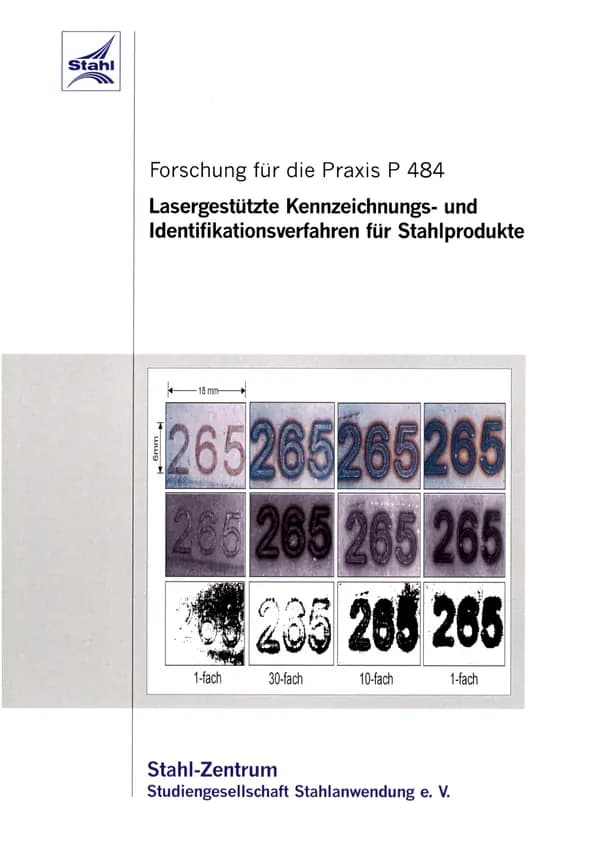
In the steel producing and processing industry, labelling and marking of steel products is an important logistical tool. Marking that cannot be clearly assigned or is incomplete results in incorrect identification of …
In the steel producing and processing industry, labelling and marking of steel products is an important logistical tool. Marking that cannot be clearly assigned or is incomplete results in incorrect identification of steel materials, which can lead to mix-ups, incorrect deliveries and increased difficulties with liability issues. The reason for the frequent occurrence of such products that cannot be clearly identified is the fact that the marking technologies currently in use, such as the application of labels or spraying processes, only fulfil requirements such as machine readability, weather resistance or temperature resistance to a limited extent.
This research project was initiated together with Salzgitter AG to improve the identifiability of steel products and to increase the competitiveness of steel manufacturers, distributors and end users. Fundamental investigations were carried out into the permanent labelling of semi-finished steel products using laser radiation and the possibilities of detecting such markings. Various laser labelling processes were used. The possibility of annealing and ablative marking was investigated. Based on these results, combined processes were developed that combine the actual marking process with cleaning of the steel surface, also using laser radiation. In addition, tests were carried out on painted steel samples. The applied paint layer is partially removed by the laser beam or its colour is changed, creating a contrast to the untreated paint. All of the aspects investigated as part of this project were used to draw up a catalogue of requirements, which was used as the basis for applying for a further research project to realise this system at European level. STUDIENGESELLSCHAFT STAHLANWENDUNG e. V.
Machine-translated title and description. The document itself is in German.
Payment by card (Stripe) or invoice (DE, AT, CH). Download link by email: automatically after ordering by card, after order approval for invoice (valid for 30 days). Terms
Digital download
Other parts and editions as well as neighbouring documents of the same series.
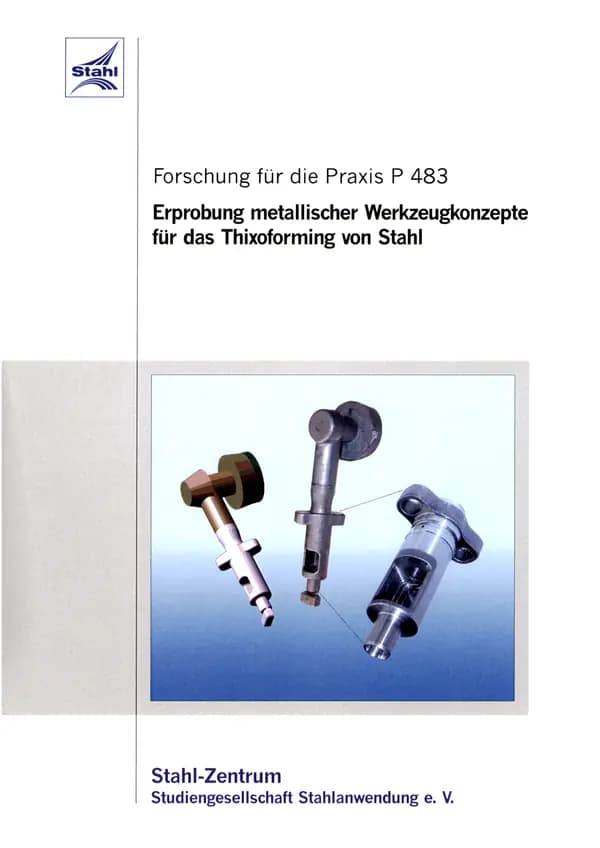
P 483 - Testing of metallic tool concepts for the thixoforming of steel Authors: D. Hartmann, U. Morjan, B. Nohn, M. Zimmer, A. Hoffmann, R. Braun Publication: 2002 Thixoforming of steel is in a very early state of development. Reduction of costs and higher freedom with lay outing the components, e.g. regarding the forged pieces, are expected. A hindering point for the industrial application is the up to now weak durability of tools. That is why research was focussed on the choice of a suitable metallic tool material as well as the development and the experimental testing of a material adapted tool-concept. The aim was to reach a standing time of the tools, which in consideration of later economical benefit makes thixoforming of steel possible. On the basis of meaningful component geometries different tool materials were investigated via numeric simulation about their suitability for thixoforming of steel. The chosen tool materials were the molybdenum based TZM (MoTi0,5Zr0,08C0,02) and the copper based Hovadur CCNB (Cu-Co1NiBe0,5). This facilitated a direct comparison to the heat resistant steel 1.2367 (X38CrMoV5 3), which was investigated in a previous project. The geometry of the testing component was selected according to a cylinder pump fabricated in mass production. Based on the chosen material a thixoforming tool concept was generated and tested in practical conditions. The research showed that the durability of the tool can be significantly extended by proper selection of tool materials and by an adapted shape concept.
available anytime
€20.00
excl. VAT
P 482: Design and calculation of lightweight rope drivesThe demands of industry and plant manufacturers with regard to higher lifting loads and lifting heights as well as changed application scenarios are forcing manufacturers of mobile hoists to guarantee ever greater hook loads and ranges with their designs. For the design and dimensioning of rope drums, this ultimately means realising greater rope pull loads and rope storage lengths while at the same time taking changed load collectives into account. Against this background, the further development of calculation methods for the design of rope drums in accordance with load requirements is an ongoing research topic. The present work contributes to the qualification of existing calculation methods for the dimensioning of rope drums. The topic is positioned in the field of multi-layer wound rope drums with a groove system divided into parallel and crossing areas. The problem of this work resulted from experimental investigations on such drum constructions, in which a non-rotationally symmetrical stress distribution in the drum shell was determined, which is not recognised by existing calculation methods. By analysing the contact ratios between the rope windings and describing the loading and unloading mechanisms between the drum and the rope, the formation of a non-rotationally symmetrical winding pressure distribution over the circumference of the drum shell was demonstrated. As an inherent property of the above groove system, this also represents the main cause of the experimentally determined stress differences. The method developed for determining the winding pressure distribution makes it possible to categorise the load differences between the creasing sectors in a practically relevant range. Based on the linear bending theory of the circular cylinder shell, the stresses on the drum shell were determined for the non-rotationally symmetrical load model developed. This analytical method can be used to specify the excess stresses compared to a rotationally symmetrical load distribution, which is the basis of the calculation methods used to date. As an effect of the non-rotationally symmetrical load, the development of additional axial forces in the connection area of the flanged discs was determined and investigated. The results of this work form the basis for a new type of dimensioning of the entire rope drum for the non-rotationally symmetrical loads that occur in practice. Publication: 2004 Authors: Dipl.-Ing. Steffen Otto
available anytime
€30.00
excl. VAT
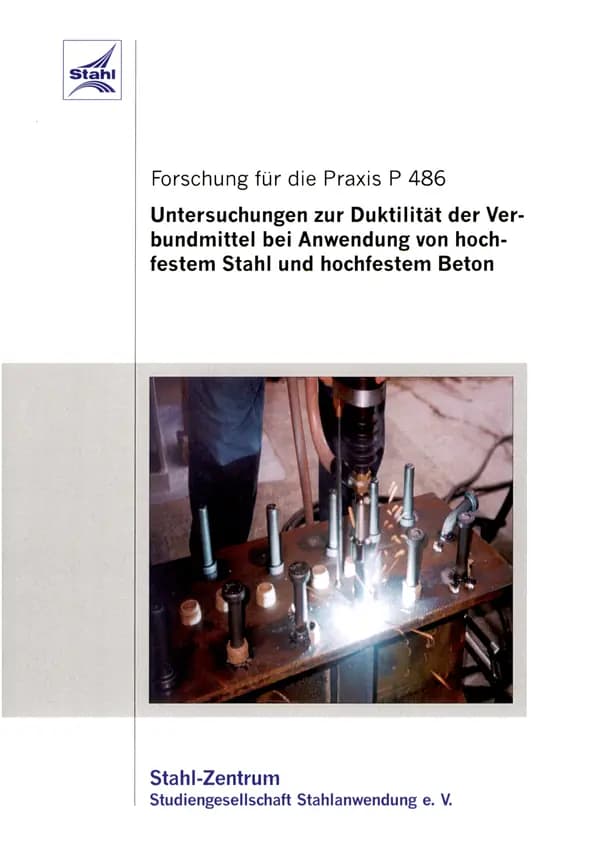
P 486 - Investigations on the ductility of composite materials when using high-strength steel and high-strength concrete Authors: J. Hegger, P. Döinghaus, G. Sedlacek, H. Trumpf Publication: 2003 Aim of the research projects are the determination of the load-bearing capacity and ductility of shear connectors in high-strength concrete as well as the development of shear connectors with a sufficient ductility in high strength concrete. Therefore various shear connectors have been tested with Push-Out test. The development of a new Push-Out test specimen enables tests on single headed stud shear connectors and its modification in high-strength concrete. Consequently an accurate analysis of the load-bearing behaviour as well as an efficient check of the various variants is achieved. So that a headed stud shear connector in high-strength concrete will exhibit ductile behaviour while retaining its ultimate load, its application can be modified by enlarging the weld collar, strengthening the connector shaft, e.g. with a sleeve made of metal, using a high-strength base material for fabricating a cold-formed headed stud shear connector (S460) or the arrangement of double connectors as close together as possible due to fabrication. At present the last procedure is the easiest to guaranty an application of headed stud shear connector as ductile shear connectors in high strength concrete. It has absolutely to be renounced on intermediate traverse reinforcement between the studs. The loadbearing capacity of the second stud has to be reduced to 80% of its design value. This possibility is directly applicable for small and medium companies.
available anytime
€25.50
excl. VAT
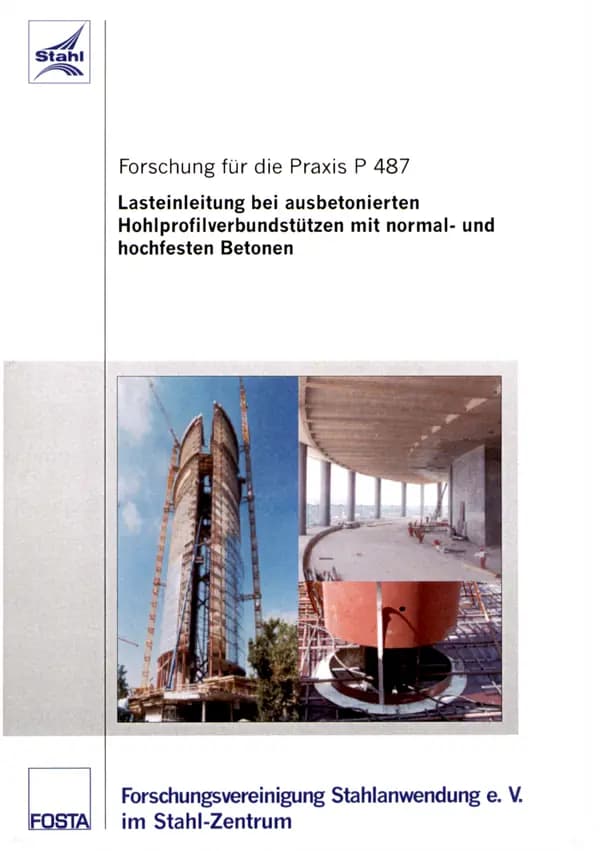
P 487: Load application for concrete-lined hollow section composite columns with normal and high-strength concretes In recent years, composite columns made of concrete-lined hollow sections have been increasingly used in multi-storey and high-rise buildings in solid and composite construction. This type of column combines the advantages of steel and concrete in an excellent way in pressure-loaded components and achieves high load-bearing capacities with small cross-sectional dimensions. This type of construction fulfils the demand for ever slimmer components by using additional adjustment profiles, whereby round and square solid core profiles are used in addition to rolled profiles. While the design of such composite columns is adequately regulated at national and European level in DIN 18806-1 and E DIN 18800-5 and in DIN V ENV 1994-1-1, there are no detailed regulations on load application. This applies in particular to the issue of partial surface pressure. This often results in very costly load introduction constructions, which represent a competitive disadvantage of this construction method. Against this background, the aim of this work was to develop design proposals for economical load transfer structures on the basis of suitable experimental investigations. This was done on the basis of 45 column tests and a further 18 slab tests. In 33 column tests, the load-bearing and deformation behaviour of centrally loaded compressed (reinforced and unreinforced) hollow section composite columns was systematically investigated, in which, among other things, the type of load application was varied. A further 12 tests were used to determine the transfer of forces from core profiles via spacer plates. The floor areas between two composite columns were analysed in the slab tests under the aspect of partial area loading due to the direct introduction of forces from the hollow section and a simultaneously applied slab load. As a significant result of the work, a new design concept for cold design has been developed for the load-bearing capacity of the introduction areas of hollow section composite columns. which takes the confinement effect of the steel tube into account to a much greater extent than before. This is independent of the type of load application analysed and provides a consistent transition to the design of compressed columns. It can be seen that the new design proposals are also valid for the partial area loading of concrete under spacer plates of core profiles. In addition, a design approach has been developed for the load-bearing part of the reinforcement, which allows reinforcement to be taken into account if it is only indirectly connected and the column cross-section is only loaded over a partial area at the same time. If the gap dimensions are less than 30 mm and the load is applied over the entire surface, the full load-bearing capacity of the reinforcement can be taken into account in round hollow section composite columns with a concrete lining and a steel tube dimension ratio of d/t < 60, as in the case of a direct connection. The new design methods have already been partially incorporated into Eurocode 4 (prEN 1994-1-1). The comparison with the previously valid verification concepts shows that a significantly more economical design of the force application areas of hollow section composite columns is possible, thus further improving the competitiveness of this type of column. RESEARCH ASSOCIATION FOR STAHLANWENDUNG e.V. Publication: 2004 Authors: Prof. Dr.-Ing. G. Hanswille, Dipl.-Ing. M. Porsch
available anytime
€40.00
excl. VAT
Payment by card (Stripe) or invoice (DE, AT, CH). Download link by email: automatically after ordering by card, after order approval for invoice (valid for 30 days). Terms