
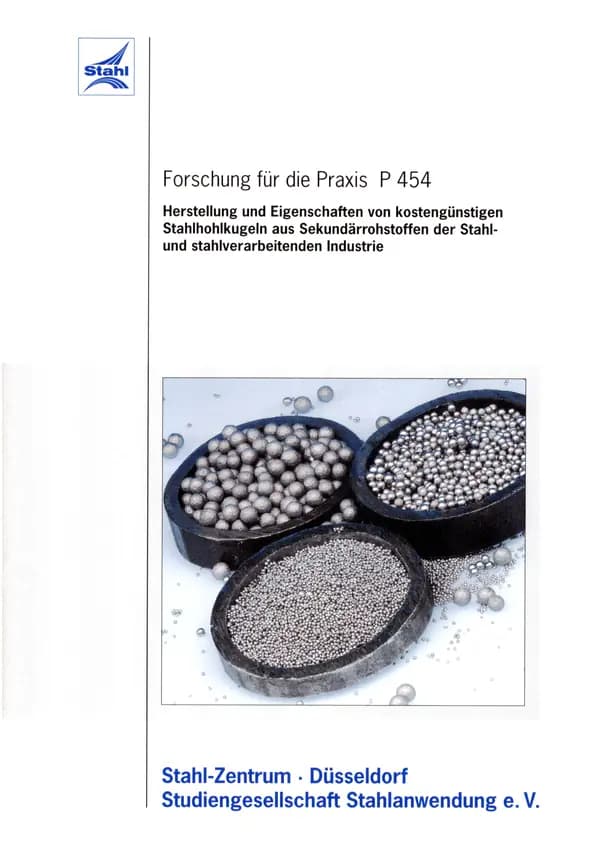
P 454 - Production and properties of low-cost hollow steel balls from secondary raw materials of the steel and steel processing industry
Hollow spheres and hollow sphere structures made of steel have various advantages over metal foams or honeycomb structures. Practical application on a larger scale - for which there are various promising approaches - is …
Content
- Publication
- 2001
- Authors
- Dr.-Ing. L. Schneider, Dipl.-Ing. U. Waag, Dipl.-Ing. H. Schneidereit
Hollow spheres and hollow sphere structures made of steel have various advantages over metal foams or honeycomb structures. Practical application on a larger scale - for which there are various promising approaches - is largely determined by the type and composition of the input material and the price of the raw material. The aim of the present research project was therefore to examine steel residues and secondary raw materials from the steel and steel processing industry with regard to their processability into hollow sphere products and to investigate their properties and applicability. The hollow steel spheres were produced by coating polystyrene spheres of a defined size by spraying a metal powder or metal oxide powder suspension through a nozzle in a fluidised bed.
Show full description
The carrier liquid of the suspension evaporates during this process and a binder dissolved in the suspension fixes the powder particles to the surface of the polystyrene spheres. This process is followed by heat treatment. The organic components are gasified and the powder particles sinter to form a spherical shell. Different types of residual and secondary raw materials were analysed for their processability depending on the particle size and its distribution, the bulk density and the chemical components. In a second step, the main properties of the hollow spherical products produced, such as spherical diameter, spherical wall thickness, porosity of the spherical wall, shrinkage during sintering and strength, were determined. The work has shown that, in principle, all residual and secondary raw materials are of interest for the production of hollow spheres if their iron content, based on material reduced with hydrogen, is more than 90 % by mass. Hollow steel spheres of a defined size can be produced with the polystyrene spheres that are commercially available in practically any diameter. Thin-walled spheres with a small diameter require a relatively small particle size of the starting grain. A higher particle size is appropriate for larger wall thicknesses and ball diameters. Particularly good strength of the hollow spheres was achieved with pickling slurries and ground mill scale. The test results have shown that unavoidable, sometimes inferior processing residues and residual materials can be turned into interesting raw materials for innovative, high-quality industrial products in this way. Among other things, this opens up cost-effective routes to mass application in lightweight construction and to functional improvements in crash and sound absorption structures. STUDIENGESELLSCHAFT STAHLANWENDUNG e.V.
Zum Zoomen hovern
€20.00excl. VAT
Payment by card (Stripe) or invoice (DE, AT, CH). Download link by email: automatically after ordering by card, after order approval for invoice (valid for 30 days). Terms
P 454 - Production and properties of low-cost hollow steel balls from secondary raw materials of the steel and steel processing industry—
€20.00