
P 452 - Process fundamentals for the semi-hot forming of corrugated parts with widely projecting mould elements
The semi-hot forming of steel materials is a high-performance process for the near-net-shape production of highly stressable (safety) components. As the basic principles for designing the complicated mould technology …
Content
- Authors
- Prof. Dr.-Ing. R. Neugebauer, Dr.-Ing. Lorenz, Dr.-Ing. H. Hartwig, Prof. Dr.-Ing. M. Geiger, Prof. Dr.-Ing. U. Engel, Dipl.-Ing. St. Bitter
- Publication
- 2003
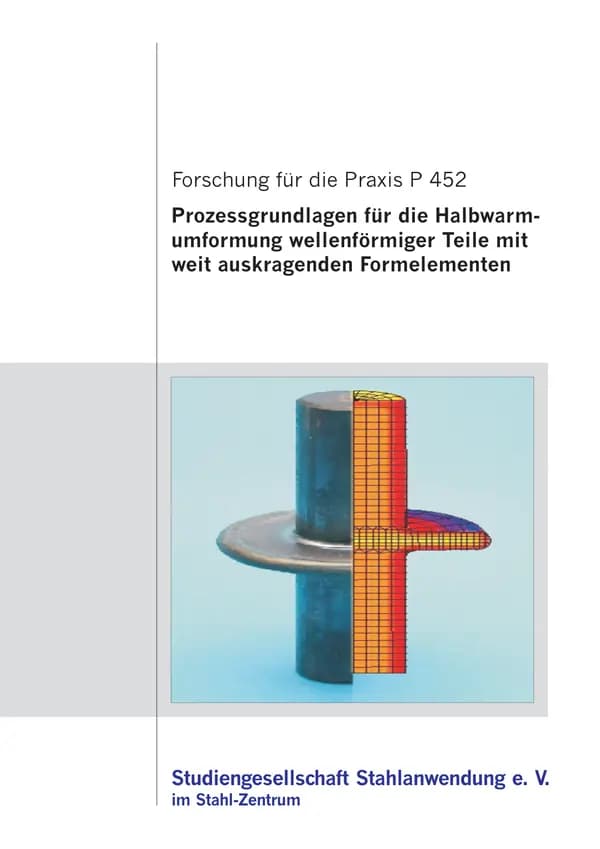
The semi-hot forming of steel materials is a high-performance process for the near-net-shape production of highly stressable (safety) components. As the basic principles for designing the complicated mould technology and for process control are only available to a few experts, the industrial application of warm forming is still limited to a small number of companies and a narrow range of components. The subject of the research project was experimental and numerical investigations into the process fundamentals of warm forming. These investigations were carried out using the example of the transverse extrusion of model gear shaft components.
Show full description
Furthermore, the development of a generally valid numerical process model to support the planning and realisation of warm forming processes. Finally, the numerical process model was applied to a different component shape or a different forming operation to open up further component ranges made of steel for warm forming. Material and process-related fundamentals were analysed. For this purpose, corresponding model tests (hot upsetting test, hot pressing test, transverse extrusion of rotationally symmetrical coils) were modified and successfully verified for the conditions of semi-hot forming. The design of the test conditions was strictly based on the conditions in industrial production, which could be recorded and analysed at a project partner in the forging industry. Information for tool design and process control was derived from the analysis of the production conditions and the results of the laboratory tests, particularly with regard to the temperature conditions on the tool and workpiece. The effects of material, tool and process parameters as well as tribological process parameters on the course of the mould change and the process limits were described. A powerful numerical process model for warm forming was developed and made available on the basis of the basic tests. The suitability of the model tests for targeted process investigations and the applicability of the numerical model in the planning of new warm forming processes was demonstrated by the computer-aided design and subsequent production of an industrial component with an alternative geometry, a control shaft with a single-sided cam. By providing methods and design guidelines, the research project laid the foundations for the gradual development of new steel component ranges for semi-forming. The coalescence of the industrial working group accompanying the project and the participating research centres has created a good infrastructure for further projects and developments in the field of semi-hot forming. Representatives of the entire process chain were involved in the industry working group: Workpiece and tool steel manufacturers, machine manufacturers, lubricant producers, forging companies and component manufacturers.
Zum Zoomen hovern
€30.00excl. VAT
Payment by card (Stripe) or invoice (DE, AT, CH). Download link by email: automatically after ordering by card, after order approval for invoice (valid for 30 days). Terms
P 452 - Process fundamentals for the semi-hot forming of corrugated parts with widely projecting mould elements—
€30.00