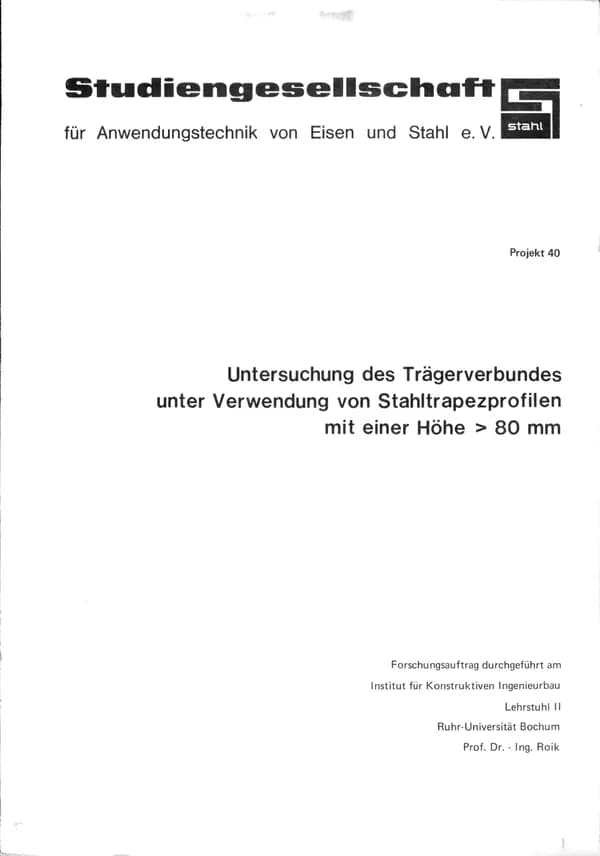
P 40 - Investigation of the beam composite using trapezoidal steel profiles with a height greater than 80 mm
The use of steel profiled sheets offers a number of demonstrable advantages in the construction of floor slabs in terms of economy, construction time and construction process as well as safety on site, regardless of …
Content
- Publication
- 1980
- Authors
- Prof. Dr.-Ing. K. Roik, Dipl.-Ing. K. E. Bürkner
The use of steel profiled sheets offers a number of demonstrable advantages in the construction of floor slabs in terms of economy, construction time and construction process as well as safety on site, regardless of whether they are only used as permanent formwork for an in-situ concrete slab, as a load-bearing steel profiled sheet slab or as longitudinal field reinforcement for a steel profiled sheet composite slab. If a steel load-bearing structure is planned, its load-bearing capacity, rigidity and cost-effectiveness can be significantly improved if the concrete of the floor - created using steel profiled sheets - acts in conjunction with the steel beams.
Show full description
This is because the optimum combination of relatively inexpensive, compression-stiff concrete and bending and tension-stiff steel makes it possible to realise very efficient and therefore economical load-bearing structures. The ribs of the steel profile sheets usually run perpendicular to the girder, which can result in significant differences between the load-bearing, deformation and failure behaviour of steel profile sheet composite girders and comparable steel composite girders with solid concrete slabs. The effects of rib heights up to 3 inches (76 mm) have been intensively researched in English-speaking countries for 15 years; the results have been confirmed in recent years by German investigations and supplemented for some additional parameters and rib heights up to 80 mm. The results of this very practical research work have already been standardised in the USA; in Europe they were adopted in the "European Recommendations", which were published in Germany in 1975. A generally approved version of rules for the design of steel profile sheet composite beams with rib heights of up to 80 mm is expected in the near future. An extension of the scope of application to steel profile sheets with rib heights of up to 125 mm was soon requested. This would have the following advantages: - Higher steel profile sheets allow larger ceiling spans with little additional material expenditure. - Larger spans when using steel profile sheets as permanent formwork reduce the number of expensive auxiliary supports required for concreting. - Larger spans when using profiled steel sheets as a load-bearing floor element reduce the number of steel girders required. - The trapezoidal profiled sheets commonly produced for roofing on a large industrial scale usually have rib heights of over 80 mm and could now also be used for the construction of ceilings in steel sheet composite structures. - The larger cells that are inevitably created with greater rib heights allow cables to pass through unhindered without any openings in the beams. This research work was commissioned by the Studiengesellschaft für Anwendungstechnik von Eisen und Stahl e.v. and carried out by Prof. Roik, full professor at the Institute for Structural Engineering at the Ruhr University Bochum. The load-bearing, deformation and failure behaviour of steel profile sheet composite beams with rib heights between 80 and 125 mm was investigated. The investigations were initially carried out experimentally on so-called push-out test specimens and on 2 large-scale beam tests. The results of the beam tests were compared with the results of theoretical investigations carried out in parallel with the tests. The main result is the submission of proposals for practical design formulae for anchor load-bearing capacities in high, slender ribs; it was also shown that the observed deformations and load-bearing capacities could be represented with good agreement using a finite element programme. Due to the small number of beam tests, suggestions for practical and easy-to-handle approximation methods could not be given, so the need for further investigations is emphasised in this context. STUDIENGESELLSCHAFT FÜR ANWENDUNGSTECHNIK VON EISEN UND STAHL e.V.
Zum Zoomen hovern
€30.00excl. VAT
Payment by card (Stripe) or invoice (DE, AT, CH). Download link by email: automatically after ordering by card, after order approval for invoice (valid for 30 days). Terms
P 40 - Investigation of the beam composite using trapezoidal steel profiles with a height greater than 80 mm—
€30.00