The task of this research project was to develop a process for the rapid and cost-effective production of deep-drawing and stretch-drawing tools for sheet metal forming. The basic principle of the process is to …
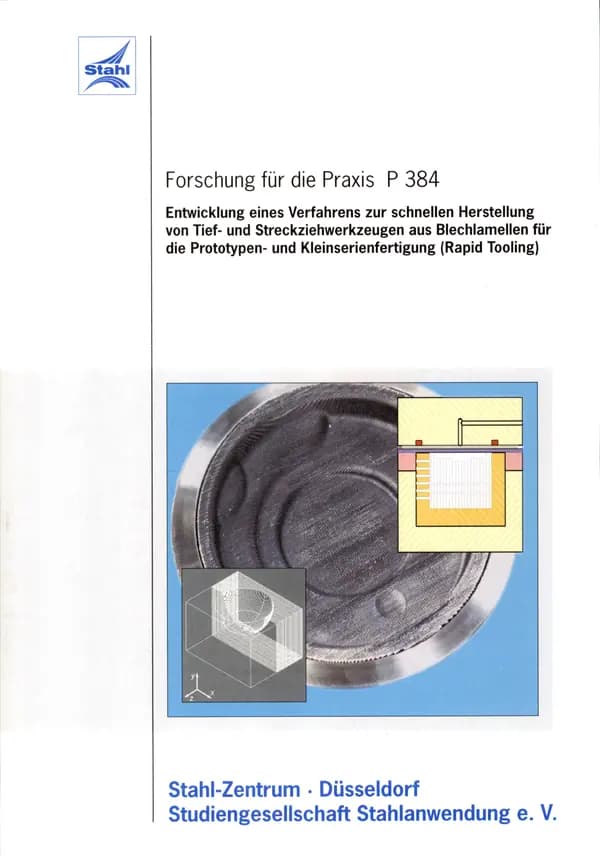
P 384: Process for the rapid manufacture of deep-drawing and stretch-drawing tools from sheet metal lamellae for prototype and small-batch production (rapid tooling) The task of this research project was to develop a process for the rapid and cost-effective production of deep-drawing and stretch-drawing tools for sheet metal forming. The basic principle of the process is to construct the deep-drawing tool from sheet steel lamellae in a vertical arrangement. A particular advantage of laminating technology compared to other rapid tooling processes is the ability to realise even large tool geometries without significant additional time expenditure.
Of particular importance is the prototype and small series production of large moulded sheet metal parts made of high-strength and higher-strength sheet steel. With regard to a short process chain, a continuous rapid tooling system should be developed from the design of the workpieces and tools on the CAD system through to the production and optimisation of prototype components. Various blank materials with and without elastomer intermediate layers were drawn using deep-drawing and stretch-drawing tools with simple and complex geometries, and the workpieces were analysed for surface quality and dimensional accuracy. The process-related stress on the intermediate layers was determined using accompanying numerical finite element simulation calculations. A self-developed clamping frame concept was used to hold the tool discs. In addition, a laminating programme was developed on the programming side and integrated into a commercial CAD system within the manufacturing process chain. The research work demonstrated the suitability of vertical laminating for the faster production of even complex sheet metal moulding tools for prototypes based on conventional deep-drawing and stretch-drawing processes as well as processes based on active media. In addition, suitable interlayer materials were identified on the basis of process-specific requirements, their reusability was demonstrated and the influence of the interlayer thickness in particular was determined on the basis of a stress analysis. The process concept developed enables small and medium-sized companies with a limited stock of semi-finished sheet metal products and a comparatively small machine park to keep up with the production of sample components and small series. STUDIENGESELLSCHAFT STAHLANWENDUNG e. V.
Payment by card (Stripe) or invoice (DE, AT, CH). Download link by email: automatically after ordering by card, after order approval for invoice (valid for 30 days). Terms
Machine-translated title and description. The document itself is in German.
Digital download
Other parts and editions as well as neighbouring documents of the same series.

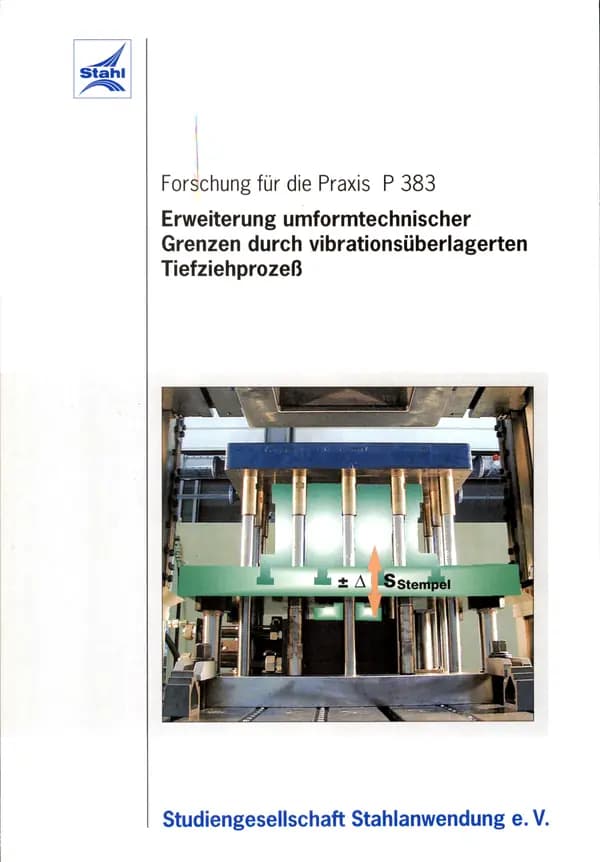
P 383: Extension of forming limits by vibration-superimposed deep-drawing process Vibration superimposition of process forces, such as blank holder or punch force, is a technological option for extending the good part window in deep drawing. The contact ratios between the workpiece and active parts are adjusted by varying the frequency and amplitude of the acting process forces. This leads to an improved material flow and to locally more favourable material stresses. As a result, higher drawing ratios and improved formability can be achieved for both conventional and high-strength materials. The aim of this research project was to provide quantitative evidence of the technological advantages, to assess the system requirements and to develop process-specific parameter spectra for the vibration-superimposed blank holder and punch force variants. The test results are intended to provide decision criteria for the workpiece-related use of these drawing techniques. Based on the results of the conventional deep drawing process, investigations were carried out at the forming limits. In addition to the already existing technical possibility of hydraulically exciting the drawing quills and thus generating a vibration of the blank holder, the vibration of the drawing punch on a single-acting press was made possible for the first time in the project in terms of design and construction. By varying the process forces superimposed with different amplitude and frequency values, the range of improved deep-drawing capability was determined for both rotationally symmetrical and non-rotationally symmetrical workpieces. The failure criteria were classic bottom tearing, wrinkling and impairment of the surface quality. The test materials were deep-drawing steel DC 04 as a reference and Fl 340 as a higher-strength steel grade. The investigations carried out were closely related to a possible reduction in lubricant quantities through improved tribological conditions during vibration superimposition. The research project was able to demonstrate an extension of the forming technology limits for the materials and moulds investigated when the hold-down force is superimposed by vibration. Similar tendencies were also found for the vibration of the drawing punch, although there are still additional possibilities in the mould and system technology. A reduction in the contact times between the active mould parts and the workpiece, which are effective in terms of process force, was identified as the cause of improved deep-drawability. This leads both to more favourable tribological conditions and to higher achievable changes in shape in the material. The fact that the results are achieved without additional lubricant application is a further indication of this. For the efficient utilisation of the process in industrial applications, a corresponding FEM model was developed and tested, which can take into account both the blank holder vibration and the punch vibration. The present work shows the spectrum and the limits of technological possibilities with vibration superposition of the process forces. The utilisation of this drawing technology on new or existing technology offers press and tool manufacturers, plant operators and steel processors alike the possibility of mastering even more demanding forming tasks. STUDIENGESELLSCHAFT STAHLANWENDUNG e.V. Publication: 2000 Authors: Dipl.-Ing. L. Klose, Dipl.-Ing. H. Bräunlich
available anytime
€20.00
excl. VAT

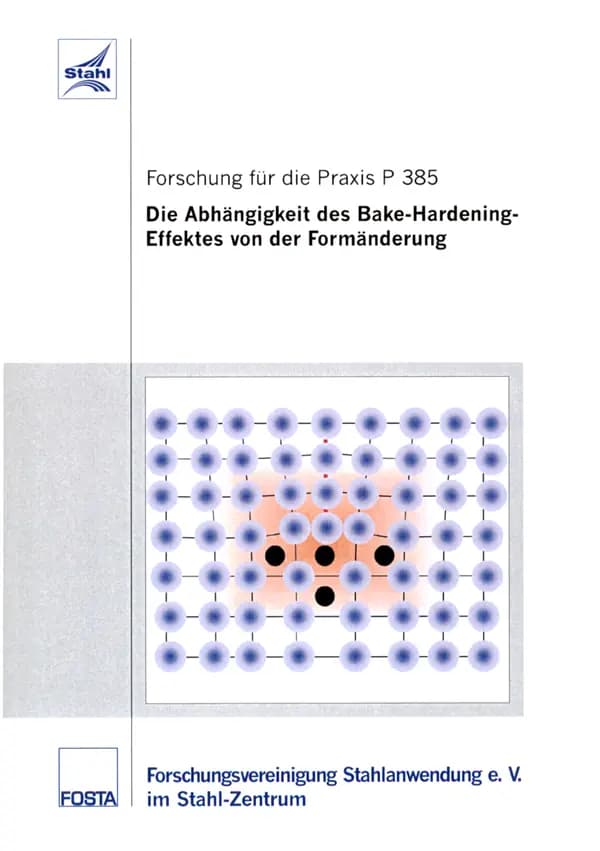
P 385 - The dependence of the beacon hardening effect on the change in shape - Development of extended design notes Authors: K. Siegert, S. Wagner, T. Müller Publication: 2005
available anytime
€36.00
excl. VAT

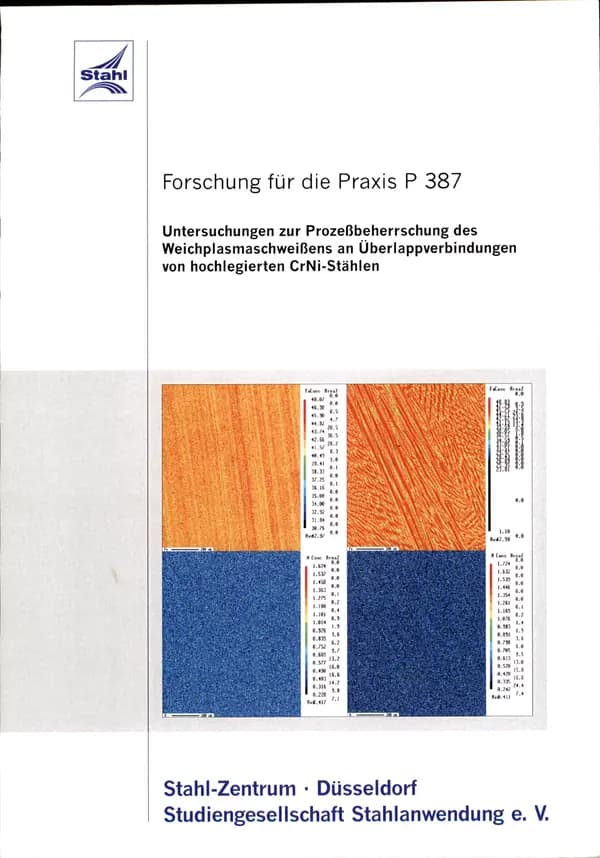
P 387: Investigations into the process control of soft plasma welding on lap joints of high-alloy CrNi steels Flat slabs in composite construction have many economic and architectural advantages. By integrating the steel profile into the reinforced concrete ceiling, the overall construction height is reduced. A smooth lower edge of the ceiling can be left as a room closure and enables free architectural design. Cost-effectiveness is achieved through higher load-bearing capacity, i.e. larger spans and higher loads, than with conventional reinforced concrete flat ceilings. The high degree of steel construction prefabrication and the use of prefabricated concrete parts or composite profile sheets can considerably reduce the construction time. However, flat slabs in composite construction have a different load-bearing behaviour compared to composite beams with high structural steel chords, particularly due to the cracking of the reinforced concrete. Composite girders with the same slab behaviour behave more like pure reinforced concrete girders than like composite girders with an overpressed concrete chord. With this new type of construction, the usual neglect of the moment of inertia and the moment contribution of the reinforced concrete in composite construction is uneconomical and no longer applicable. The subject of the investigations is the determination of the load-bearing behaviour and the optimisation of the design of composite beams in hat form with the same slab. The main focus is on the realistic determination of the deformation, taking into account the partial composite effect. Experimental investigations with a total of nine test girders were carried out to verify the results derived by calculation. Six test beams were designed as single-span beams. Three test beams were tested in the negative moment range. A proposal for determining the deformations of flat slabs with hat profiles was derived on the basis of a calculation model that iteratively records the compliance in the composite joint and the material non-linearity of the reinforced concrete chord. With the new modified moments of inertia for the time t = 0 or t = _, more realistic deformations are determined compared to the very conservative regulations of the standard for this type of construction. In the usual area of application of flat slabs with hat profiles, reductions in the calculated deformations of up to 250 % result. By recording the reinforcement when determining the positive moment load-bearing capacity of the flat slab with hat profile, increases in load-bearing capacity of up to 35 % are possible in the usual area of application. For the negative moment range, the standard currently only permits a composite joint with full dowelling. Initial investigations show the influence of the partial bond effect on flat slabs with hat profiles under negative moment loads. The results of this study enable a more economical application of this new type of composite floor system. Structural engineers are provided with practical tools and decision criteria which, the authors hope, will lead to a wider acceptance of composite flat slabs in building construction. FORSCHUNGSVEREINIGUNG STAHLANWENDUNG e. V. Publication: 2002 Authors: Dr.-Ing. T. Böllinghaus, Dr.-Ing. Noack, Dipl.-Ing. T. Michael
available anytime
€30.00
excl. VAT

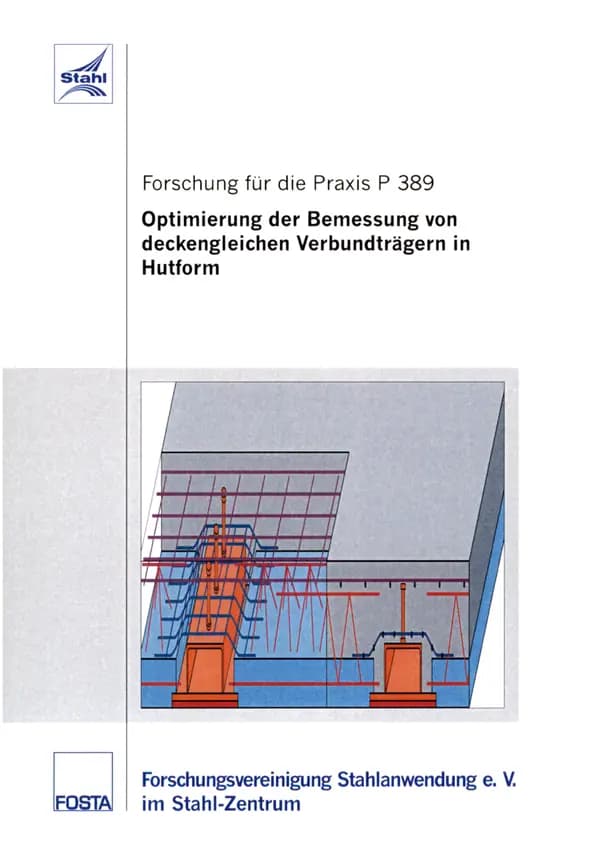
P 389: Optimisation of the design of composite beams in hat form with the same slab thickness Flat slabs in composite construction have many economic and architectural advantages. By integrating the steel profile into the reinforced concrete slab, the overall building height is reduced. A smooth lower edge of the ceiling can be left as a room closure and allows a free architectural design. Cost-effectiveness is achieved through higher load-bearing capacity, i.e. larger spans and higher loads, than with conventional reinforced concrete flat ceilings. The high degree of steel construction prefabrication and the use of prefabricated concrete parts or composite profile sheets can considerably reduce the construction time. However, flat slabs in composite construction have a different load-bearing behaviour compared to composite beams with high structural steel chords, particularly due to the cracking of the reinforced concrete. Composite girders with the same slab behaviour behave more like pure reinforced concrete girders than like composite girders with an overpressed concrete chord. With this new type of construction, the usual neglect of the moment of inertia and the moment contribution of the reinforced concrete in composite construction is uneconomical and no longer applicable. The subject of the investigations is the determination of the load-bearing behaviour and the optimisation of the design of composite beams in hat form with the same slab. The main focus is on the realistic determination of the deformation, taking into account the partial composite effect. Experimental investigations with a total of nine test girders were carried out to verify the results derived by calculation. Six test beams were designed as single-span beams. Three test beams were tested in the negative moment range. A proposal for determining the deformations of flat slabs with hat profiles was derived on the basis of a calculation model that iteratively records the compliance in the composite joint and the material non-linearity of the reinforced concrete chord. With the new modified moments of inertia for the time t = 0 or t = _, more realistic deformations are determined in comparison to the very conservative regulations of the standard for this type of construction. In the usual area of application of flat slabs with hat profiles, reductions in the calculated deformations of up to 250 % result. By recording the reinforcement when determining the positive moment load-bearing capacity of the flat slab with hat profile, increases in load-bearing capacity of up to 35 % are possible in the usual area of application. For the negative moment range, the standard currently only permits a composite joint with full dowelling. Initial investigations show the influence of the partial bond effect on flat slabs with hat profiles under negative moment load. The results of this study enable a more economical application of this new type of composite floor system. Structural engineers are provided with practical tools and decision criteria which, the authors hope, will lead to a wider acceptance of composite flat slabs in building construction. FORSCHUNGSVEREINIGUNG STAHLANWENDUNG e. V. Publication: 2004 Authors: Prof. Dr.-Ing. U. Kuhlmann, Dipl.-Ing. J. Fries
available anytime
€30.00
excl. VAT
Payment by card (Stripe) or invoice (DE, AT, CH). Download link by email: automatically after ordering by card, after order approval for invoice (valid for 30 days). Terms