Automotive companies are also under high cost pressure in the production of niche vehicles due to the small quantities involved. However, the necessary moulded sheet metal parts with less than 100 pieces per day cannot …
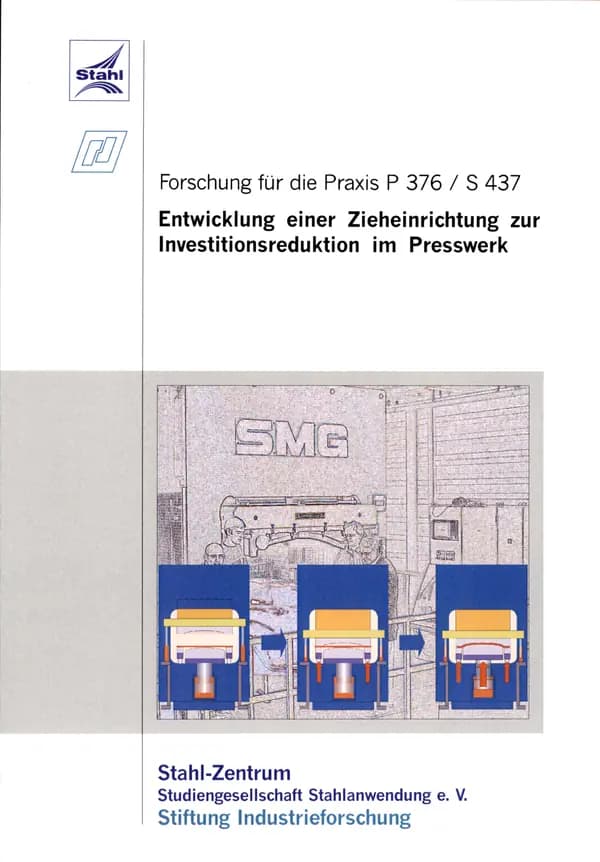
Automotive companies are also under high cost pressure in the production of niche vehicles due to the small quantities involved. However, the necessary moulded sheet metal parts with less than 100 pieces per day cannot be produced economically with large-format presses. For this reason, a new concept for a weight- and cost-reduced press system was to be developed and tested in the research project. The prototype of such a forming unit was developed and built as part of an interactive collaboration between the Chair of Metal Forming and Foundry Technology, Munich, Schuler-SMG GmbH, Waghäusel, and Nothelfer GmbH, Wadern-Lockweiler.
Trial pressings were carried out using a deep-drawing mould for the first drawing stage of an outer door panel. The initial focus of the investigations was on checking the accuracy behaviour of the forming unit and recording the influencing variables responsible for this as well as the elastic interactions during deep drawing. Information on the dimensional accuracy and surface quality of the components was provided by a comparison between the manufactured door panels and the original door from a large-scale press. In addition, a suitable FEM simulation model was generated for the forming unit and compared with the test results. Based on this comparison, the measurement results of the accuracy test could be interpreted and used for improvements. The research results proved that the new press concept can be used to produce moulded sheet metal parts in outer skin quality. The accuracy parameters required by press manufacturers and users are met and in some cases exceeded. Due to its low weight, the press can be used for mobile applications without compromising on quality. The application of this new type of lighter and also more cost-effective press system is aimed at the production of small quantities, for example in line with demand on a production line. The high local flexibility allows cost-optimised adaptation to new production conditions. The new development also allows small production series to be manufactured economically. STUDIENGESELLSCHAFT STAHLANWENDUNG e.V.
Payment by card (Stripe) or invoice (DE, AT, CH). Download link by email: automatically after ordering by card, after order approval for invoice (valid for 30 days). Terms
Machine-translated title and description. The document itself is in German.
Digital download
Payment by card (Stripe) or invoice (DE, AT, CH). Download link by email: automatically after ordering by card, after order approval for invoice (valid for 30 days). Terms
Other parts and editions as well as neighbouring documents of the same series.

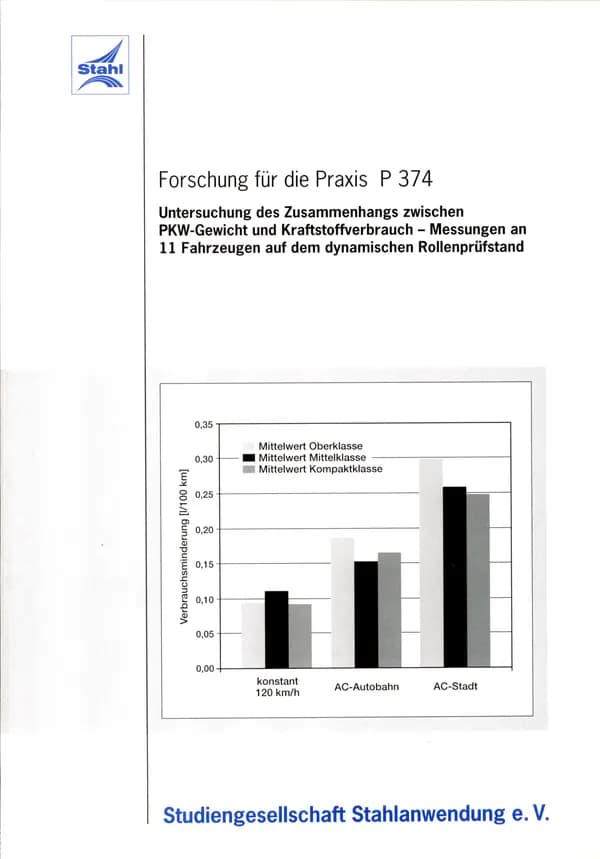
P 374: Investigation of the relationship between car weight and fuel consumption - measurements on 11 vehicles on the dynamic chassis dynamometer The vehicle weight influences - among other factors - the fuel consumption of motor vehicles. Therefore, in order to reduce fuel consumption and thus to save energy and conserve resources, weight reduction is a particular aim in the further development of road vehicles. In order to be able to evaluate the effect of a wide range of measures, it is desirable to have precise knowledge of the direct correlation between weight reduction and fuel savings. This applies in particular to the present investigation of current vehicles by means of lightweight construction measures, in which a weight reduction of 100 or 200 kg per vehicle is achieved in stages, without a fundamentally new design being considered. In this case, the Institute of Automotive Engineering at the Rheinisch-Westfälische Technische Hochschule Aachen has demonstrated in a comprehensive study that the fuel savings for a number of the vehicles examined and the driving cycles completed are between 0.05 and 0.15 litres per 100 km and 100 kg weight reduction. Measured values above this can often be explained by the driving cycles that increase fuel consumption. In no case have the key figures widely used in public debate to describe the influence of weight reduction on consumption of approx. 0.5 to 0.7 litres per 100 km and 100 kg weight reduction been measured in the scientific study; the study addresses this discrepancy in more detail. As part of the project, the influence of a weight reduction of 100 kg on fuel consumption was determined on 11 selected vehicles by measuring very different driving cycles on a chassis dynamometer. The research results presented enable a quantitative evaluation of lightweight construction measures and the resulting weight reduction in road vehicles. STUDIENGESELLSCHAFT STAHLANWENDUNG e.V. Publication: 2000 Authors: Prof. Dr H. Wallentowitz, Priv.-Doz. Dr J.-W. Biermann, Dipl.-Ing. Ch. Renner
available anytime
€20.00
excl. VAT

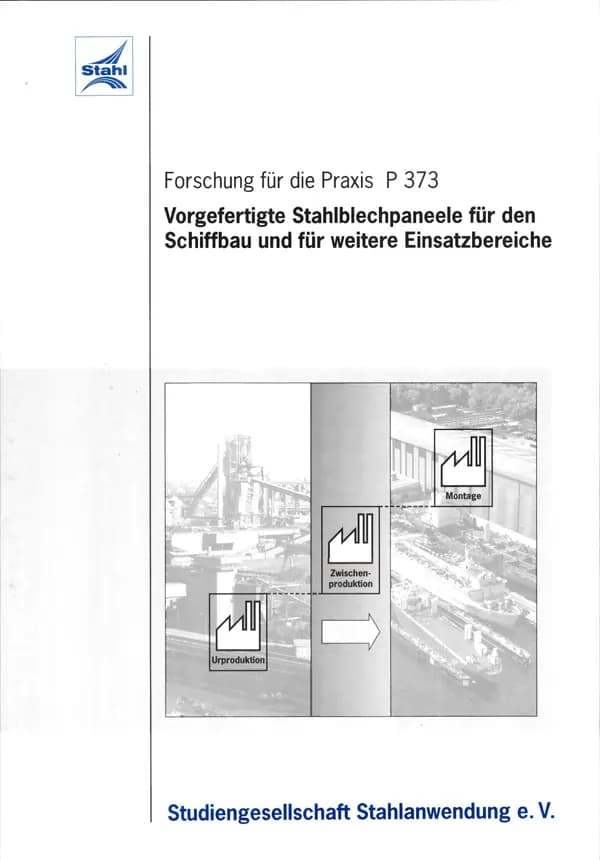
P 373: Prefabricated sheet steel panels for shipbuilding and other applications Sheet steel panels are flat supporting structures, stiffened on one side and often provided with cut-outs and markings, which are conventionally welded together from heavy plates - in the thickness range above 6 mm up to 45 mm - and profiles. Panels are still a typical intermediate product in shipbuilding production today. It is striking that most German shipyards produce their own panels. Sheet steel panels are also used in other areas, e.g. in steel bridge construction in the form of the so-called "orthotropic plate". With a view to the marketable, application-orientated semi-finished products that are made available to the automotive industry as "tailored blanks" by the steel industry and with reference to the "tailored beams" currently under development, it has been investigated whether sheet steel panels have a market opportunity as an innovative semi-finished product from production concentrated in one place in shipbuilding and other sectors. The considerable differences in the type of production lead to different products, which means that the production of sheet steel panels, measured by the success factors of cost, time and quality, leads to remarkably different results. The theoretical market potential for steel panels in German shipbuilding is between 70,000 and 120,000 tonnes per year. In steel bridge construction, an average of 5,000 tonnes of steel for orthotropic panels are processed in Germany every year. The current state of knowledge has been compiled with a view to desirable product improvements and process innovations, whereby the limits and possibilities of laser technology in particular have been comprehensively analysed. The complex interrelationships that arise in the market due to different products, different manufacturing processes, divergent manufacturer and customer interests and location issues have been subjected to a fundamental comparative assessment in order to sharpen the focus for innovative production lines in concentrated sheet steel panel production. In principle, this approach can be successful, but the risk for a single centralised panel production linked to a steel producer appears to be too high. However, smaller decentralised production variants, in which all available material and process engineering innovations are bundled together with an economic optimum, have a great chance of serving several customers from one production facility. This study has thus opened up a field of work that could lead to improved economic and technological co-operation between steel manufacturers and the shipbuilding industry in the future. STUDIENGESELLSCHAFT STAHLANWENDUNG E.V. Publication: 1998 Authors: Prof. Dr.-Ing. Ch. Nedeß, Dipl.-Ing. oec. U. Stalleicken
available anytime
€30.00
excl. VAT

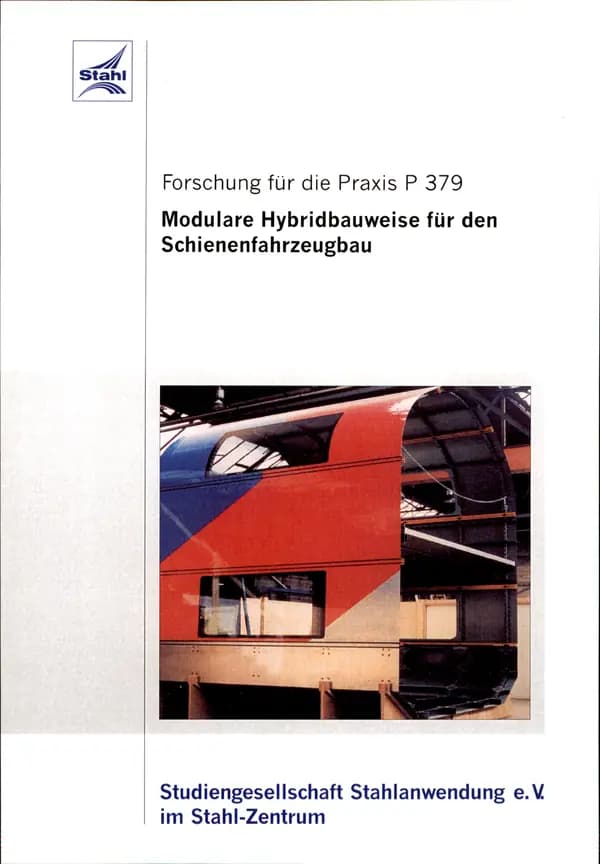
P 379 - Modular hybrid design for rail vehicle construction Authors: K. Altenburg, O. Sauer, M. Zimmermann Publication: 2003
available anytime
€18.00
excl. VAT

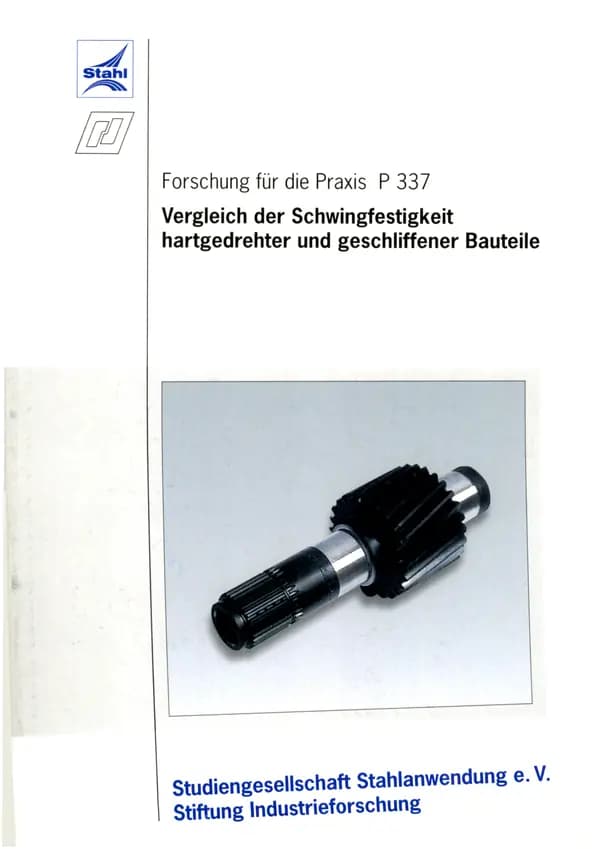
P 337: Comparison of the fatigue strength of hard-turned and ground components In competition with grinding, hard turning fulfils the demand for higher economic efficiency with better ecological compatibility. For a broad application of hard turning, it has not yet been proven that at least the performance properties, in particular the fatigue strength of components with a ground surface, can be achieved. This is where the present research project comes in and investigates whether hard turning can replace grinding, which has been the standard hard machining process to date. For the comparative investigation of grinding and turning of case-hardened components, notched round specimens made of 16MnCr5 case-hardening steel were selected as the material and subjected to 4-point alternating bending. A sufficiently small test radius ensured that the cracks only originated from the surface. To investigate the influence of tool wear during hard turning, the test specimens were turned with both new and defined worn inserts at two feed rates. Compared to ground samples, the fatigue strength was determined in the Wöhler test and the fatigue strength test. Cracking was used as the failure criterion for all test series. The fatigue tests were accompanied by metallographic analyses and residual stress measurements. The samples from hard turning with new tools always show a higher fatigue strength than the ground samples in the single-stage test with constant amplitude. The strengths decrease with tool wear; they are only lower than those of ground samples after prolonged tool use. In the fatigue strength tests with different amplitudes, no influence of tool wear was found in the load range investigated. The hard-turned samples always produced better fatigue strength values than the ground samples. With the help of a specially developed calculation concept, the Wöhler and fatigue strength results from the test series with turned specimens can be reproduced well. In contrast, the results of the test series with ground samples could not be determined satisfactorily by calculation due to the different surface topography, which was not adequately captured by the surface parameter used. As long as the tool wear during hard turning does not exceed a certain level, the fatigue strength is generally at least equal to or better than that of ground samples. The fatigue strength of hard turned samples only drops in comparison to ground samples at larger, but technically easily detectable wear mark widths. Up to this limit, hard turning is always more favourable than grinding case-hardened components, a finding that particularly benefits the small and medium-sized manufacturing industry. STUDIENGESELLSCHAFT STAHLANWENDUNG e.V. Publication: 2000 Authors: Dipl.-Ing. F. Renner, Prof. Dr.-Ing. H. Zenner, Dipl.-Ing. Ch. Borbe
available anytime
€30.00
excl. VAT