Composite structures are of great importance in the building industry. For reasons of structural fire protection, in many cases the areas between the chords of the steel girder are concreted out, in which case the …
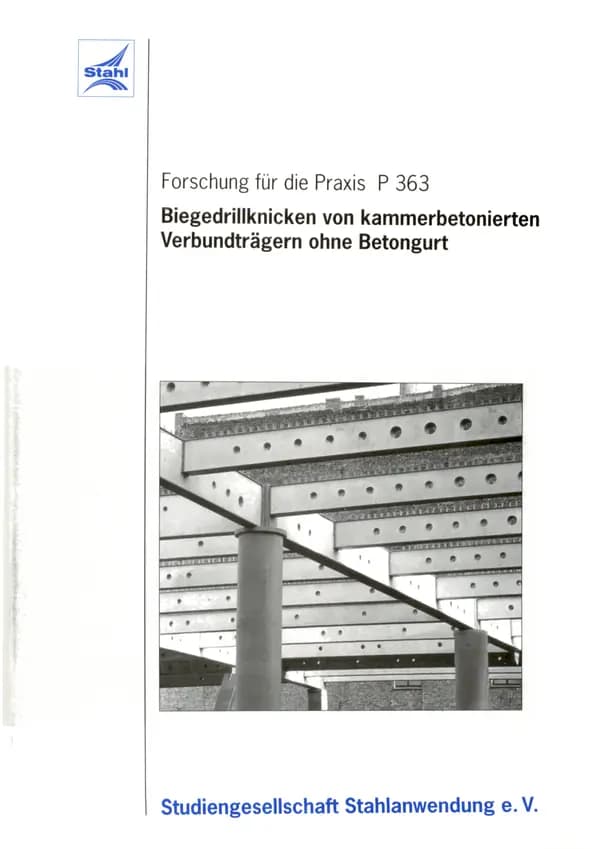
P 363: Flexural lateral-torsional buckling of chamber-concreted composite beams without concrete chord Composite structures are of great importance in the building industry. For reasons of structural fire protection, in many cases the areas between the chords of the steel girder are concreted out, in which case the composite girders are chamber-concreted. For these composite beams without concrete chords, lateral-torsional buckling, in which the beam can move laterally and twist at the same time in the failure state, is often decisive for the design. As torsion occurs during lateral-torsional buckling, it is crucial to take the decisive torsional stiffness into account.
If only the torsional stiffness of the steel girder alone is used for the chamber-concreted composite girder, then you are on the safe side. For economic reasons, however, it is desirable and necessary to also take the concrete into account in the calculation with regard to lateral-torsional buckling. The usual values for reinforced concrete beams cannot generally be used for composite beams with chambered concrete, as they require continuous longitudinal reinforcement and closed stirrups. In addition, the interaction of the chambered concrete with the steel beam must be ensured by means of bonding agents. Within the scope of this research project, 22 large-scale tests were carried out on composite beams made of chambered concrete. Particular attention was paid to the structural design of the chambers. It was shown that with all designs a sufficient co-operation of the concrete with regard to the torsional stiffness can be achieved. The case of the Z-hooks with head bolt dowels was particularly effective, but the economically interesting case with head bolt dowels only is also satisfactory. Based on the results of the large-scale tests, the most important research result presented is a calculation method with which the lateral-torsional buckling of chamber-concreted composite beams can be easily analysed. To determine the stiffness values, the part of the concrete that forms the plastic pressure range in the calculated failure state is assumed to be statically effective. This may be considered constant over the entire length of the beam. In order to avoid calculating the load-bearing capacity using the proposed calculation method in frequently occurring cases, load-bearing capacity tables are provided to facilitate application in practice. The maximum line load that can be absorbed by a single-span beam can be taken from these tables, taking into account rolled sections of the IPE and HEA series of steel grade S355 and concrete grade B 35. STUDIENGESELLSCHAFT STAHLANWENDUNG E.V.
Payment by card (Stripe) or invoice (DE, AT, CH). Download link by email: automatically after ordering by card, after order approval for invoice (valid for 30 days). Terms
Machine-translated title and description. The document itself is in German.
Digital download
Other parts and editions as well as neighbouring documents of the same series.

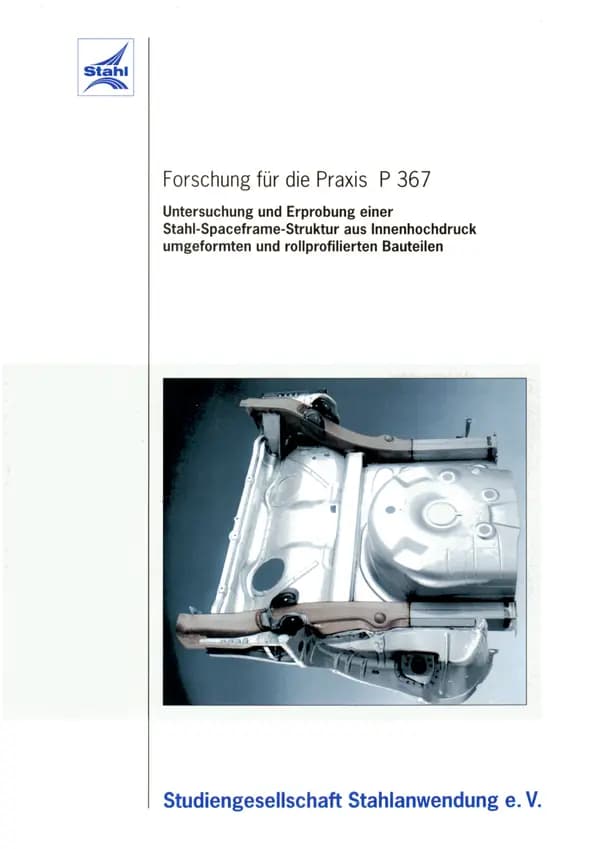
P 367: Investigation and testing of a steel spaceframe structure made of hydroformed and roll-formed components In today's car body construction, the multi-shell design in steel is leading. The main advantages here are the low costs and the proven suitability for mass production. In view of the level of maturity achieved today, there are only a few opportunities left to realise further optimisation potential. Due to the differential shell design and the sub-optimal properties of some structural bodywork components as a result of the joining technology required, an approach to saving weight with the same or better performance is seen in the steel sector with a body structure in the form of a spaceframe, as previously known from the aluminium sector. Theoretically, the conceptual advantages that can be achieved from the closed profiles used there - low weight with good rigidity and crash properties - can be partially transferred to steel bodies. A promising approach here is to use rolled profiles instead of extruded aluminium spaceframes and to replace cast nodes with hydroformed (hydroformed) parts. The stiffening sheet metal panels are usually produced as deep-drawn sheet metal mouldings. The aim of this project was therefore to provide and verify statements on the suitability of rolled and hydroformed body components as well as information on the weight-saving potential and suitable joining processes. In a previous feasibility study, a complex car body node from the rear end of the vehicle was examined for its manufacturability by hydroforming. The result showed that the component could be designed to be suitable for hydroforming by making minor adjustments - caused by the high degree of forming. Appropriately designed initial tubes were then formed into hydroformed parts in practical trials. Critical design areas were iteratively minimised in the course of the tests. These were, for example, sharp radii, strong cross-sectional jumps or secondary moulding elements that hinder the flow of the material. In parallel, different materials were used to determine the most favourable potentials from this point of view. The prototypes produced were installed in a car body with an adapted rear end and measured. The measurement results show good agreement with the originally determined FEM results. Due to the complexity of the component, the existing geometry could only be produced in one forming step using one of the materials investigated, 1.4303. For other steel grades, further design steps were necessary. For other steel grades, further design changes to the component or additional production steps were necessary, resulting in a lower degree of integration. A detailed profitability analysis is required here. The selected concept of hydroforming nodes and rolled profiles made it possible to reduce the number of components for the rear carriage from 44 to 35 and the weight by 10% (5870 g). The stiffness values determined for the installed rear carriage were in good agreement with the calculated predictions. The project also provided valuable insights into the design and material selection of complex body components adapted to the hydroforming process, as well as their integration into an existing self-supporting, multi-shell vehicle body. STUDIENGESELLSCHAFT STAHLANWENDUNG e.V. Publication: 2000 Authors: Dr.-Ing. T. Krusche, Dipl.-Ing. H. Walter, Dr.-Ing. K.-U. Dudziak
available anytime
€20.00
excl. VAT

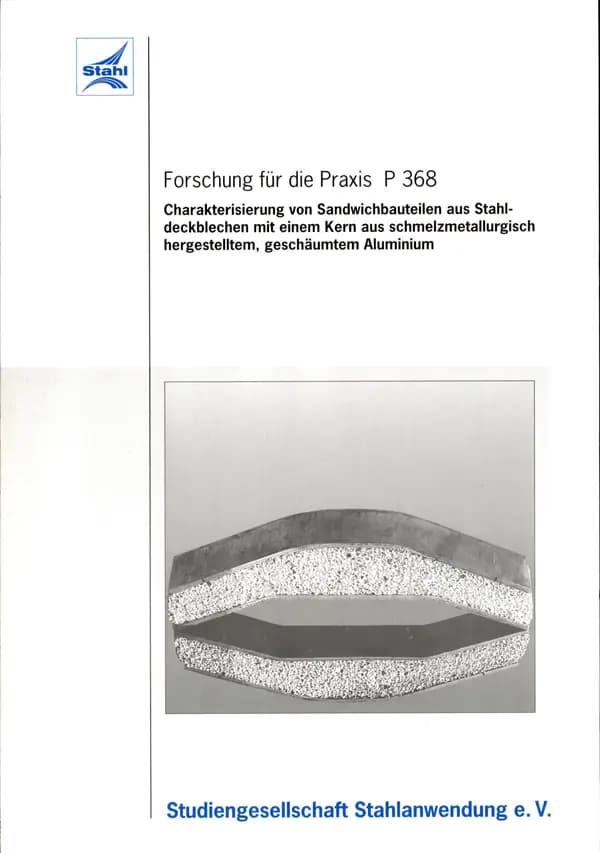
P 368: Characterisation of sandwich components made of steel cover sheets with a core of fused metallurgically produced foamed aluminium In the preceding project P 281.1 "Industrial use of sheet steel composites with foamed aluminium Project 1 Sandwich constructions made of sheet steel with foamed aluminium" of the Studiengesellschaft Stahlanwendung e.V., a new type of sandwich composite made of steel cover sheets and an aluminium foam core with a metallic bond between the components was developed. This sandwich composite combines a low weight per unit area with the good strength and surface properties of steel and the functional properties of the foam core layer (energy absorption, reduced thermal conductivity, etc.). The P 368 research project, which has now been completed, was designed to test whether a similar bond between steel cover sheets and aluminium foam core is possible by bonding the two metals. Experiments with various adhesive systems showed that a durable, shear-resistant bond between the aluminium foam core layer and steel cover sheets can be achieved by bonding with a viscous epoxy resin adhesive to produce a sandwich composite. By roughening the surfaces and heat-curing the adhesive, reproducible sandwiches can be produced in which the foam core layer is the weakest link. Bonding the sandwich partners also enables sandwiches with steel cover sheets of more than 2 mm (here 3 and 5 mm) and corresponding foam core layers (30 and 50 mm), which cannot be produced using the method developed in P 281.1. The testing of bonded sandwich panels in shear, tensile and bending tests shows that, depending on the selected foam core alloy, similarly good properties can be achieved as with material with a metallic bond. The peel strengths determined for bonded sandwiches are also acceptable despite the rather hard and brittle epoxy resin adhesive. Uncoated steel sheets have slightly lower peel strengths than roll-aluminised cover sheets, but these should also be fully adequate for use. It should be noted that due to the low thermal resistance of the resin adhesive, high-temperature applications are not possible and joining by welding has not yet been realised experimentally. Three-dimensional moulded parts are also not yet feasible. STUDIENGESELLSCHAFT STAHLANWENDUNG e.V. Publication: 1998 Authors: Prof. D.-Ing. W. Bleck, Dipl.-Ing. H. von Hagen
available anytime
€20.00
excl. VAT

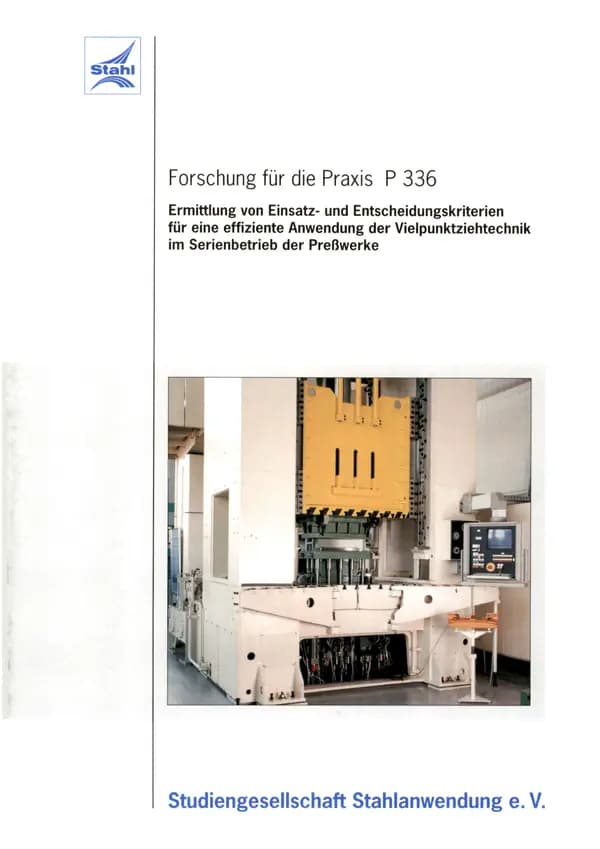
P 336: Determination of application and decision criteria for an efficient application of multi-point drawing technology in the series operation of pressing plants Multi-point drawing equipment in press shops can be used to increase the drawing depths of deep-drawn components, especially those made of high-strength materials, and to improve the quality level and productivity. The aim of this research work was to demonstrate the technological advantages and to develop process-specific knowledge about initial settings and parameter influences. The research results should provide decision criteria for the introduction and industrial implementation of this technology. A computer programme for realistic finite element process simulation was developed to illustrate the technological relationships. A special feature is the elastic modelling of the hold-down device. It allows modelling of the deformation under the effect of force during the sheet metal run-in. Corresponding practical tests were carried out on a hydraulic press with 16-point drawing systems. These included conventional deep drawing without and with an elastic hold-down plate as well as multi-point drawing with the elastic hold-down plate. Sheet thickness distribution, flange tightening, contact conditions and blank holder deformations in the process were monitored and quantitatively evaluated as comparative criteria. The test materials were the soft deep-drawing steel DC 04 as a reference and ZStE 220i and H340 as isotropic or higher-strength steel grades. The investigations demonstrated in simulation and practice that the use of multi-point drawing technology can increase process reliability and at the same time extend the technological limits. Unfavourable distributions of the actually prevailing local surface pressures between the blank holder, sheet and die proved to be the cause of failures. It was shown that the use of an elastic hold-down device is a prerequisite for a functional multi-point drawing system and technologically optimised results. Advice is given on the effective initial setting of the quill forces with the aid of FEM simulation for various applications. This work contains valuable information for the technological design of multi-point drawing presses and provides new arguments for the use of this technology by steel processors. STUDIENGESELLSCHAFT STAHLANWENDUNG e.V. Publication: 2000 Authors: Dipl.-Ing. L. Klose, Dipl.-Ing. H. Bräunlich
available anytime
€30.00
excl. VAT
Payment by card (Stripe) or invoice (DE, AT, CH). Download link by email: automatically after ordering by card, after order approval for invoice (valid for 30 days). Terms