
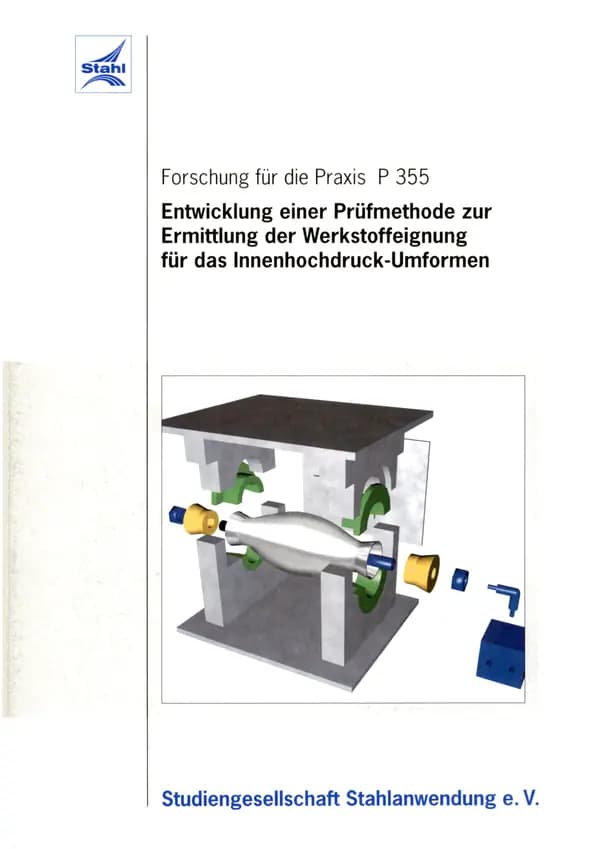
P 355 - Development of a test method to determine the suitability of materials for hydroforming
Innovative hydroforming (hydroforming) has established itself among forming technologies in recent years. However, the use of this process in series production means that the specific semi-finished product …
Content
- Publication
- 2000
- Authors
- Dipl.-Ing. Ch. Hielscher, Dr.-Ing. P.-J. Bolt, Dr.-Ing. A. Floß
Innovative hydroforming (hydroforming) has established itself among forming technologies in recent years. However, the use of this process in series production means that the specific semi-finished product characteristics must be known in order to ensure consistent component quality. This is the only way to recognise variations in hardness, for example, which can very quickly lead to high reject rates, and to adapt the process control to the new semi-finished product parameters. At present, conventional test methods are used to check the hydroforming suitability of roll-formed tubes and the material properties of the sheets used for tube production or the finished tube are determined in the longitudinal direction.
Show full description
The material properties that change over the circumference of the pipe as a result of the manufacturing process have not yet been considered, or only to a limited extent. For this reason, the material behaviour of tubes and sheets in relation to hydroforming was investigated in a joint project between the Institute for Production Technology and Forming Machines (PtU) at the Technical University of Darmstadt, the TNO Institute for Industrial Technology, Eindhoven (NL) and Engineering System International GmbH (ESI) Eschborn, in order to develop specific semi-finished product testing methods. The PtU concentrated its work on the semi-finished product tube, while TNO and ESI focussed on sheet metal testing using hydraulic cupping and thus the usability of an already known test method. In theoretical and practical investigations, the design features of hydroforming test rigs for pipes and sheet metal were developed and initial testing experience was gained with the aid of the test rigs realised on this basis. In the case of pipe testing, it was shown that both the pipe manufacturing process and various material parameters, especially geometry parameters, are of particular influence. The finite element simulation is in good agreement with the strains achieved in the real test results. This allows a good estimation of the time of failure. A comparison of the tube tests with the corresponding tests on sheet metal showed that some of the factors that determine the suitability for hydroforming could not be recognised in the case of sheet metal. The semi-finished product test for hydroforming properties of pipes must therefore always be carried out on the semi-finished pipe product. The test procedure developed for tubes enables tube manufacturers and hydroforming users to specifically analyse and test the semi-finished product properties that are of decisive importance for hydroforming. The test results make an important contribution to the optimisation of pipe production and to incoming inspection for hydroforming users. With regard to hydroforming plant operation, the measured forming pressures provide initial indications for process control and its adaptation. STUDIENGESELLSCHAFT STAHLANWENDUNG e.V.
Zum Zoomen hovern
€30.00excl. VAT
Payment by card (Stripe) or invoice (DE, AT, CH). Download link by email: automatically after ordering by card, after order approval for invoice (valid for 30 days). Terms
P 355 - Development of a test method to determine the suitability of materials for hydroforming—
€30.00