
P 352 - Development of a pneumomechanical deep drawing process for the forming of high-strength steel sheets
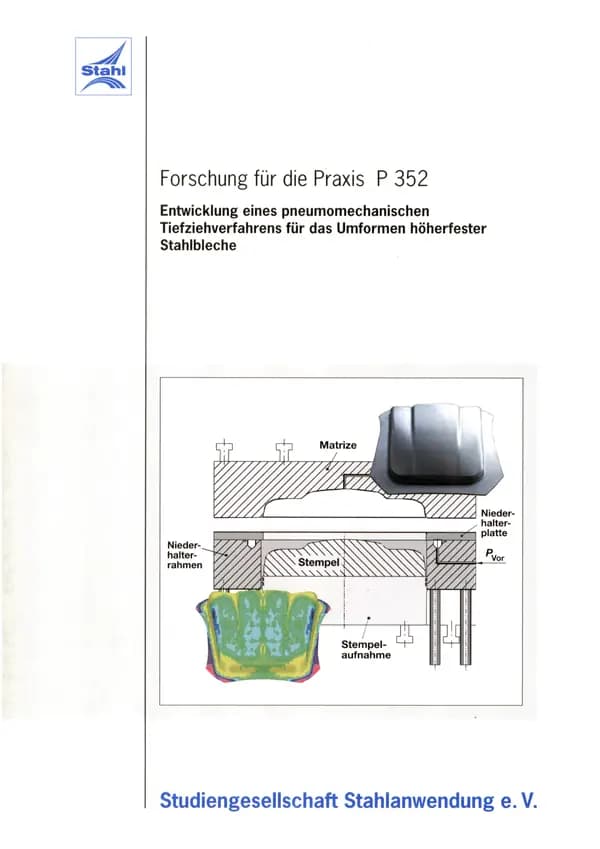
The task of this research project was the development of a new pneumomechanical deep drawing process (PMT) for sheet metal forming by a suitable combination of active media-based forming and conventional deep drawing. …
Content
- Publication
- 2000
- Authors
- Prof. Dr.-lng. M. Kleiner, Dipl.-Ing. A. Brosius, Dipl.-Ing. A. Gartzke, ]}, Dipl.-Ing. T. Weidner
The task of this research project was the development of a new pneumomechanical deep drawing process (PMT) for sheet metal forming by a suitable combination of active media-based forming and conventional deep drawing. This technology enables the targeted stretching of certain parts of the workpiece by skilfully influencing the stretching and deep-drawing parts during active-media-based pre-forming. The final shape is only produced during conventional deep drawing in an immediately subsequent operation in the same mould. By utilising the specific advantages of each process, improvements in component properties were expected, particularly when processing higher-strength sheet steel.
Show full description
The object of the work was the development of a tool system for conventional presses, with which it is possible to apply the forming processes of high-pressure sheet metal forming (HPF) and conventional deep drawing to a component geometry. This should make it possible to compare the individual processes and their combination and, after determining suitable process parameters for the PMT, allow an evaluation with regard to the forming result. The tests were carried out on a scaled-down bonnet with an integrated recessed grip as a secondary forming element. The materials analysed were a dual-phase steel DP500, a micro-alloyed high-strength steel ZStE340 and, as a reference, a conventional deep-drawing steel DC04. As part of the investigations, it was demonstrated that upstream forming with compressed air using active media offers process-specific improvements. On the one hand, it is possible to achieve a greater proportion of stretch forming with increased hardening in the centre of the component. This is particularly advantageous for high-strength steel materials due to the work hardening at a higher stress level. On the other hand, the risk of failure in the form of tearing can be minimised through targeted material pre-distribution and at the same time the number of forming stages can be reduced. Additional variation options for the forming conditions result in a larger process window and improved process reliability. The advantages of this new type of forming process are particularly evident in large-area components. It is primarily intended for use in the automotive industry and its suppliers. However, the possibility of saving on forming stages and simultaneously increasing component strength also makes this process attractive for other companies that previously used conventional deep drawing. STUDIENGESELLSCHAFT STAHLANWENDUNG e.V.
Zum Zoomen hovern
€20.00excl. VAT
Payment by card (Stripe) or invoice (DE, AT, CH). Download link by email: automatically after ordering by card, after order approval for invoice (valid for 30 days). Terms
P 352 - Development of a pneumomechanical deep drawing process for the forming of high-strength steel sheets—
€20.00