
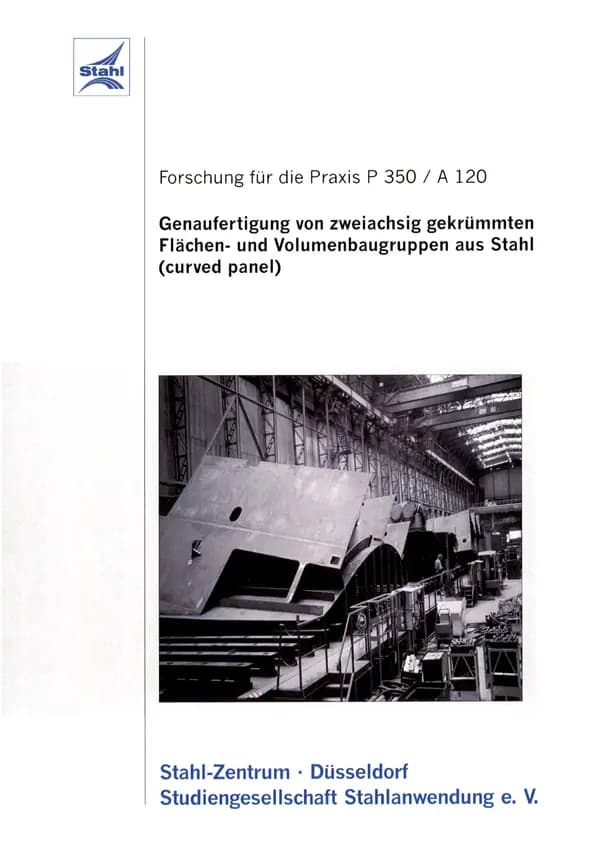
P 350 - Precision production of biaxially curved steel surface and volume assemblies (curved panel)
In today's shipyard practice, it is common for assemblies with simple geometry - i.e. at least one outer surface is flat - to be manufactured with increased accuracy in the midship area, so that fitting work is largely …
Content
- Publication
- 2002
- Authors
- Dr H. Zorn, Dr K.-M. Henkel, Dipl.-Ing. U. Kothe, ]}, Prof. Dr E. Wiebeck
P 350: Precision production of biaxially curved surface and volume assemblies made of steel (curved panel) In today's shipyard practice, it is common for assemblies with simple geometry - i.e. at least one outer surface is flat - to be manufactured with increased accuracy in the midship area, so that fitting work is largely eliminated. In the case of assemblies with a biaxially curved boundary surface (curved assembly), as is typical for the transition from the midship area to the fore and aft ship, it is still necessary to compensate for inaccuracies in terms of dimensions, shape and position relationships during assembly, which means that a lot of adjustment and reworking is required.
Show full description
The rework can account for up to 30 % of the total costs. The aim of the project was therefore to investigate the conditions and possibilities for manufacturing curved assemblies with as little adjustment and rework as possible. Firstly, the manufacturing methods for curved assemblies as practised in German shipyards were analysed using special processes. The welding work to be carried out during production causes deformation as a result of localised shrinkage, the control of which is an essential component of a shipbuilding genetic assembly. Gene production requires meaningful testing of actual geometries. On the one hand, corresponding target data must be made available by CAD systems, and on the other hand, suitable measurement technology must be used to record actual data. Both complexes were analysed. A TARGET-ACTUAL comparison also requires the definition of references and the specification of justified permissible deviations, i.e. well-founded production and function-related tolerances. Investigations were also carried out in this regard. The results of the investigations lead to important findings and point to problems in the production of curved assemblies. In order to assess the welding shrinkage that occurs and the resulting dimensional and shape changes, it is essential to have objective, production and function-related specifications for dimensional references, reference points and representative geometric elements that are relevant in practice. For the determination of accuracy (= comparison of TARGET and ACTUAL), starting points were developed in this respect and tendencies with regard to data generation and data transfer were identified. The necessity and content of further research work in the field of gene generation of curved assemblies is derived from these findings and problems. STUDIENGESELLSCHAFT STAHLANWENDUNG e.V.
Zum Zoomen hovern
€30.00excl. VAT
Payment by card (Stripe) or invoice (DE, AT, CH). Download link by email: automatically after ordering by card, after order approval for invoice (valid for 30 days). Terms
P 350 - Precision production of biaxially curved steel surface and volume assemblies (curved panel)—
€30.00