
FOSTA
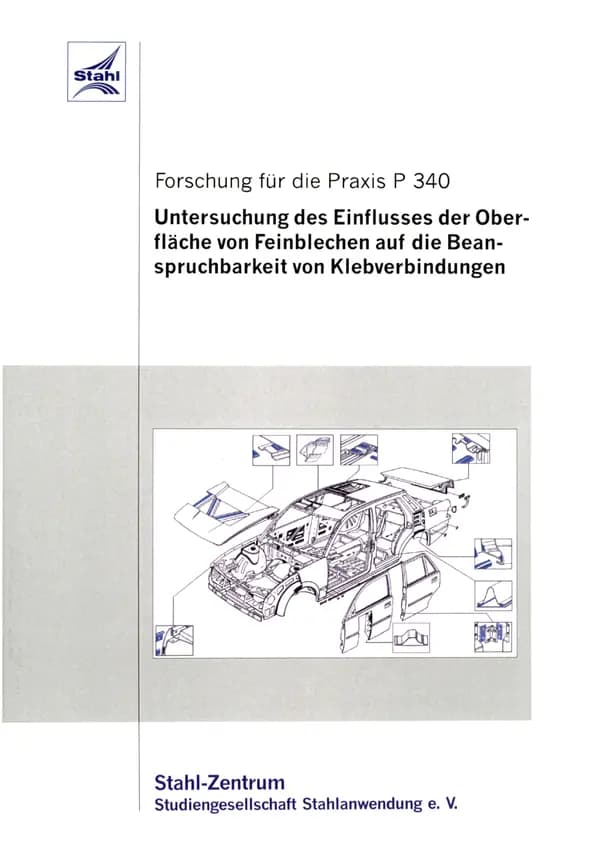
The present research project examined sheet metal surface topographies produced by various roll-texturizing processes, chemical surface compositions of uncoated sheet, and corrosion-resistant coatings of sheet metal as …
The present research project examined sheet metal surface topographies produced by various roll-texturizing processes, chemical surface compositions of uncoated sheet, and corrosion-resistant coatings of sheet metal as potential factors influencing the strength of adhesive bonded joints. In a first experimental step, various topographies were imparted to a strip in a bandshaped pattern by skin-pass rolling. The specimens taken from this strip were analyzed for their topography, chemical surface composition, and adhesive bonding characteristics. The specimens of different topography were evidently identical in terms of their near-surface chemical composition.
Bonding tests using different testing geometries were carried out with two epoxy resin adhesives. From the results of this first trial phase it emerged that the different sheet topographies examined had no influence on the bonding quality obtained with amine-curing epoxy resin adhesives, regardless of whether a cleaned or oily steel surface was used or whether the adhesive joint was tested before or after ageing. A second experimental step was designed to determine the impact of the substrate's near-surface chemical composition on the durability of adhesive bonding joints. For this purpose uncoated sheets of different topographies, sourced from various suppliers, were included in the test programme.
Machine-translated title and description. The document itself is in German.
Payment by card (Stripe) or invoice (DE, AT, CH). Download link by email: automatically after ordering by card, after order approval for invoice (valid for 30 days). Terms
Digital download
Other parts and editions as well as neighbouring documents of the same series.
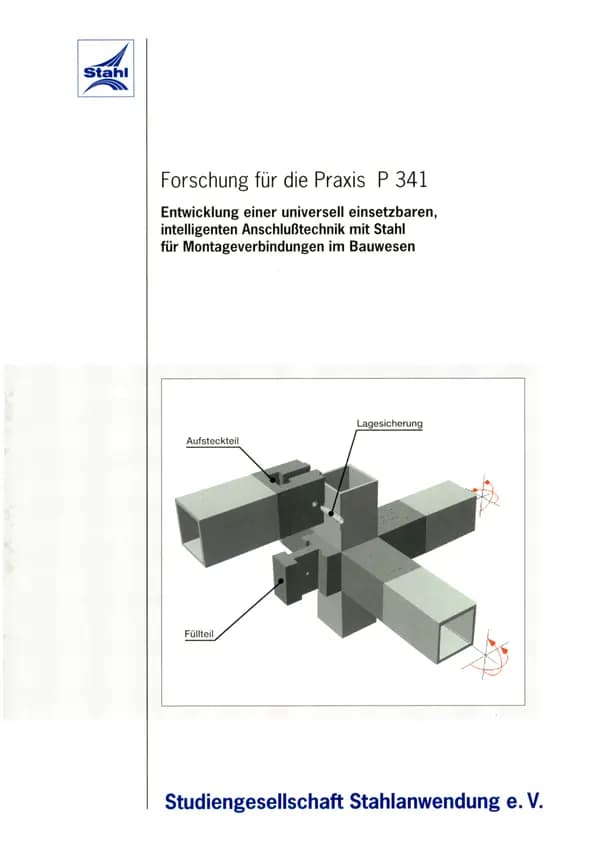
P 341: Development of a universally applicable, intelligent connection technology with steel for assembly connections in the construction industry The design requirements of clients and architects sometimes lead to spectacular buildings with high demands on planning and production. Connection technology has not yet followed this development. For the rigid assembly of individual components on the construction site, bolted head plate joints or construction site welds are still used. This is where the work of the research project comes in. The newly developed SIGMA node is an innovative, rigid plug-in connection to simplify the assembly of prefabricated individual parts on the construction site. The patented assembly connection consists of the standardised filling and push-on part and can be manufactured precisely as a mechanically processed element. The node transfers uniaxial and biaxial bending with and without normal forces as well as shear forces via contact. The positive locking required for this type of load transfer is achieved by inclined surfaces inside the node. Hollow sections with external dimensions of 40 mm to 200 mm, which are favoured in structural steelwork, can be connected to the node in a rigid manner. The high precision of both the joining technology and the prefabricated components enable problem-free assembly without the need for special tools. The SIGMA node is a virtually 'invisible' connecting element in hollow profile constructions and is therefore particularly suitable for use in buildings with sophisticated designs. Examples of this include residential buildings with steel, bar domes and large, slender steel and glass façades. In addition to square and rectangular hollow profiles, I, hat or U profiles can also be easily connected with the node, which always has a rectangular or square cross-section. The first practical application of the SIGMA node was in the construction of the Christ Pavilion for the EXPO 2000 "Man-Nature-Technology" world exhibition in Hanover. After the pavilion has been used for a limited period, the cloister and church for the Volkenroda monastery in Thuringia are to be realised at a later date. The SIGMA node is predestined for precisely this purpose. It enables easy disassembly and subsequent reassembly of the components. STUDIENGESELLSCHAFT STAHLANWENDUNG e.V. Publication: 2000 Authors: Engineer E. Rüter, Dr.-Ing. R. Grube, Dipl.-Ing. S. Landskröner
available anytime
€30.00
excl. VAT
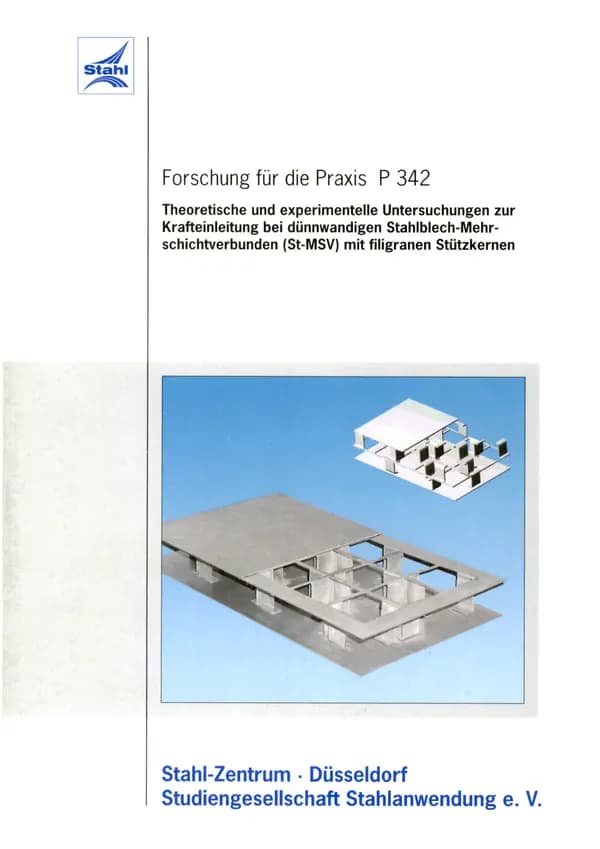
P 342: Theoretical and experimental investigations of force transmission in thin-walled steel multi-layer composites (St-MSV) with filigree support cores The global and local load-bearing behaviour of the still relatively young semi-finished product group of metal multi-layer composites (M-MSV) has so far only been insufficiently investigated from a structural-mechanical point of view, which is probably the reason why many potential users are still somewhat reluctant to use them - despite the particular advantages of lightweight construction. Stress concentrations, for example in the area of edge terminations and cut-outs, represent particularly highly stressed zones in the structural practice of steel sheet multilayer composites. Due to the interactions between global and composite-specific local deformation and stress fields, conventional methods can only be used to analyse notch influences in special cases. Using the example of the joint composite and the dimpled sheet composite, the unusual structural phenomena for selected edge and cut-out geometries are therefore analysed theoretically and experimentally. With the help of structural calculation methods, the stress and deformation behaviour of such new semi-finished products is recorded and failure-critical zones due to stiffness discontinuities with the resulting stress concentrations are determined. From the comprehensive knowledge of the interactions of individual design parameters on the complex load-bearing behaviour, design proposals are derived as suitable structural optimisation measures for the stress-optimised design of the edge areas. Experimental verification of the numerical simulation is carried out for both unreinforced and selected edge-reinforced structures. The notch stress analysis of anisotropic metal multilayer composites is further complicated by the three-dimensional heterogeneous structural design and the often complex design of the secondary mould elements. Notch cuts and discontinuous reinforcing elements induce an interference stress field that is strongly influenced depending on the position of the local mould inhomogeneities towards the notch edge. The approximate solutions presented here for the calculation of steel sheet multilayer composites and their experimental support by means of specially developed structural test methods provide fundamental findings on the dependence of the position and design of the force introduction and edge areas on the global and local structural behaviour. The solution strategy developed using examples of dimpled sheet metal composites and joint composites allows an application-orientated assessment of the structural suitability of new types of steel sheet multilayer composites, which is confirmed by the good agreement between theory and experiment. This provides the calculation engineer with a powerful tool for the design and layout of St-MSV. STUDIENGESELLSCHAFT STAHLANWENDUNG E.V. Publication: 2000 Authors: Dr.-Ing. F. Adam, Prof. Dr.-Ing. habil. W. Hufenbach
available anytime
€20.00
excl. VAT
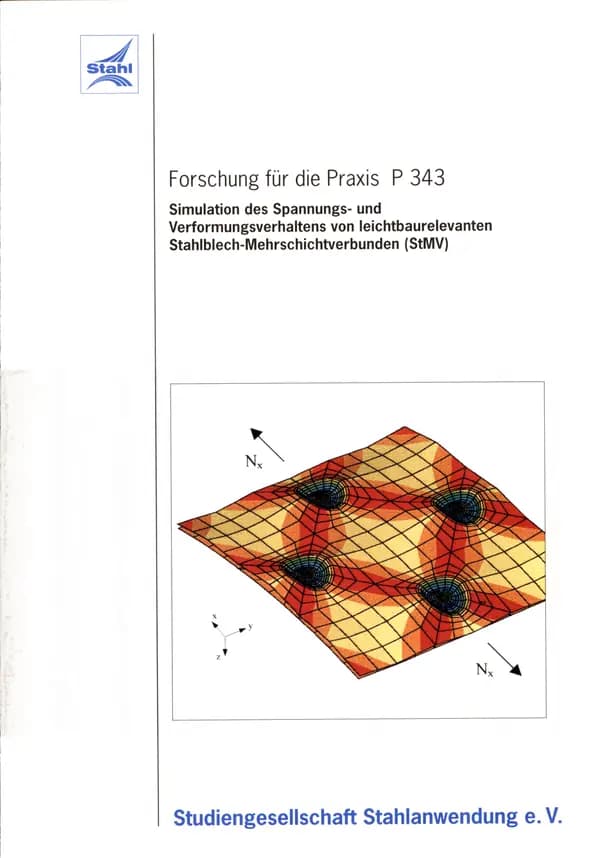
P 343: Simulation of the stress and deformation behaviour of lightweight steel multi-layer composites (StMV) Steel sheet multi-layer composites with adjustable direction-dependent properties offer a wide range of possible applications for multiple requirements. Their potential, especially for cost-effective lightweight structures, is considerable. The aim of this research project was to develop computer-aided simulation techniques and to utilise them for the application of rigid, filigree sheet steel support core composites under high lightweight construction requirements. Refined principles and simulation techniques were developed on an analytical and numerical FE basis for calculating the properties of these generally anisotropic, bending-stressed composites with adapted stiffness. With the aid of a structure-appropriate homogenisation technique, the load-bearing behaviour of selected steel sheet multi-layer composites was simulated holistically with special consideration of the joining techniques for component joints. The theoretical findings obtained with the aid of these new computational models were verified on components using a specially developed material and structural testing procedure. The work carried out as part of this project has led to new analytical possibilities that allow global statements to be made about the stiffness-determining components of the material type and composite. Through intensive co-operation with development engineers and by responding to practical requirements, direct integration into the user software was ensured. The new computer-aided simulation model provides the designer with a tool for the efficient use of steel sheet multi-layer composites in many areas of mechanical and vehicle engineering and construction. This opens up new application possibilities for steel as a material, even for particularly high lightweight construction requirements. STUDIENGESELLSCHAFT STAHLANWENDUNG e.V. Publication: 1998 Authors: Dr.-Ing. F. Adam, Prof. Dr.-Ing. habil. W. Hufenbach, Dr.-Ing. Hillmann
available anytime
€30.00
excl. VAT
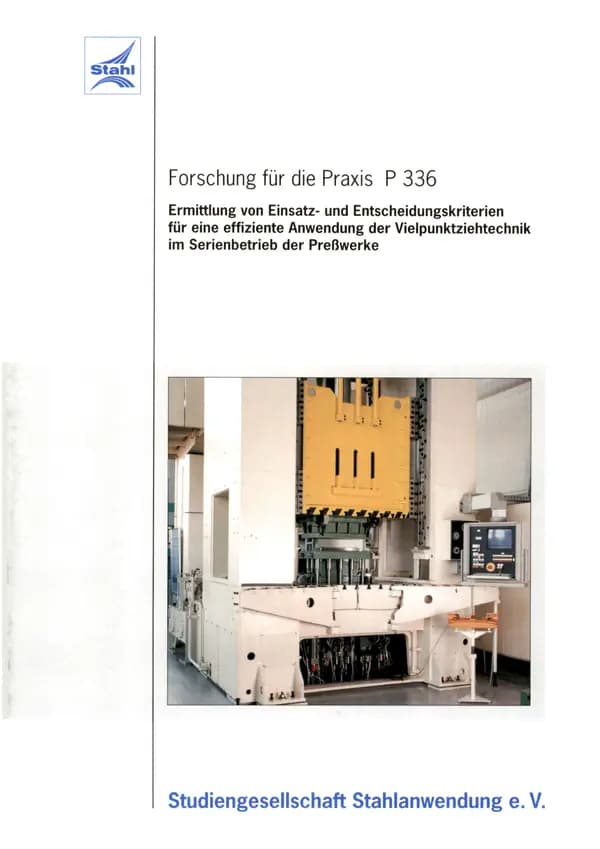
P 336: Determination of application and decision criteria for an efficient application of multi-point drawing technology in the series operation of pressing plants Multi-point drawing equipment in press shops can be used to increase the drawing depths of deep-drawn components, especially those made of high-strength materials, and to improve the quality level and productivity. The aim of this research work was to demonstrate the technological advantages and to develop process-specific knowledge about initial settings and parameter influences. The research results should provide decision criteria for the introduction and industrial implementation of this technology. A computer programme for realistic finite element process simulation was developed to illustrate the technological relationships. A special feature is the elastic modelling of the hold-down device. It allows modelling of the deformation under the effect of force during the sheet metal run-in. Corresponding practical tests were carried out on a hydraulic press with 16-point drawing systems. These included conventional deep drawing without and with an elastic hold-down plate as well as multi-point drawing with the elastic hold-down plate. Sheet thickness distribution, flange tightening, contact conditions and blank holder deformations in the process were monitored and quantitatively evaluated as comparative criteria. The test materials were the soft deep-drawing steel DC 04 as a reference and ZStE 220i and H340 as isotropic or higher-strength steel grades. The investigations demonstrated in simulation and practice that the use of multi-point drawing technology can increase process reliability and at the same time extend the technological limits. Unfavourable distributions of the actually prevailing local surface pressures between the blank holder, sheet and die proved to be the cause of failures. It was shown that the use of an elastic hold-down device is a prerequisite for a functional multi-point drawing system and technologically optimised results. Advice is given on the effective initial setting of the quill forces with the aid of FEM simulation for various applications. This work contains valuable information for the technological design of multi-point drawing presses and provides new arguments for the use of this technology by steel processors. STUDIENGESELLSCHAFT STAHLANWENDUNG e.V. Publication: 2000 Authors: Dipl.-Ing. L. Klose, Dipl.-Ing. H. Bräunlich
available anytime
€30.00
excl. VAT
Payment by card (Stripe) or invoice (DE, AT, CH). Download link by email: automatically after ordering by card, after order approval for invoice (valid for 30 days). Terms