The lightweight construction potential of high-strength steels is increasingly being utilised in automotive engineering. For the cold-rolled profiles used, a simple substitution of soft deep-drawing grades in roll …
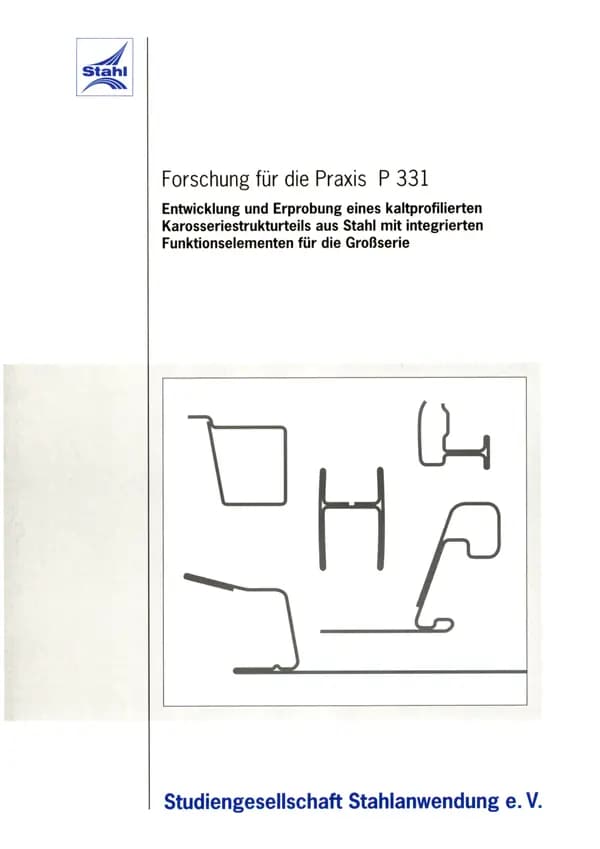
The lightweight construction potential of high-strength steels is increasingly being utilised in automotive engineering. For the cold-rolled profiles used, a simple substitution of soft deep-drawing grades in roll forming - the most important cold-forming process - is often hindered by a lack of expertise in adapting the production parameters. The aim of this research project was to create a manufacturing basis for the series use of higher-strength steels and to integrate the processing of essential functional elements into the roll forming process with a view to later use as a component. The continuous roll-forming process of high-strength steel and the simultaneous introduction of integrated functional elements and add-on parts was investigated and industrially tested for an automobile cross member as a structural body part.
Coming from the coil, the steel strip first passes through two production facilities in the stop and go process, which on the one hand fix reinforcing sheets to the strip with the aid of clinching elements and on the other hand insert punching nuts. This is followed by the continuous roll forming process. The brief stopping of the strip in the upstream production equipment requires appropriate strip storage or loops, which enable the pilot plant to operate continuously overall. To prevent the functional elements from colliding with the rollers, these are turned out in the corresponding contour areas around the circumference. The carrier prototype is closed by laser welding. The profiles are then cut to length. It has been demonstrated that the production of cold-profiled structural body parts made of steel with integrated functional elements is suitable for large-scale production. The manufacturing costs can be considerably reduced by processing the functional elements before the roll forming process. The results achieved in this research project will make a significant contribution to increasing the range of applications for the roll forming process and thus strengthen the competitiveness of the supplier industry, which is mostly made up of medium-sized companies. STUDIENGESELLSCHAFT STAHLANWENDUNG E.V.
Payment by card (Stripe) or invoice (DE, AT, CH). Download link by email: automatically after ordering by card, after order approval for invoice (valid for 30 days). Terms
Machine-translated title and description. The document itself is in German.
Digital download
Other parts and editions as well as neighbouring documents of the same series.

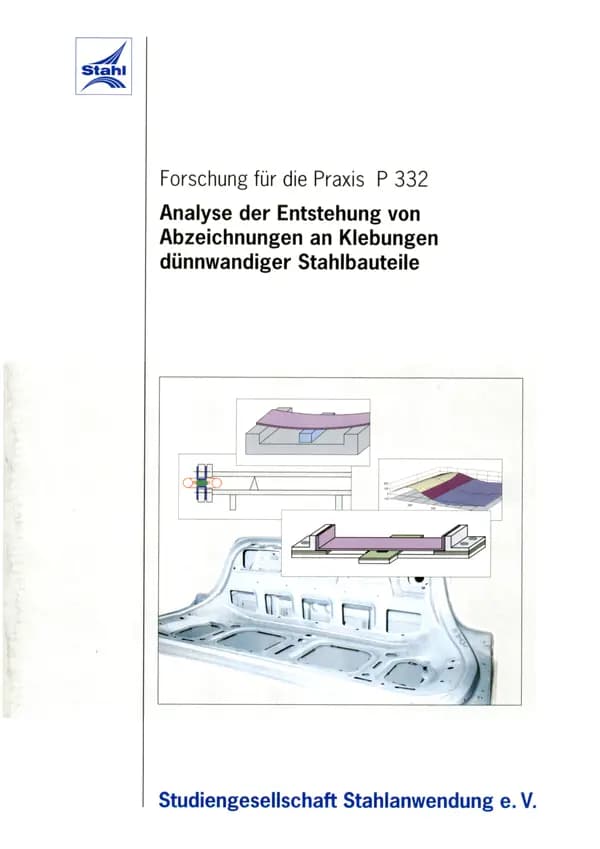
P 332: Analysing the formation of markings on bonded thin-walled steel components Adhesive bonding is a suitable joining technique for the manufacture of lightweight sheet steel components due to the fact that the joining seam can be designed almost arbitrarily and is already used extensively in the series production of cars and other vehicles. However, practice shows that the curing of the preferably used single-component adhesives in paint drying ovens causes residual stresses in the bonded seam, which lead to component deformation, i.e. to visual defects (markings), but also to loss of strength. The occurrence of production-related component deformations is due to the local and temporal temperature field in the joining partners during the curing of the heat-curing adhesives. A distinction must be made between two deformation mechanisms. On the one hand, the thermal expansion or contraction and the reaction-related increase in density of the adhesive lead to deformations in the area of the bonded joint. On the other hand, relative movements of the joining partners during the oven cycle, which can be of the order of several millimetres, can be frozen as the adhesive cures. In order to understand in detail the processes that take place during the heat curing of single-component reactive adhesives and to be able to derive measures to minimise the resulting component deformations, laboratory test methods have been developed with which the various effects can be considered separately from each other as far as possible. Based on the knowledge gained from the laboratory test specimens, a component-like test specimen was initially developed, which approximates the complexity of series components and allows a wide variation in the design of the joining zone. The findings were then verified through tests on series components. The tests on realistic test specimens and series components clearly show that a holistic view of the system consisting of component, adhesive and curing process is essential to avoid markings. The type of component deformation resulting from the tempering process is determined by the combination of various geometry-, adhesive- and process-specific boundary conditions. The main result is a checklist which provides specific solution proposals for characteristic problem cases. The checklist describes the development mechanisms, the damage pattern and the proposed remedial measures. On the one hand, the formation of markings can be counteracted as early as the design phase by designing steel components to be adhesive-free and, on the other hand, markings can be minimised in existing components and processes through appropriate optimisation measures. Mark-free bonding opens up potential applications in lightweight constructions, particularly for high-strength steel sheets of low thickness, where spot joining methods only allow insufficient material utilisation or where the material is only suitable for spot welding to a limited extent. STUDIENGESELLSCHAFT STAHLANWENDUNG e.V. Publication: 2000 Authors: Prof.Dr.-lng. O. Hahn, Dipl.-Ing. G. Meschut, Dipl.-Ing. M. Eis
available anytime
€30.00
excl. VAT

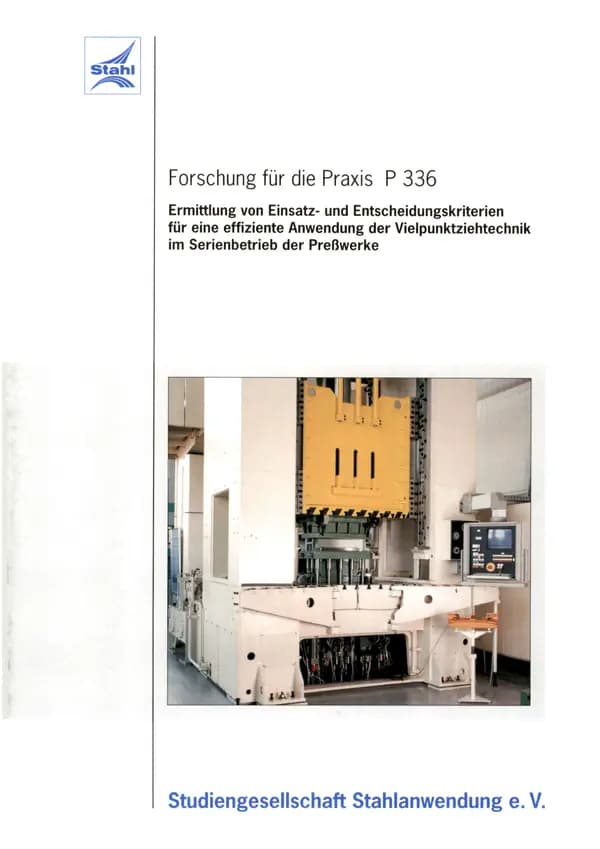
P 336: Determination of application and decision criteria for an efficient application of multi-point drawing technology in the series operation of pressing plants Multi-point drawing equipment in press shops can be used to increase the drawing depths of deep-drawn components, especially those made of high-strength materials, and to improve the quality level and productivity. The aim of this research work was to demonstrate the technological advantages and to develop process-specific knowledge about initial settings and parameter influences. The research results should provide decision criteria for the introduction and industrial implementation of this technology. A computer programme for realistic finite element process simulation was developed to illustrate the technological relationships. A special feature is the elastic modelling of the hold-down device. It allows modelling of the deformation under the effect of force during the sheet metal run-in. Corresponding practical tests were carried out on a hydraulic press with 16-point drawing systems. These included conventional deep drawing without and with an elastic hold-down plate as well as multi-point drawing with the elastic hold-down plate. Sheet thickness distribution, flange tightening, contact conditions and blank holder deformations in the process were monitored and quantitatively evaluated as comparative criteria. The test materials were the soft deep-drawing steel DC 04 as a reference and ZStE 220i and H340 as isotropic or higher-strength steel grades. The investigations demonstrated in simulation and practice that the use of multi-point drawing technology can increase process reliability and at the same time extend the technological limits. Unfavourable distributions of the actually prevailing local surface pressures between the blank holder, sheet and die proved to be the cause of failures. It was shown that the use of an elastic hold-down device is a prerequisite for a functional multi-point drawing system and technologically optimised results. Advice is given on the effective initial setting of the quill forces with the aid of FEM simulation for various applications. This work contains valuable information for the technological design of multi-point drawing presses and provides new arguments for the use of this technology by steel processors. STUDIENGESELLSCHAFT STAHLANWENDUNG e.V. Publication: 2000 Authors: Dipl.-Ing. L. Klose, Dipl.-Ing. H. Bräunlich
available anytime
€30.00
excl. VAT

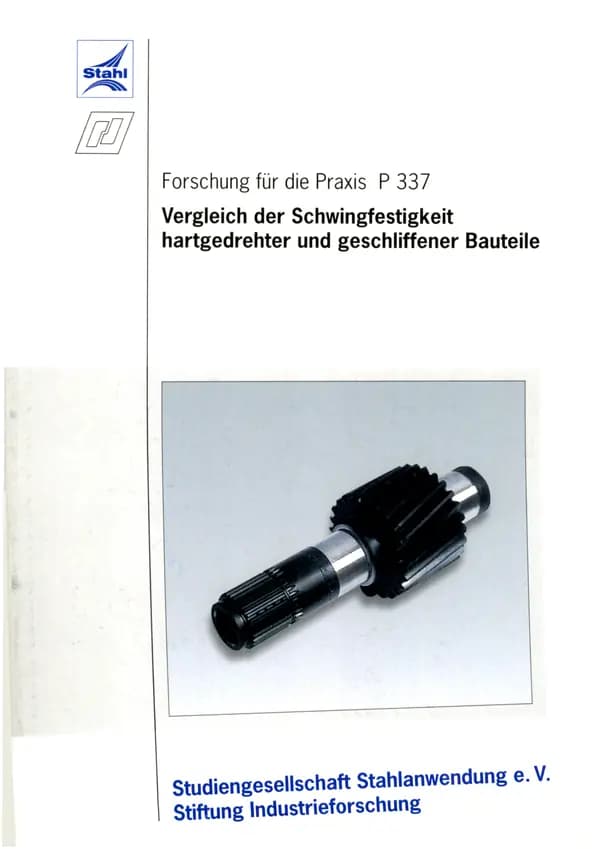
P 337: Comparison of the fatigue strength of hard-turned and ground components In competition with grinding, hard turning fulfils the demand for higher economic efficiency with better ecological compatibility. For a broad application of hard turning, it has not yet been proven that at least the performance properties, in particular the fatigue strength of components with a ground surface, can be achieved. This is where the present research project comes in and investigates whether hard turning can replace grinding, which has been the standard hard machining process to date. For the comparative investigation of grinding and turning of case-hardened components, notched round specimens made of 16MnCr5 case-hardening steel were selected as the material and subjected to 4-point alternating bending. A sufficiently small test radius ensured that the cracks only originated from the surface. To investigate the influence of tool wear during hard turning, the test specimens were turned with both new and defined worn inserts at two feed rates. Compared to ground samples, the fatigue strength was determined in the Wöhler test and the fatigue strength test. Cracking was used as the failure criterion for all test series. The fatigue tests were accompanied by metallographic analyses and residual stress measurements. The samples from hard turning with new tools always show a higher fatigue strength than the ground samples in the single-stage test with constant amplitude. The strengths decrease with tool wear; they are only lower than those of ground samples after prolonged tool use. In the fatigue strength tests with different amplitudes, no influence of tool wear was found in the load range investigated. The hard-turned samples always produced better fatigue strength values than the ground samples. With the help of a specially developed calculation concept, the Wöhler and fatigue strength results from the test series with turned specimens can be reproduced well. In contrast, the results of the test series with ground samples could not be determined satisfactorily by calculation due to the different surface topography, which was not adequately captured by the surface parameter used. As long as the tool wear during hard turning does not exceed a certain level, the fatigue strength is generally at least equal to or better than that of ground samples. The fatigue strength of hard turned samples only drops in comparison to ground samples at larger, but technically easily detectable wear mark widths. Up to this limit, hard turning is always more favourable than grinding case-hardened components, a finding that particularly benefits the small and medium-sized manufacturing industry. STUDIENGESELLSCHAFT STAHLANWENDUNG e.V. Publication: 2000 Authors: Dipl.-Ing. F. Renner, Prof. Dr.-Ing. H. Zenner, Dipl.-Ing. Ch. Borbe
available anytime
€30.00
excl. VAT

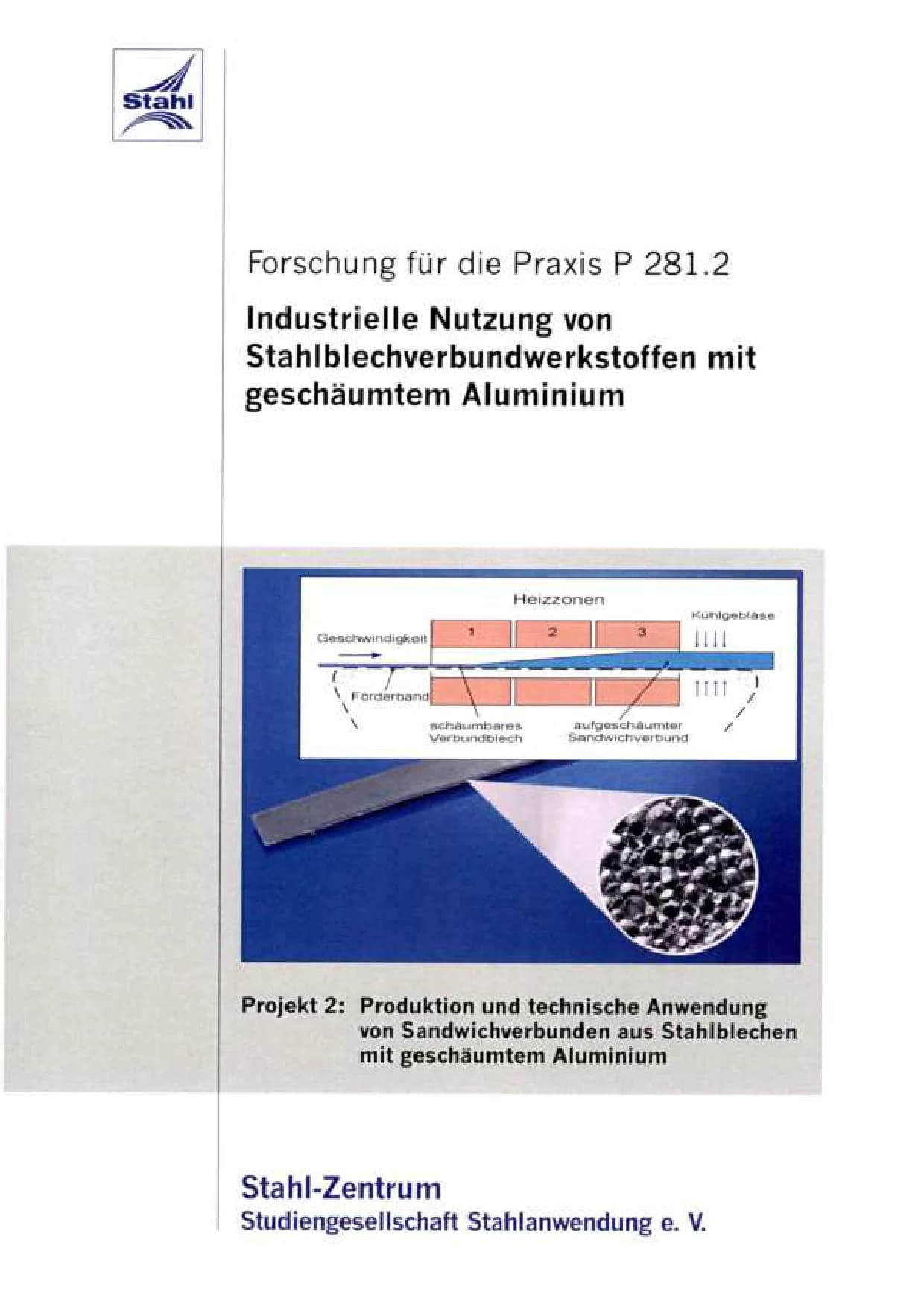
P 281.2: Industrial use of steel sheet composites with foamed aluminium Project 2: Production and technical application of sandwich composites made of steel sheets with foamed aluminium As part of a two-part project on the industrial use of sheet steel composites with foamed aluminium, project 281.1 investigated the manufacturability of such sandwich constructions on a laboratory scale ( Research report P 281.1 of the Studiengesellschaft Stahlanwendung e.V. ). It has been shown that the new type of sandwich composite offers interesting properties for a wide range of possible innovative applications. It combines the significant properties of steel in the form of cover sheets with a core layer of very low density and additional, functionally useful properties. The aim of the second part of the project with this final report ( P281.2 ) was to transfer the flamer production developed on a laboratory scale to an industrial level in order to be able to manufacture sandwich panels with large dimensions and thus a broader application base. In pursuit of this task, the dimensions of the producible foamable semi-finished product were increased to 450 mm x 4000 mm x 3 mm by using a modified extrusion mould. Larger dimensions were achieved using various joining processes such as laser beam, friction stir and TIG welding, also in order to be able to integrate the foamable semi-finished product into a coil of conventional aluminium strip for a roll cladding process with stable process parameters. DC01 (1.0330) and, for the first time, X5CrNil 8- 10 (1.4301) steels were used as cover sheet materials for roll cladding. Foaming was carried out continuously in a newly developed continuous belt furnace so that sheets with dimensions of 400 mm x 1600 mm could be produced. The sandwich composites were successfully joined using laser beam welding, and forming limit diagrams were created by means of cupping tests, on the basis of which forming simulations could be carried out for various components. A broad database on the fatigue strength of various aluminium foams and aluminium foam composites was generated through corresponding tests. The favourable energy absorption behaviour was also demonstrated in dynamic compression tests for high strain rates. With regard to the application, designs, calculations and investigations were carried out for the use of steel-aluminium foam sandwich composites in a mobile makeshift bridge, in an unsinkable lifeboat, as a protective device and as a high car longitudinal beam. The unsinkable lifeboat was designed and built on a scale of 1:5. In additional tests, angled profiles and U-profiles were produced. Investigations into the foaming of pipes, e.g. for side impact protection in cars, and the design and manufacture of a foamed roller for rotary printing machines open up further potential applications. As a summarised result of the investigations, a product data sheet has been produced which provides potential users of steel sandwich composites with information about the product, its manufacture, its properties and its processing. The main result of project P 281.2 is that the process technology for manufacturing the sandwich composites has been significantly improved in all process steps and larger dimensions have also been achieved. In addition, important material characteristics were determined. The relatively low strength of aluminium foam makes its use in sandwich composites particularly useful when the requirements of the application under consideration and the specific profile of the functional and structural properties of the aluminium foam coincide. Reproducibility and homogeneity must be further improved, especially in the powder metallurgical production of aluminium foam. STUDIENGESELLSCHAFT STAHLANWENDUNG e.V. Publication: 2003 Authors: Dr rer. nat. J. Baumeister, Prof. Dr W. Bleck, Dipl.-Ing. T. Böllinghaus, Dipl.-Ing. M. Paschen, Prof. Dr G. Sedlacek
available anytime
€30.00
excl. VAT
Payment by card (Stripe) or invoice (DE, AT, CH). Download link by email: automatically after ordering by card, after order approval for invoice (valid for 30 days). Terms