The design of load-bearing structures in civil engineering is based on the limit load under maximum possible stresses. With regard to the actions to be applied, e.g. due to weather events, certain standard values are …
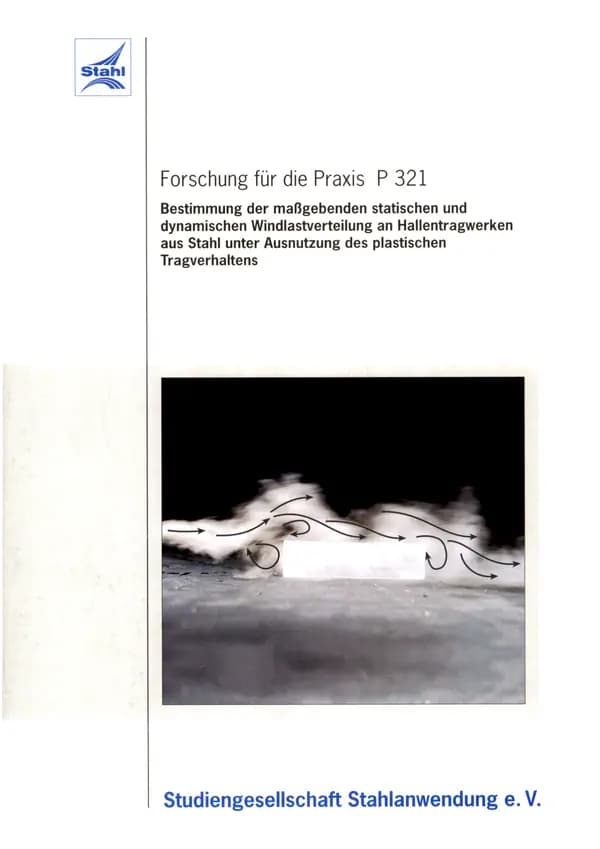
The design of load-bearing structures in civil engineering is based on the limit load under maximum possible stresses. With regard to the actions to be applied, e.g. due to weather events, certain standard values are used in the calculation. The decisive wind load to be applied here is currently still based on elastic load-bearing behaviour. However, modern regulations allow the design on the plasticised system, which results in a redistribution of the internal forces compared to the elastic calculation. For the plastic design, no wind load relevant to the design can be taken from the current standards. This is where the research objective of the project comes in: By investigating in particular the interaction between the time course of the wind effects and the elastic-plastic structural reactions of hall buildings of standard dimensions, realistic failure limits were to be determined in order to improve the accuracy of the design.
The time histories of the wind pressure distributions on the windward, leeward and roof sides were determined in a wind tunnel using models of hall structures. From this, the static and dynamic reactions of a hall frame up to failure were determined in time step calculations. Excessive lateral deformations or material fatigue due to repeated plastic deformations were used as failure criteria. The results show that the previous designs are on the safe side if only the wind load assumptions (see EUROCODE 1 - Part 2.4) are used. The load redistributions in the steel structures form a load reserve of up to 9 %. However, if one assumes the combination factors for wind plus snow, then the load reserve is even higher due to a reduction in the load assumptions, and thus a change in the standard (EUROCODE 1 - Part 2.3 Snow / 2.4 Wind) is indicated. It has also been shown that no increase in safety factors is necessary due to allegedly insufficient reserves in light steel structures. A comparison of these results with an evaluation of data from the German Weather Service on the probability of the interaction of snow and wind for a few locations and examples showed that excessive combination coefficients had always been calculated. Further investigations are currently underway to determine the general validity of these findings. An adaptation of the calculation to the real effects of the load combinations will lead to more economical load-bearing structures. STUDIENGESELLSCHAFT STAHLANWENDUNG e.V.
Payment by card (Stripe) or invoice (DE, AT, CH). Download link by email: automatically after ordering by card, after order approval for invoice (valid for 30 days). Terms
Machine-translated title and description. The document itself is in German.
Digital download
Other parts and editions as well as neighbouring documents of the same series.

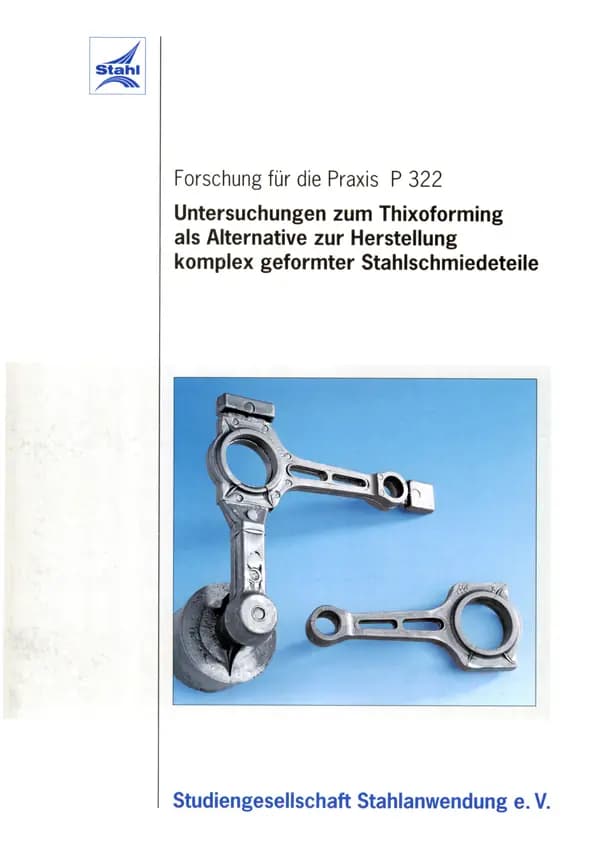
P 322: Investigations into thixoforming as an alternative for the production of complex shaped steel forgings Thixoforming as a way of shaping metals within the temperature range between the solid and liquid state means combining the process-specific advantages of casting to produce complex geometries and forging to achieve excellent mechanical properties. The aim of this research project was to apply this processing method, which is already used industrially for aluminium, to steel materials that melt at significantly higher temperatures. In addition to material-related questions, fundamental process-related questions also had to be clarified. Using three standard steel grades selected as examples - quenched and tempered steel (C45R and 41Cr4) and a connecting rod material (C70S6, rolled and stretched) - it was shown that a homogeneous, globular microstructure can be set as the required processing condition. The promising possibilities of developing process-optimised alloys have not yet been exploited. Further shaping tests were carried out on a sintered connecting rod as an example of the high mould complexity of a mass-produced product manufactured with relatively low tooling costs. This component impressively demonstrated the high flowability of the selected material C70S6 and the very good contour reproduction. The introduction of scale was avoided by taking suitable measures in the mould construction. The inhomoginities found in some of the sample components can be avoided by optimising the initial microstructure and the moulding and cooling conditions. Overall, the results of the research work are so encouraging that the industrial feasibility of the process can be recognised. A high degree of design freedom combined with a low component weight are the technical and economic potential for an innovative process technology for the industrial production of near-net-shape blanks. STUDIENGESELLSCHAFT STAHLANWENDUNG e.V. Publication: 1999 Authors: Dipl.-Ing. D. Koesling, Dipl.-Ing. Ch.n Tinius, Dr.-lng. R. Cremer, Dipl.-Ing. U. Morjan, Dipl.-Ing. B. Nohn, Dipl.-Ing. T. Wittstamm, Dr.-Ing. T. Witulski
available anytime
€30.00
excl. VAT

P 327 - Comparative assessment of the fire behaviour of different structural steels to determine fire-resistant steel structures without additional fire protection measures Authors: G. Sedlacek, C. Heinemeyer Publication: 2003 The choice of the material for structural elements between e.g. steel, wood or concrete depends on the experiences of the designer with the specific material and planning reliability that can be achieved in early design stages of the project. On aspect for choice of materials is fire safety. Therefore it is usually proved if the structural element fulfils general requirements given by codes or other regulations. These general requirements give classifications for the performance of structural members under ISO-fire condition. The lowest level of load bearing classification under ISO-fire can in most cases on be achieved by using protections systems for the structural elements. The use of protection systems such as coating or cladding of the elements leads to uneconomic solutions for steel structures and architectural design aspects cannot be fulfilled. One possibility to realize fire safe, economic and unprotected steel structures is the global fire safety design which considers realistic fires (Natural fires) and which allows to estimate the load bearing resistance under these fire conditions. (Visible steel by invisible protection measures.) To perform global fire safety design all influences on the definition of a fire have to be known. This is a disadvantage of this design procedure because all these influences are not surely known until a later design stage of the project is reached.
available anytime
€25.50
excl. VAT

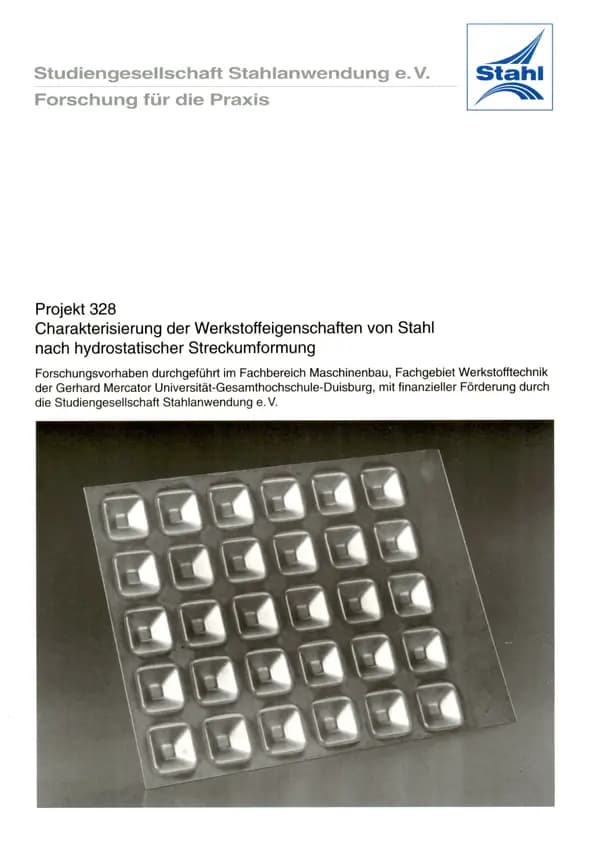
P 328: Characterisation of the material properties of steel after hydrostatic stretch forming Forming with hydraulic active media is still a relatively uncommon innovative processing method for steel. To date, there is no general test method tailored to these special forming conditions for determining material suitability. The aim of the project was therefore to investigate the behaviour of various ferritic and austenitic steels under the conditions of hydrostatic forming into bump plates and the subsequent characterisation of the material properties. The information gained from this is to be used to develop a suitable method for determining material suitability and formability limits. The tests were carried out on the ferritic deep-drawing steels St 14, StE 180BH and DB 500 as well as on the austenitic steels 1.4318 and 1.4301. For the tests, bumps were stamped onto sheets with a thickness of 0.5 to 1.25 mm using hydrostatic stretch forming in a two-stage process. The forming result was analysed with regard to thickness change and hardness progression as well as metallurgically. In parallel, comparative computer simulations were carried out to analyse and explain the forming results. The findings were compared with the results of supplementary bulge tests. The investigations have shown that the wall thickness distribution of the deformed sheets can be predicted with the aid of the forming limits and the use of a simulation programme. The test results provide information on the manufacturability of products of any geometry by means of forming with hydraulic moulding media. Based on the direct correlation between the degree of forming and hardness, the hardening at any point of a planned product can be predicted. The research results show that the selected forming process to form cusps is not suitable as a general test method. In contrast, an appropriately modified bulge test probably offers good conditions for the forming behaviour in relation to hydraulic active media. STUDIENGESELLSCHAFT STAHLANWENDUNG e.V. Publication: 1996 Authors: Dipl.-Ing. W. Bausch, Prof. Dr.-Ing. H. Nowack
available anytime
€30.00
excl. VAT

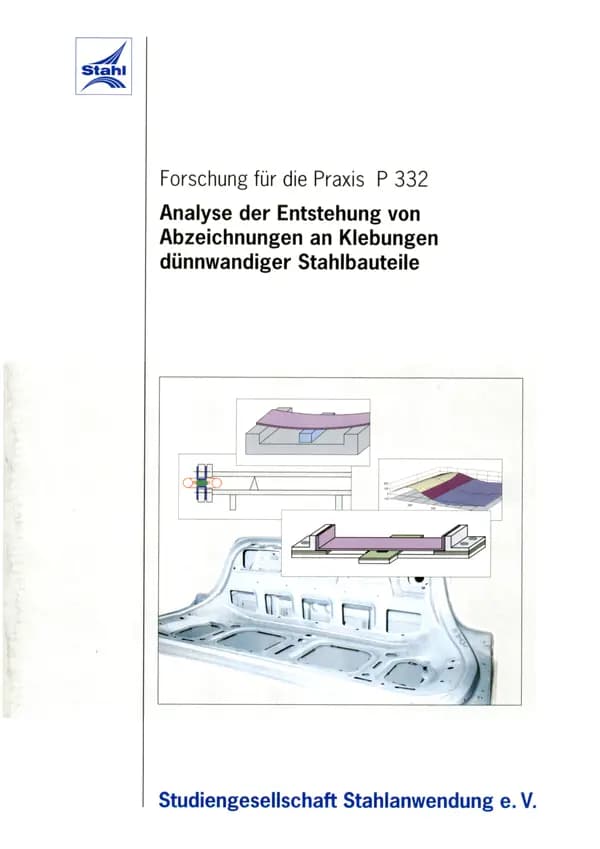
P 332: Analysing the formation of markings on bonded thin-walled steel components Adhesive bonding is a suitable joining technique for the manufacture of lightweight sheet steel components due to the fact that the joining seam can be designed almost arbitrarily and is already used extensively in the series production of cars and other vehicles. However, practice shows that the curing of the preferably used single-component adhesives in paint drying ovens causes residual stresses in the bonded seam, which lead to component deformation, i.e. to visual defects (markings), but also to loss of strength. The occurrence of production-related component deformations is due to the local and temporal temperature field in the joining partners during the curing of the heat-curing adhesives. A distinction must be made between two deformation mechanisms. On the one hand, the thermal expansion or contraction and the reaction-related increase in density of the adhesive lead to deformations in the area of the bonded joint. On the other hand, relative movements of the joining partners during the oven cycle, which can be of the order of several millimetres, can be frozen as the adhesive cures. In order to understand in detail the processes that take place during the heat curing of single-component reactive adhesives and to be able to derive measures to minimise the resulting component deformations, laboratory test methods have been developed with which the various effects can be considered separately from each other as far as possible. Based on the knowledge gained from the laboratory test specimens, a component-like test specimen was initially developed, which approximates the complexity of series components and allows a wide variation in the design of the joining zone. The findings were then verified through tests on series components. The tests on realistic test specimens and series components clearly show that a holistic view of the system consisting of component, adhesive and curing process is essential to avoid markings. The type of component deformation resulting from the tempering process is determined by the combination of various geometry-, adhesive- and process-specific boundary conditions. The main result is a checklist which provides specific solution proposals for characteristic problem cases. The checklist describes the development mechanisms, the damage pattern and the proposed remedial measures. On the one hand, the formation of markings can be counteracted as early as the design phase by designing steel components to be adhesive-free and, on the other hand, markings can be minimised in existing components and processes through appropriate optimisation measures. Mark-free bonding opens up potential applications in lightweight constructions, particularly for high-strength steel sheets of low thickness, where spot joining methods only allow insufficient material utilisation or where the material is only suitable for spot welding to a limited extent. STUDIENGESELLSCHAFT STAHLANWENDUNG e.V. Publication: 2000 Authors: Prof.Dr.-lng. O. Hahn, Dipl.-Ing. G. Meschut, Dipl.-Ing. M. Eis
available anytime
€30.00
excl. VAT
Payment by card (Stripe) or invoice (DE, AT, CH). Download link by email: automatically after ordering by card, after order approval for invoice (valid for 30 days). Terms