Matplus LogoMatplus Shop
/
/
Cart (0)
HomeStoreFOSTAFOSTA Documentation
Topics
Matplus LogoMatplus ShopFollow us on LinkedIn
FOSTA
  • FOSTA Overview
  • FOSTA Documentation
  • Topics
  • Technical Standards
  • Steel-iron worksheets (SEB)
  • Steel and iron usage lists (SEE)
  • Steel-iron delivery terms (SEL)
  • Steel-iron test sheets (SEP)
  • Steel-iron material sheets (SEW)
Legal
  • FAQ
  • Imprint
  • Cookie Policy
  • Privacy Policy
  • Legal Notice
  • Withdrawal policy
  • Withdraw from contract
  • General Terms and Conditions

Payment by card (Stripe) or invoice (DE, AT, CH) · Digital delivery: download link to your PDFs by email, automatically after ordering by card, after order approval for invoice; valid for 30 days.

© 2026 Matplus Shop. All rights reserved.

Header
FOSTA

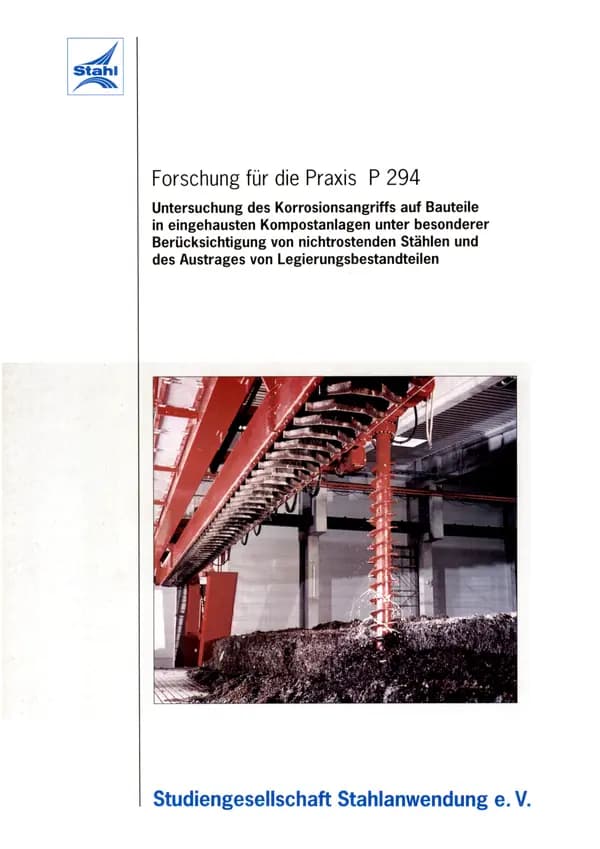
P 294 - Investigation of the corrosion attack on components in enclosed composting plants with special consideration of stainless steels and the discharge of alloy components

In environmental and disposal technology, steel is exposed to high mechanical and corrosive conditions. The aim of this research project was to develop quantitative statements on the corrosion resistance of selected …

Content

Publication
1998
Authors
Dr rer. nat. P. Dierschke, Dipl.-Chem. A. Tulke

In environmental and disposal technology, steel is exposed to high mechanical and corrosive conditions. The aim of this research project was to develop quantitative statements on the corrosion resistance of selected steels and thus to provide information on material suitability according to application areas in enclosed composting plants. With regard to environmental protection, the significance of the alloy components for the composition of the compost was to be analysed in particular. As part of the research project, a corrosion register was compiled on the basis of literature research, surveys of operators and inspections of composting plants.

Show full description

The corrosion resistance of selected steel materials was analysed by means of ageing tests under practical conditions in various types of plant. With the help of a service life-cost analysis - PC programme: "Stainless steel in service life-cost comparison" from the Informationsstelle Edelstahl Rostfrei, Düsseldorf - various material alternatives were tested as models. Corrosion damage has occurred in all enclosed composting plants to date, which could have been avoided if the available expertise had been applied. Based on the information standard DIN 50 929, assessment standards for corrosiveness under the various conditions in composting plants are presented. Based on practical experience, theoretical considerations and observed material behaviour, material recommendations are given for various requirement profiles. Model calculations based on the corrosion rates determined show that the discharge of heavy metals from stainless steels is orders of magnitude lower than the average background load of composts in Germany. In view of the fact that up to now only sporadic and little systematic information has been published on corrosion in composting plants, the research project closes an information gap. The results can be used by designers and plant operators as a decision-making basis for the selection of materials when planning new plants or renovating existing plants. STUDIENGESELLSCHAFT STAHLANWENDUNG e.V.

Machine-translated title and description. The document itself is in German.
P 294 - Investigation of the corrosion attack on components in enclosed composting plants with special consideration of stainless steels and the discharge of alloy components
Zum Zoomen hovern
€20.00excl. VAT

Payment by card (Stripe) or invoice (DE, AT, CH). Download link by email: automatically after ordering by card, after order approval for invoice (valid for 30 days). Terms

P 294 - Investigation of the corrosion attack on components in enclosed composting plants with special consideration of stainless steels and the discharge of alloy components—
€20.00
What's included

✓

Digital download

Similar documents

Other parts and editions as well as neighbouring documents of the same series.

  • Thumbnail
    FOSTA

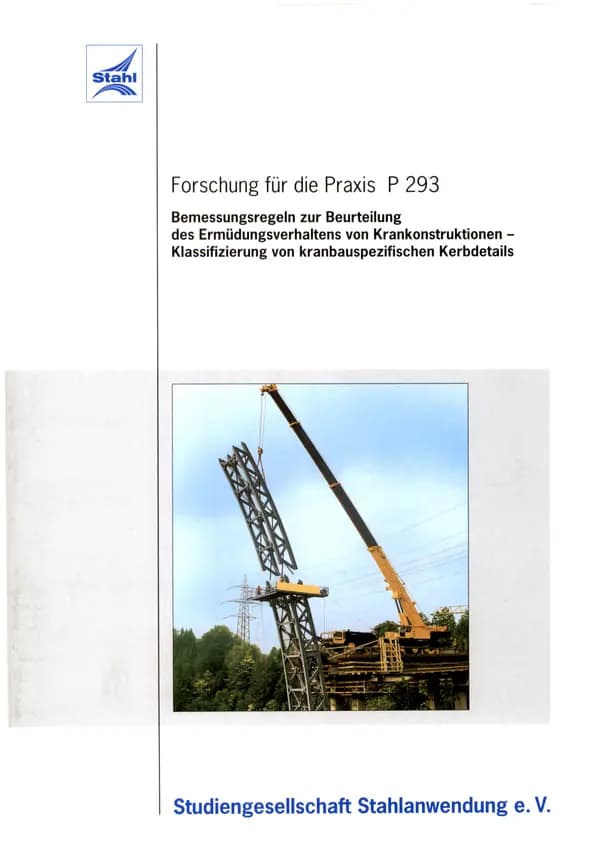
    P 293 - Design rules for the assessment of the fatigue behaviour of crane structures - Classification of crane-specific notch details

    P 293: Design rules for the assessment of the fatigue behaviour of crane structures - Classification of crane-specific notch details The aim of the research project was to identify and close normative gaps with regard to the fatigue analyses of crane structures. Therefore, in close contact with the industry, a selection of those crane-specific design details were investigated which frequently occur in practice but are not yet included in the notch detail catalogues of the various standards. In addition, the influence of the use of high-strength steels on certain notch details was investigated in more detail. On the basis of the investigations carried out, concrete proposals for categorisation in the notch classes according to EC 3 could be made for the notch details angle connections, box sections welded from L-sections and for eye bars with round sections. Rough classifications could also be made for the notch details dovetail plate, attached rectangular plate and for eye bars with rectangular profiles, which still need to be verified by further tests. The use of high-strength steels for the notch detail of stud welds does not change the classification in the existing notch tables, which were developed for normal-strength steels, due to the notch sharpness. For tack welds on high-strength fine-grain structural steels, the few results of the pilot tests are well above the highest notch class according to EC 3. For the detail of lamellae welded onto high-strength fine-grain structural steels, it is also evident that the base material has a clear positive influence on both the fatigue strength and the Wöhler line inclination. There is still a considerable need for research in this area of the general transfer of the rules for fatigue analyses for normal-strength steels to high-strength steels. This project makes a contribution to extending the existing notch case tables in the applicable standards to include some crane-specific notch details. Pilot tests were carried out on further details with positive results, which emphasise the need for further activities in this field. It has also been shown that certain notch details can be rated higher in terms of fatigue strength by using high-strength materials. STUDIENGESELLSCHAFT STAHLANWENDUNG e.V. Publication: 2000 Authors: Prof. Dr F. Mang, Dr S. Herion, Prof. Dr G. Sedlacek, Dipl.-Ing. Ch. Müller, Dipl.-Ing. M. Kästner

    available anytime

    €50.00

    excl. VAT

    View details →
  • Thumbnail
    FOSTA

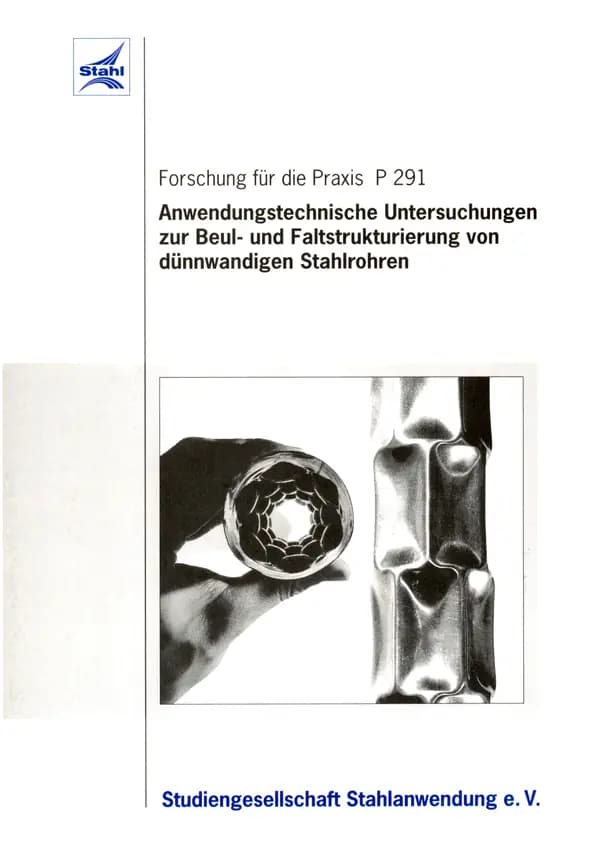
    P 291 - Application-technical investigations into the buckling and folding structuring of thin-walled steel pipes

    P 291: Application-technical investigations into the buckling and folding structuring of thin-walled steel pipes Bulge structuring with the aid of hydraulic active media is a new deformation technique for processing semi-finished pipe products. Tubes receive raised or inwardly directed regular or irregular deformations of their jacket. Structured tubes have better strength and vibration properties than smooth tubes in many areas of application. The bulging structure also influences the external and internal flow and reflects sound and light waves in a special way. The material steel is particularly suitable for the production of the various structural shapes. The selection of grades suitable for the stresses in combination with a buckling structure adapted to the different requirements offers simple and often surprising, innovative solutions for known and new problems. The present research project served to define technical parameters on the way to an industrial, targeted and reproducible buckling structuring of steel pipes. Supplementary work was carried out to analyse the strength of these pipes under fatigue loading with regard to bending (point and line load), compression and torsion. The sound-absorbing effect of the structuring was demonstrated in acoustic tests. The present research work provides numerous indications of the many possible applications of this new type of deformation technology and thus opens up new technical possibilities for the use of steel pipes. A supplementary prospective market analysis examines and describes specific applications for the use of structured steel pipes. Selected examples are used to illustrate the market potential. STUDIENGESELLSCHAFT STAHLANWENDUNG e.V. Publication: 1997 Authors: Prof. Dr.-Ing. U. Hellwig, Dipl.-Ing. T. Görlich, Dipl.-Ing. H. Nikolaus

    available anytime

    €30.00

    excl. VAT

    View details →
  • Thumbnail
    FOSTA

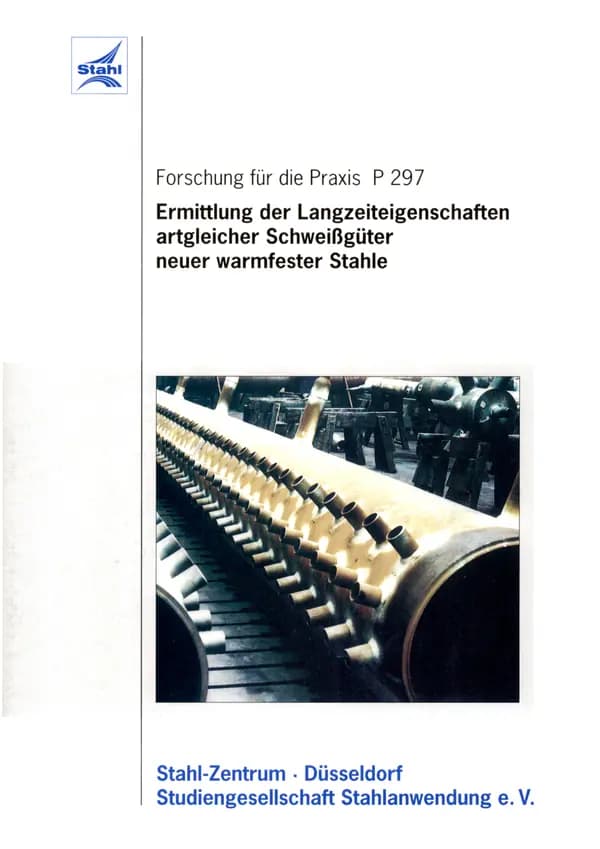
    P 297 - Determination of the long-term properties of similar weld metals of new high-temperature steels

    P 297: Determination of the long-term properties of similar weld metals of new high-temperature steels The operators of fossil-fuelled power stations are endeavouring to increase the efficiency of their plants by increasing the steam pressure and temperature, among other things. To this end, new high-temperature steels have been developed in Europe and Japan in recent years that allow operating temperatures of 600 - 625 °C in the long-term range. The steel developed in Europe bears the designation E 911 (1.4905; X 11 CrMoWVNb with 9 % chromium, 1 % molybdenum and 1 % tungsten). The Japanese steel is known under the designation Nf 616 or under the American designation P 92 (9 % chromium, 2 % tungsten). At the same time as the materials were being developed, welding materials of the same type were developed. The new steels are already being used in the new power plants (Alvedore and Niederaussem). The aim of this research project was to optimise the welding consumables of the same type for the welding processes TIG (tungsten inert gas welding), LBH (manual metal arc welding) and SAW (submerged arc welding). The main aim was to determine the long-term properties in comparison to the two base materials. The starting point for the investigations were the analysis ranges and minimum mechanical values of the two base materials E 911 and P 92. To ensure sufficient toughness properties, the analysis specifications for the filler metals were slightly modified compared to the base materials. Once sufficient toughness of the pure weld metals (at least 41 J at room temperature) had been ensured with the shortest possible heat treatment (WBH) after welding, the creep rupture properties of both the pure weld metals and the welded joints were determined. At the time of reporting, test results were available for creep rupture tests up to 18,000 h for the pure weld metal and 30,000 h for the welded joints. The breaking points of the weld metal E 911 were within the scatter band curves of the two base metals, while the weld metal P 92 was partly below the lower base metal scatter band curve at long load times. In the welded joints, the fracture zones are predominantly located in the softening zone of the heat-affected zone (HAZ). In some cases, fractures were detected in the weld metal of the P 92 joints. At the highest temperatures and longer running times, the fractures were also located in the HAZ. The findings were rounded off with extensive metallographic and electron microscopic analyses. The investigations provided a high degree of certainty for estimating the service life of welded components made of high-temperature steels in power plants. Power plant operators will also benefit from this, as will plant manufacturers and their suppliers and the acceptance organisations. STUDIENGESELLSCHAFT STAHLANWENDUNG e.V. Publication: 2000 Authors: Dr H. Heuser, Dr W. Bendick, Dr B. Melzer, Dr M. Zschau, Prof. Dr H. Cerjak, Dipl.-Ing. E. Letofsky. Melzer, Dr.-Ing. M. Zschau, Prof. Dr.-Ing. H. Cerjak, Dipl.-Ing. E. Letofsky

    available anytime

    €30.00

    excl. VAT

    View details →
  • Thumbnail
    FOSTA

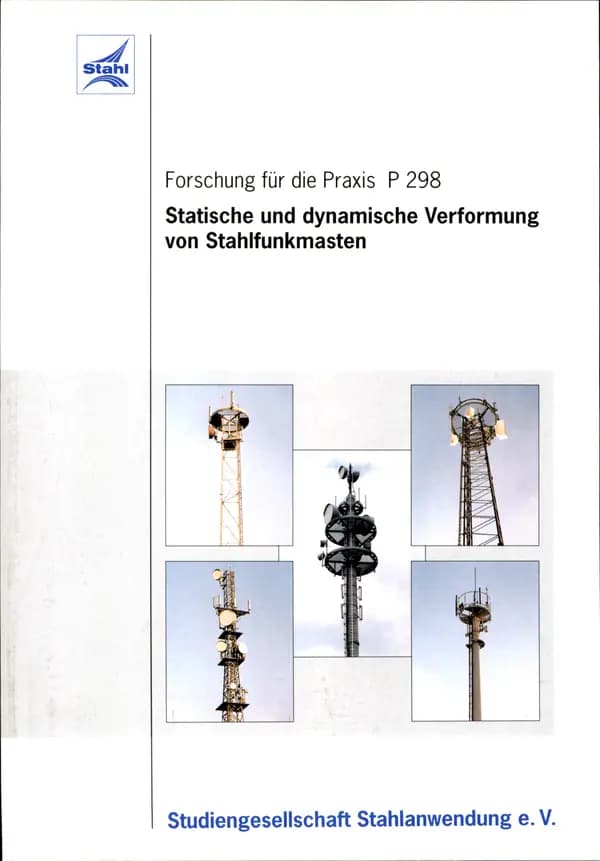
    P 298 - Static and dynamic deformations of steel radio masts

    P 298: Static and dynamic deformations of steel radio masts The subject of the research project was radio masts in steel and reinforced concrete construction, as they are currently used for the nationwide expansion of mobile phone networks. The static and dynamic deformation behaviour under the influence of wind was to be investigated up to the serviceability limit state. For long-term observations and measurements, five original masts were selected as examples from the variety of competing construction methods - in a steel, a spun concrete solid wall construction and in three different steel lattice designs. At the same time, model tests were carried out in the boundary layer wind tunnel. By analysing the measurement results with regard to the maximum twist angle at the top of the mast and the duration for which the permissible change in the deflection angle was exceeded, reliable frequency curves were to be obtained. They should also include strong wind events or allow conclusions to be drawn about their effect by extrapolation. Both original measurements and modelling tests showed that the stresses and deformations calculated on the basis of existing design concepts could not be achieved under any circumstances. On the basis of these investigations, a new concept was proposed which is orientated towards the design philosophy of the Eurocodes. For the design of radio masts in the serviceability limit state under the influence of wind, the previously valid arbitrary deterministic criterion of half the dynamic pressure without gust reaction is no longer used. Instead, the assessment is carried out on the basis of the frequency with which the operator authorises exceeding the radiation limit angle as a result of the probability of extreme wind situations. According to the newly gained knowledge, there is still potential for optimisation in the design of new structures for all construction methods in steel and reinforced concrete. It is also expected that design reserves can be demonstrated on existing radio masts, which the mast operators can utilise for retrofitting with additional antennas. Due to the planned development of areas with little infrastructure, capacity expansions and the addition of new network providers, a high demand for radio mast construction projects can be expected in the medium term. In the long term, the Europe-wide expansion of mobile communications networks will be at the centre of construction activity. Due to the large quantities of steel required, regardless of the chosen construction method, there is a large market for German steel construction. STUDIENGESELLSCHAFT STAHUNWENDUNG e.V. Publication: 1999 Authors: Dipl.-Ing. Ch. Kammel, Prof. Dr.-lng. G. Sedlacek, Dipl.-Ing. W. Langer

    available anytime

    €40.00

    excl. VAT

    View details →
€20.00excl. VAT

Payment by card (Stripe) or invoice (DE, AT, CH). Download link by email: automatically after ordering by card, after order approval for invoice (valid for 30 days). Terms

P 294 - Investigation of the corrosion attack on components in enclosed composting plants with special consideration of stainless steels and the discharge of alloy components—
€20.00