High-strength steels have attracted increasing attention from the sheet metal processing industry over the past 25 years. The automotive industry in particular is interested in the use of higher-strength steels in view …
High-strength steels have attracted increasing attention from the sheet metal processing industry over the past 25 years. The automotive industry in particular is interested in the use of higher-strength steels in view of its endeavours to reduce weight. At present, micro-alloyed, phosphorus-alloyed and bake-hardening steels as well as multiphase steels with different strength and forming properties are available. Only by using optimised joining techniques is it possible to utilise the improved strength of the materials in joined structures in the form of increased strength or reduced sheet thickness. Resistance spot welded joints of higher-strength sheet steel only utilise the advantage of higher joint strength under quasi-static loading.
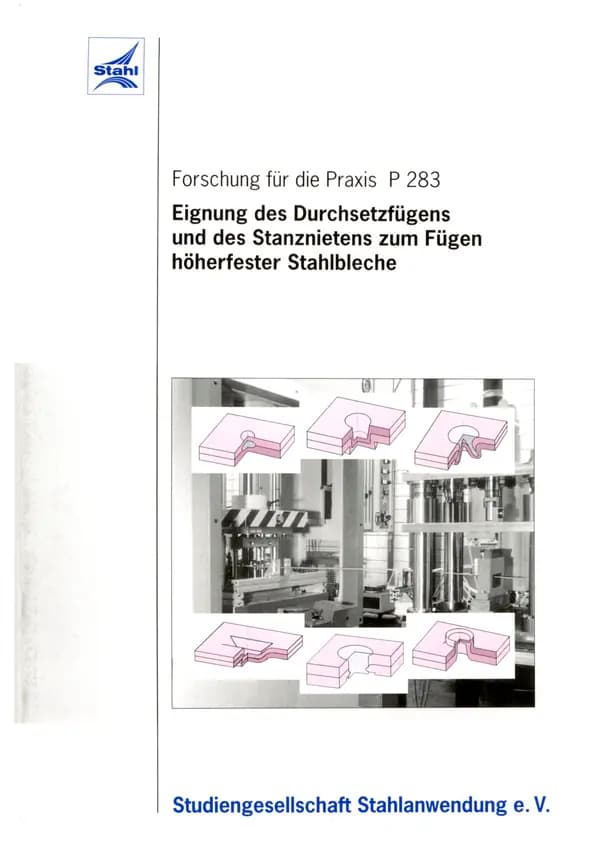
Under oscillating loads, especially in the direction of head tension, the increased strength of higher-strength steels compared to soft, unalloyed deep-drawing sheets cannot be converted into increased strength of the spot-welded joints to the desired extent. The mechanical joining processes clinching and punch riveting with their different process variants represent interesting alternatives to resistance spot welding. The suitability of various single-stage non-cutting, single-stage cutting and multi-stage clinching processes as well as self-pierce riveting with semi-tubular and solid rivets for joining high-strength sheet steel was investigated in this research project. High-strength sheet steel materials in the thickness range from 0.6 mm to 2.5 mm were selected as test materials. These included micro-alloyed, phosphorus-alloyed and bake-hardening steels as well as dual-phase steels with yield strengths of 195 MPa to 544 MPa. Overall, the investigated processes are well suited to joining the higher-strength steel sheets. Limitations were observed in some cases due to limited joining forces and the selected tool dimensions. However, by selecting suitable parameters, all materials investigated can be joined appropriately. Under quasi-static loading, the strength of the mechanically joined joints of high-strength steel sheets was almost linearly related to the yield strength of the joining materials. Depending on the joining method and sheet thickness, there were different increases in joint strength with increased joint strength. Fatigue tests were carried out in stages on spot-welded and mechanically joined, component-like H specimens made from the materials ZStE 180 BH, ZStE 420 and DP 500. The self-pierce riveted joints of high-strength steels exhibited higher joint strengths under fatigue loading than comparable spot-welded joints. The Wöhler curves of the clinched joints were very flat and intersected with the Wöhler curves of the spot-welded joints, i.e. at low load amplitudes the clinched joints had a longer service life than the spot-welded joints. In contrast to the spot-welded joints, the potential of higher-strength steels can also be converted into increased joint strengths under fatigue loading with self-pierce rivet and clinch joints. Tests under impact loads were used to gain knowledge about the suitability of mechanically joined components in crash-prone areas. With increasing joint strength, a reduced deformation of the test specimens was observed. The deformation was independent of the joining method used. Tool life tests were carried out on clinching tools from three suppliers on soft deep-drawing sheets and micro-alloyed high-strength steel sheets. The tool life of the tools was greater than 200,000 joining points. Significant differences between tool wear on soft and high-strength grades could not be detected despite the increased joining forces when clinching the high-strength steels. The joint strengths remained largely constant over the service life of the tools. Clinching and self-pierce riveting are alternatives to spot welding of high-strength steel sheets, which contribute to adequately utilising the strength potential of these materials, particularly in the form of improved fatigue strength of joined assemblies. STUDIENGESELLSCHAFT STAHLANWENDUNG e .V.
Payment by card (Stripe) or invoice (DE, AT, CH). Download link by email: automatically after ordering by card, after order approval for invoice (valid for 30 days). Terms
Machine-translated title and description. The document itself is in German.
Digital download
Other parts and editions as well as neighbouring documents of the same series.

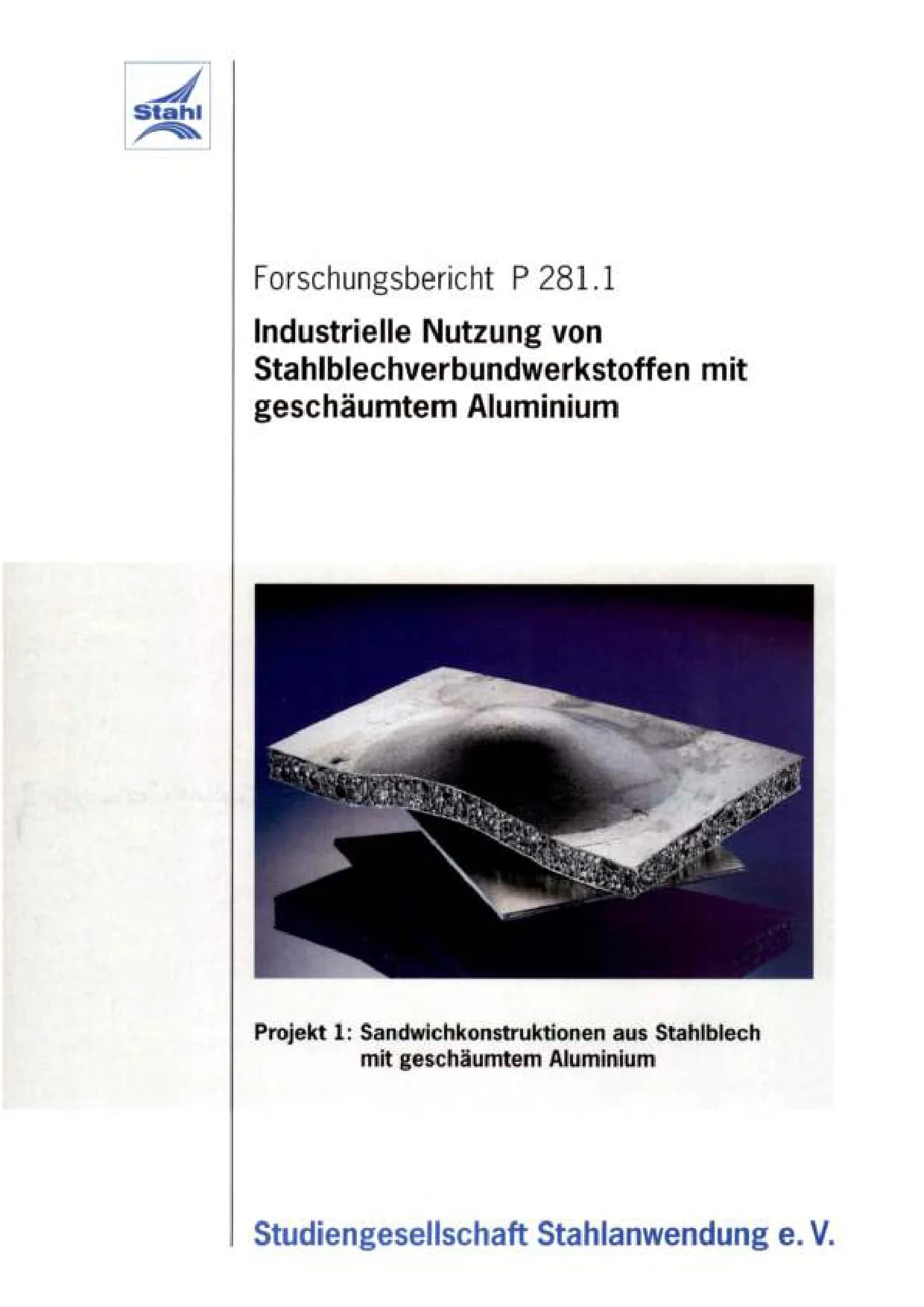
P 281.1: Industrial use of sheet steel composites with foamed aluminium Project 1: Sandwich constructions made of sheet steel with foamed aluminium The aim of this project is the development, production and characterisation of a new sandwich composite material based on sheet steel and foamed aluminium. aluminium foam-steel cover sheet. Such a sandwich composite represents an innovative construction method for lightweight construction based on a combination of purely metallic components. It combines the low density and functional properties of the foam core layer, such as energy absorption capacity and reduced thermal conductivity, with the good strength properties, surface quality and excellent elastic properties of steel. The rigid sandwich composite is primarily suitable for lightweight construction applications where a combination of functionally and structurally relevant properties is required, as the greatest benefit can be realised synergistically from the advantages of the individual components. In principle, a sandwich structure consisting of an aluminium foam core layer and steel cover sheets can be produced using various processes. The focus of this project is the roll cladding of a foamable aluminium semi-finished product produced by powder metallurgy with steel cover sheets to form a composite sheet, which can then be foamed to form a lightweight sandwich. As part of the project, activities were undertaken with regard to the development and optimisation of the cladding process and the foaming process in sandwich production. Investigations into alternative manufacturing processes and tests to characterise the pore structure in the aluminium foam and the boundary layer between the aluminium core and the steel cover sheets complement the process parameter studies. The properties of the new material aluminium foam sandwich with steel cover sheets can be characterised using standardised and newly developed methods. Basic characteristic values for the foam core layer are obtained from the compression test and the shear test. The bending test characterises the sandwich composite under a realistic load, while the peel test provides information on the adhesion of the components. Technological tests such as buckling tests and corrosion tests provide information on further application properties. Initial positive results regarding the formability of the unfoamed composite sheet and the weldability of the sandwich are also available, as are findings on the functional properties of the aluminium foam core layer. With regard to a possible application, considerations have been made for the calculation and design of sandwich components that take into account the special properties of the material. STUDIENGESELLSCHAFT STAHLANWENDUNG e.V. Publication: 1997 Authors: Dipl.-Phys. J. Baumeister, Prof. Dr W. Bleck, Dipl.-Ing. H. von Hagen, Dipl.-Ing. D. Nicklas, Dipl.-Ing. M. Paschen, Prof. Dr G. Sedlacek, Dr M. Weber
available anytime
€30.00
excl. VAT

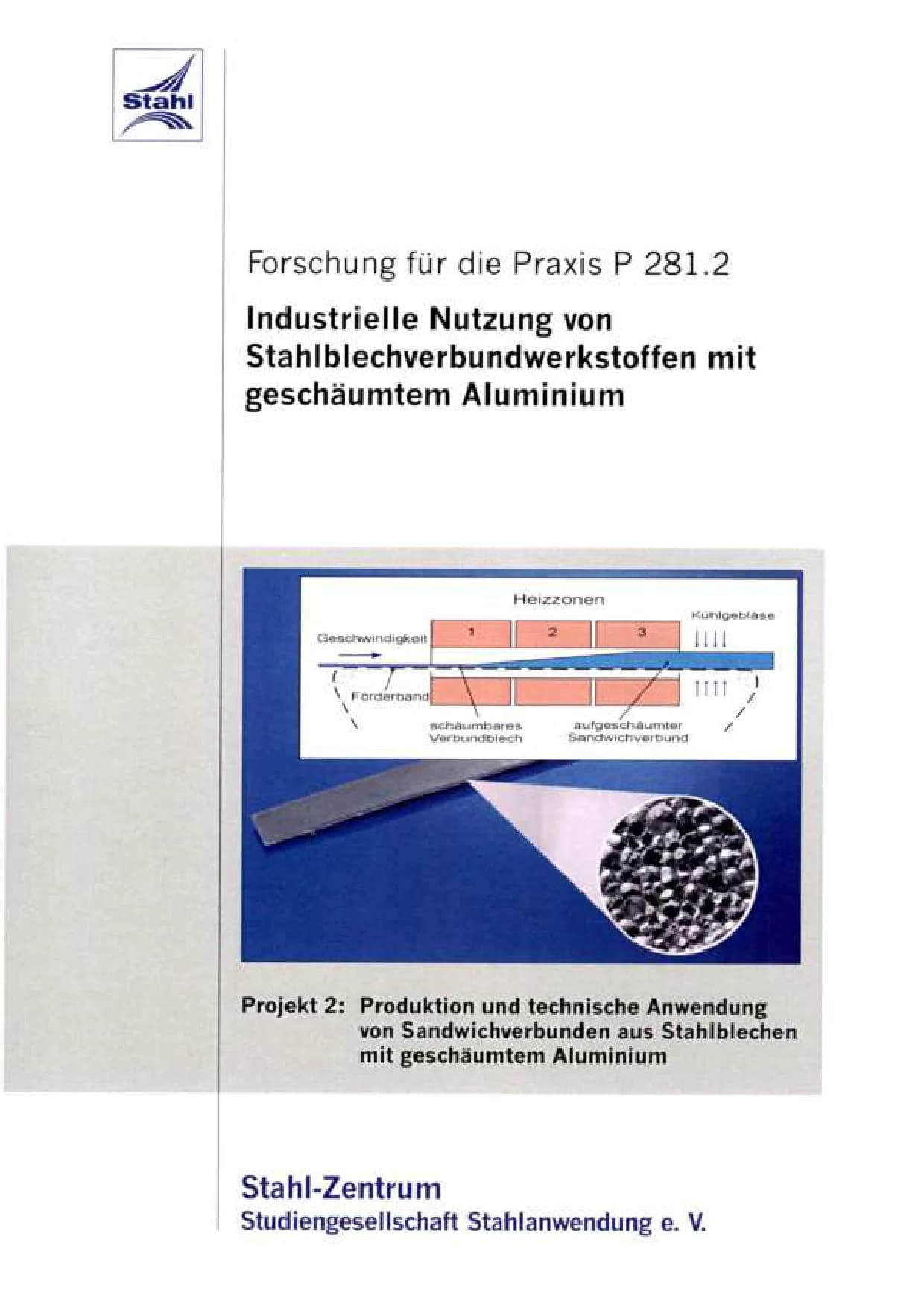
P 281.2: Industrial use of steel sheet composites with foamed aluminium Project 2: Production and technical application of sandwich composites made of steel sheets with foamed aluminium As part of a two-part project on the industrial use of sheet steel composites with foamed aluminium, project 281.1 investigated the manufacturability of such sandwich constructions on a laboratory scale ( Research report P 281.1 of the Studiengesellschaft Stahlanwendung e.V. ). It has been shown that the new type of sandwich composite offers interesting properties for a wide range of possible innovative applications. It combines the significant properties of steel in the form of cover sheets with a core layer of very low density and additional, functionally useful properties. The aim of the second part of the project with this final report ( P281.2 ) was to transfer the flamer production developed on a laboratory scale to an industrial level in order to be able to manufacture sandwich panels with large dimensions and thus a broader application base. In pursuit of this task, the dimensions of the producible foamable semi-finished product were increased to 450 mm x 4000 mm x 3 mm by using a modified extrusion mould. Larger dimensions were achieved using various joining processes such as laser beam, friction stir and TIG welding, also in order to be able to integrate the foamable semi-finished product into a coil of conventional aluminium strip for a roll cladding process with stable process parameters. DC01 (1.0330) and, for the first time, X5CrNil 8- 10 (1.4301) steels were used as cover sheet materials for roll cladding. Foaming was carried out continuously in a newly developed continuous belt furnace so that sheets with dimensions of 400 mm x 1600 mm could be produced. The sandwich composites were successfully joined using laser beam welding, and forming limit diagrams were created by means of cupping tests, on the basis of which forming simulations could be carried out for various components. A broad database on the fatigue strength of various aluminium foams and aluminium foam composites was generated through corresponding tests. The favourable energy absorption behaviour was also demonstrated in dynamic compression tests for high strain rates. With regard to the application, designs, calculations and investigations were carried out for the use of steel-aluminium foam sandwich composites in a mobile makeshift bridge, in an unsinkable lifeboat, as a protective device and as a high car longitudinal beam. The unsinkable lifeboat was designed and built on a scale of 1:5. In additional tests, angled profiles and U-profiles were produced. Investigations into the foaming of pipes, e.g. for side impact protection in cars, and the design and manufacture of a foamed roller for rotary printing machines open up further potential applications. As a summarised result of the investigations, a product data sheet has been produced which provides potential users of steel sandwich composites with information about the product, its manufacture, its properties and its processing. The main result of project P 281.2 is that the process technology for manufacturing the sandwich composites has been significantly improved in all process steps and larger dimensions have also been achieved. In addition, important material characteristics were determined. The relatively low strength of aluminium foam makes its use in sandwich composites particularly useful when the requirements of the application under consideration and the specific profile of the functional and structural properties of the aluminium foam coincide. Reproducibility and homogeneity must be further improved, especially in the powder metallurgical production of aluminium foam. STUDIENGESELLSCHAFT STAHLANWENDUNG e.V. Publication: 2003 Authors: Dr rer. nat. J. Baumeister, Prof. Dr W. Bleck, Dipl.-Ing. T. Böllinghaus, Dipl.-Ing. M. Paschen, Prof. Dr G. Sedlacek
available anytime
€30.00
excl. VAT

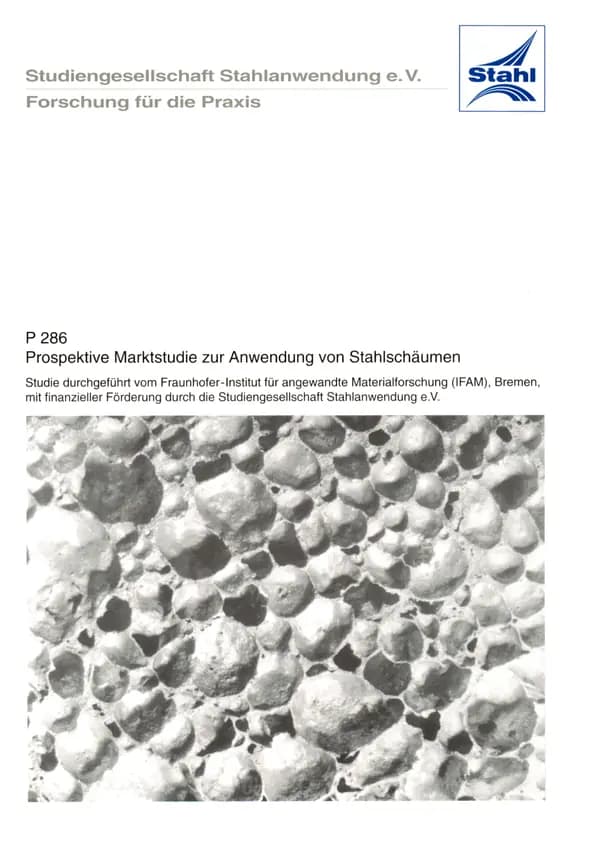
P 286: Prospective market study on the application of steel foams New materials have repeatedly celebrated spectacular successes in recent years. The novel combinations of properties of the new material "metal foam" also open up new application possibilities for metals. In the past, processes for the production of metal foams were described in patent literature and in a few specialised publications, although these were mostly non-ferrous metal foams. In recent years, considerable progress has been made in the field of aluminium foams with two fundamentally new processes. In particular, the powder metallurgical process developed at IFAM has already been transferred to various other metals (Zn, Pb, Sn, etc.). Initial, orientating tests have shown that a large number of pores can also be isolated and frozen in molten steel powder compacts. From this it can be assumed that iron-based materials can also be foamed. In order to be able to focus further development work on potential products with high market interest, it made sense to start with a kind of "forward-looking market study". The aim was to identify resilient steel foam products with interesting market potential in advance of the development work. STUDIENGESELLSCHAFT STAHLANWENDUNG e.V. Publication: 1995 Authors: Dipl.-Ing. M. Weber
available anytime
€20.00
excl. VAT

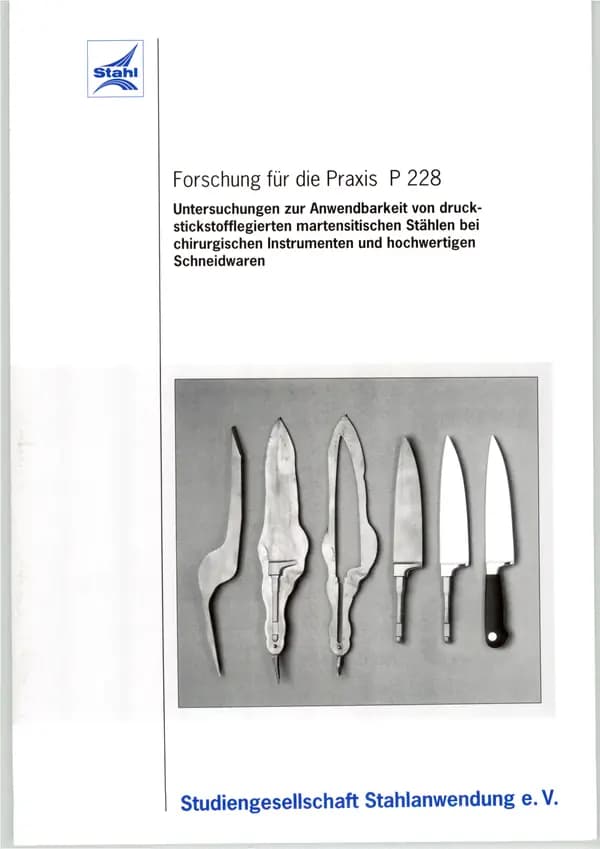
P 228: Investigations into the applicability of pressurised nitrogen-alloyed martensitic steels for surgical instruments and high-quality cutlery Corrosion of conventional metallic household cutlery made of martensitic steels is partly caused by the constantly increasing contamination of water with chlorine ions. Another cause of rapid corrosion is the use of aggressive cleaning agents, disinfectants and sterilising agents. If, for example, surgical instruments are exposed to solutions containing extremely reactive hypochlorides, such as those found in disinfectants, for a long period of time, significant signs of corrosion can be observed. The use of an extremely corrosion-resistant steel, both for high-quality consumer goods in the cutting and cutlery industry and for cutlery for medical, especially surgical use, is therefore obvious. Pressurised nitrogen-alloyed steels are a group of materials which, in addition to the required high corrosion resistance, can also exhibit excellent wear resistance, which, for example, essentially determines the cutting ability and edge retention of cutting edges. Two variants of pressurised nitrogen-alloyed steels were investigated as part of this research project. These are the grades X15CrNiMoN15-2-1 and X30CrMoN15-1, each with 0.30 to 0.50 %N. The tests on the two steel grades show that these pressurised nitrogen-alloyed steels, used for the production of high-quality cutting tools, have a significant potential for increasing wear resistance in the cutting performance test and corrosion resistance in the alternating immersion test. Both the hardness of the X15CrNiMoN15-2-1 steel and the cutting performance results are well above the required minimum values. The steel showed no signs of corrosion in the alternating immersion test. The difference to samples made of steel without a higher nitrogen content is considerable, so that the steel grade with nitrogen is also suitable for aggressive environmental conditions or for the manufacture of surgical instruments. The steel grade X30CrMoN15-1 with a higher carbon content even surpasses these results. Both the hardness values and the cutting performance results are higher or better than those of the other steel. The corrosion tests show the same outstanding resistance to the NaCI solution in the alternating immersion test. If pressurised nitrogen-alloyed steel grades become established on the market for high-quality cutlery and surgical instruments due to the advantages shown, the industry will achieve a leap in quality in the manufacture of highly stressed products. STUDIENGESELLSCHAFT STAHLANWENDUNG e.V. Publication: 1999 Authors: Dr.-Ing. A. R. Rosenthal
available anytime
€30.00
excl. VAT
Payment by card (Stripe) or invoice (DE, AT, CH). Download link by email: automatically after ordering by card, after order approval for invoice (valid for 30 days). Terms