For the selection of materials for use under wear conditions, there is currently neither a practical selection procedure nor corresponding material parameters. The aim of the investigations was therefore to solve this …
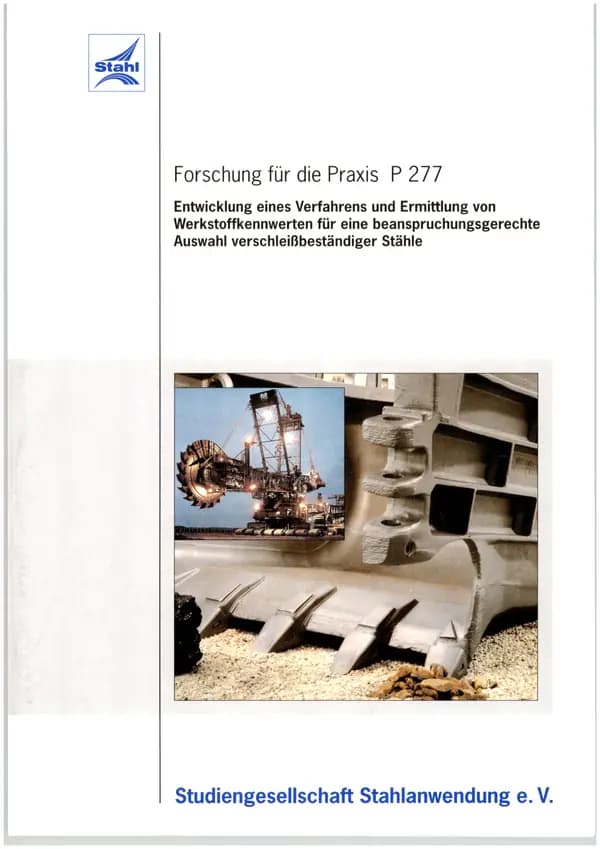
For the selection of materials for use under wear conditions, there is currently neither a practical selection procedure nor corresponding material parameters. The aim of the investigations was therefore to solve this problem by developing specific information on material behaviour and providing it via a computer-aided interactive selection system. In close co-operation with steel manufacturers and representatives of some industrial companies confronted with special wear problems, a generally applicable selection procedure for steel materials was developed on the basis of a tribological system analysis in accordance with DIN 50320. The focus was on abrasive sliding wear (bonded and unbonded grain), hydroabrasive wear, sliding, impact and angular jet wear as well as cavitation erosion.
Comparative investigations of different steels on special wear testing machines were used to obtain characteristic values regarding the material properties. The tests were carried out under different tribological stresses, in some cases also under corrosive conditions. Parallel to this work, a PC-supported programme system for material selection was developed to archive and provide the characteristic values for rapid access from practice. The research project was the first systematic investigation of steel materials commonly available on the market and suitable for use under wear conditions. The characteristic values determined during this work formed the basis for the creation of an expandable database. Within the framework of interactive utilisation, it is expected that the existing database will be expanded by providing characteristic values on materials and stresses from the circle of those involved in the work and from other companies. In this way, the database and selection system will become a valuable tool for optimisation and preventive maintenance in practice. The results of the research work can make a significant contribution to reducing maintenance-related production downtime. This results in a significant reduction in costs and a sustainable increase in the competitiveness of companies. The research results are available to interested companies without restriction on the basis of data exchange. STUDIENGESELLSCHAFT STAHLANWENDUNG e.V.
Payment by card (Stripe) or invoice (DE, AT, CH). Download link by email: automatically after ordering by card, after order approval for invoice (valid for 30 days). Terms
Machine-translated title and description. The document itself is in German.
Digital download
Other parts and editions as well as neighbouring documents of the same series.

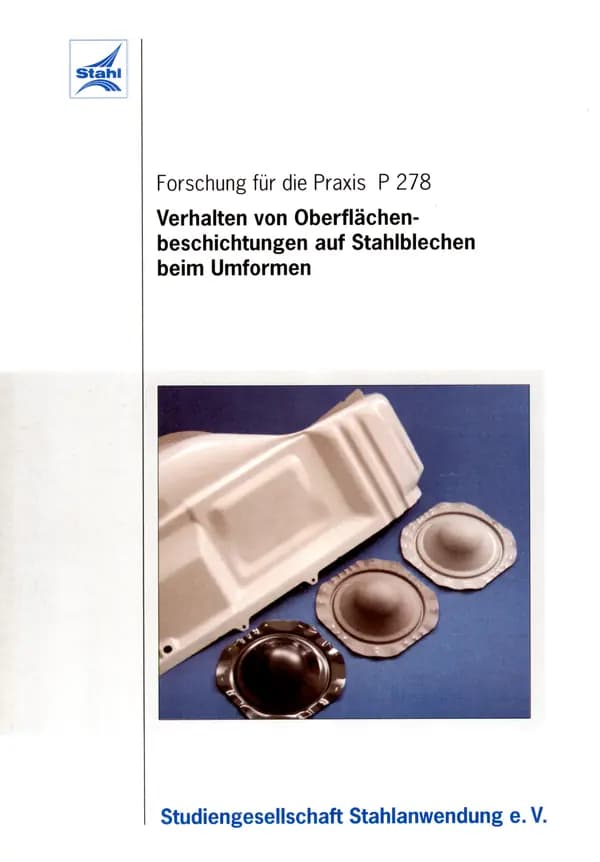
P 278: Behaviour of surface coatings on steel sheets during forming Increasingly, steel materials are already being provided by manufacturers with a surface that meets subsequent practical requirements and delivered to processors. The importance of organic coatings is growing, e.g. to improve the forming properties, increase corrosion resistance and save production steps including painting. The aim of this research project was to develop reliable knowledge of forming behaviour and to create objective assessment criteria for evaluating the quality of formed organic-coated materials. As part of the present work, numerous base materials with their organic coating variants were analysed with regard to their mechanical characteristics, the thickness of the individual layers and their external appearance. At the same time, the behaviour under various types of stress, including tension (bending on the outside) and compression (bending on the inside), buckling, stretching, folding and deep drawing were investigated under laboratory conditions. In addition, the behaviour of the material and coating systems was tested with various workpiece geometries under practical conditions at an automotive manufacturer. As a result of these investigations, statistically verified qualitative and quantitative statements are available on various materials with the organic coating variants Pladur, polyurethane, Bonazinc and Zincroplex. User guidelines were developed for the industrial use of the material variants analysed. The research results provide steel manufacturers with important information for further development work with regard to the production of organically coated thin sheets. Steel users, in particular the automotive industry and its suppliers as well as equipment and plant manufacturers, are thus provided with important criteria for processing and favourable use for body and housing parts. STUDIENGESELLSCHAFT STAHLANWENDUNG e.V . Publication: 1998 Authors: Dipl.-Ing. H. Bräunlich, Dipl.-Ing. M. Demmler
available anytime
€30.00
excl. VAT

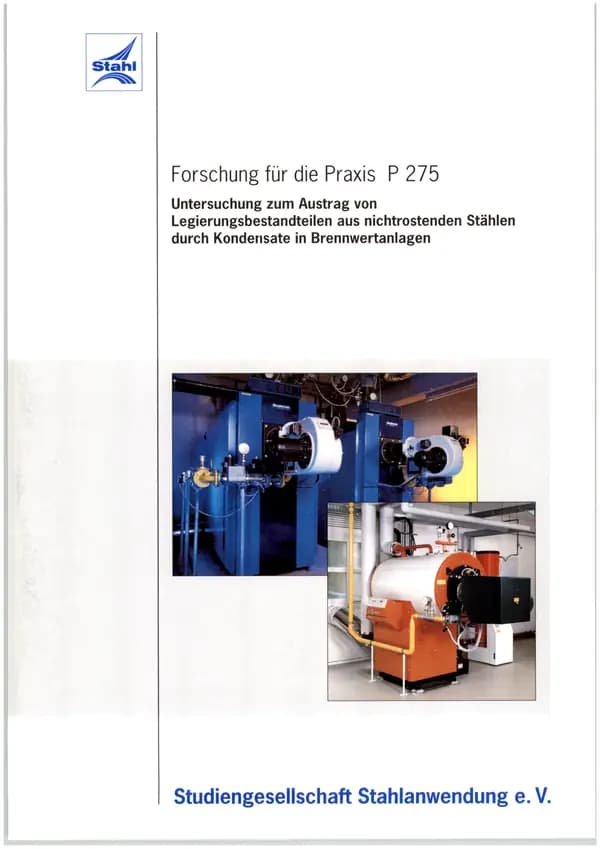
P 275: Investigations on the discharge of alloying constituents from stainless steels by condensates in condensing plants Condensing boiler technology enables optimum utilisation of the energy source in heating systems and thus makes a very positive contribution to environmental protection. The principle of operation includes the formation of condensate and its discharge into the waste water. From an ecological point of view, the question arises as to whether the release of alloying elements from the stainless steels used for boilers and exhaust gas-carrying components can have an environmentally relevant impact on the waste water. This research project addresses this question. The aim of the investigations was also to develop factual arguments for a new assessment of the currently valid DIN 4133 standard, which generally requires a corrosion allowance for the wall thickness of stainless steel pipes exposed to waste gas. Systematic and practical investigations were carried out over a full heating period on firing systems in the output range from 22 to 1000 Kw. - on the respective operating condition, - the chloride and sulphur loads of the energy sources and their influence on the steel surface as well as - the nickel and chromium content of the waste water The possibility of correlating short-term laboratory and long-term practical tests was examined in a specially constructed test facility. The present investigations have shown that the permissible guideline value for the nickel concentration of 1 mg/l in the condensation water samples obtained from operating plants under calorific value conditions was always undercut. The test conditions in the laboratory plant could be set in a practical and reproducible manner. The test results obtained on steel materials under condensing corrosion conditions in condensing boiler operation corresponded to those obtained in practice. Even under more stringent laboratory conditions, it was shown that the standard steel used, material no. 1.4571, is not subject to any significant metal erosion and is therefore permanently resistant and excellently suited for condensing boilers and pipes exposed to flue gas, i.e. also for steel chimneys. According to these test results, the corrosion surcharge on the wall thickness currently required by DIN 4133 is no longer justified. STUDIENGESELLSCHAFT STAHLANWENDUNG e.V. Publication: 1999 Authors: Dr rer.nat. N. Arlt, Dr.-lng. W. Heimann, Dr. rer.nat. P. Dierschke, Dr G. Steinbeck
available anytime
€30.00
excl. VAT

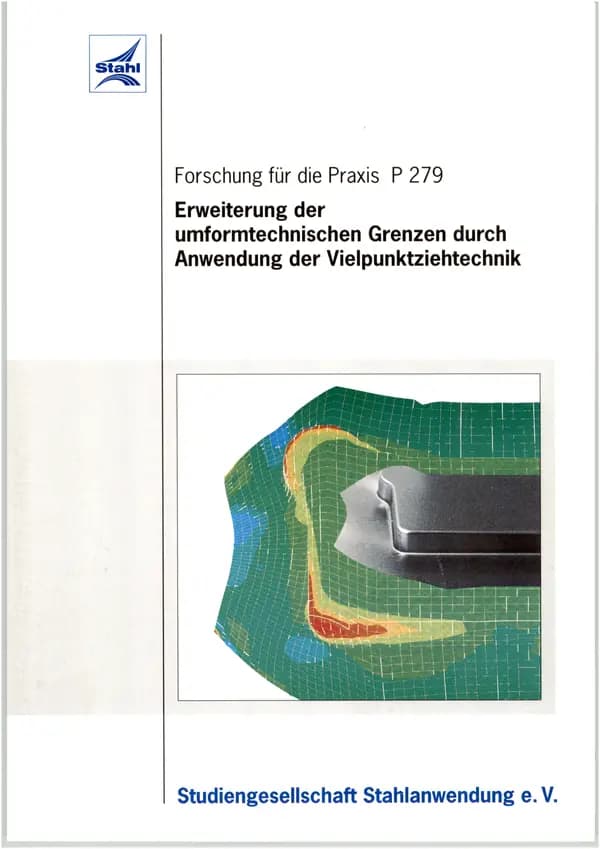
P 279: Extending the limits of forming technology by applying the multi-point drawing technique For complicated deep-drawn parts, the reliable control and reproducibility of the forming process is primarily determined by the possibilities offered by the forming system and, in particular, the blank holder system. Many drawing processes also require locally varying surface pressures along the drawing path. This is achieved with the aid of a special multi-point drawing device using independently acting pins for the controlled, direct application of force to the blank holder. Although this technology is now offered by many press manufacturers, its use in practice is very hesitant due to the higher costs and the still existing uncertainty about the achievable effects. The present pilot project was initially intended to demonstrate the qualitative effects of using the multi-point drawing technique and to prepare further quantitative investigations. This is the first time that the combination of the multi-point drawing technique and a flexible hold-down device has been tested in practice. Initially, only selected materials and model workpieces were considered as part of an orientated test programme. With the help of a finite element calculation and analysis as well as practical drawing tests on a multi-point drawing machine, the drawing depths achievable with locally different force applications in the blank holder were determined. As a result, there is a tendency towards an increase in the possible drawing depth. The reason for this is a better distribution of the surface pressure and a reduction in the number of partial pressure maxima occurring between the blank holder, workpiece flange and die. The greatest increases in drawing depth compared to conventional die cushion technology can be achieved in the integrated tool with an elastic blank holder and optimised pinch force distribution according to the workpiece geometry. The use of the flexible hold-down device and variable quill force design can also reduce the amount of work involved in setting up the mould. The focus of further activities will be the predetermination of the number, arrangement and force regime of the individual quills of multi-point drawing devices for the production of any sheet metal moulded parts. The research results will be used to show steel processors, in particular the automotive industry and its suppliers, how finite element simulation can be used to predict the material flow and shift the previous technical forming limits. STUDIENGESELLSCHAFT STAHLANWENDUNG e.V. Publication: 1996 Authors: Dipl.-Ing. H. Bräunlich, Dipl.-Ing. L. Klose, Prof. Dr.-Ing. habil. R. Neugebauer
available anytime
€20.00
excl. VAT

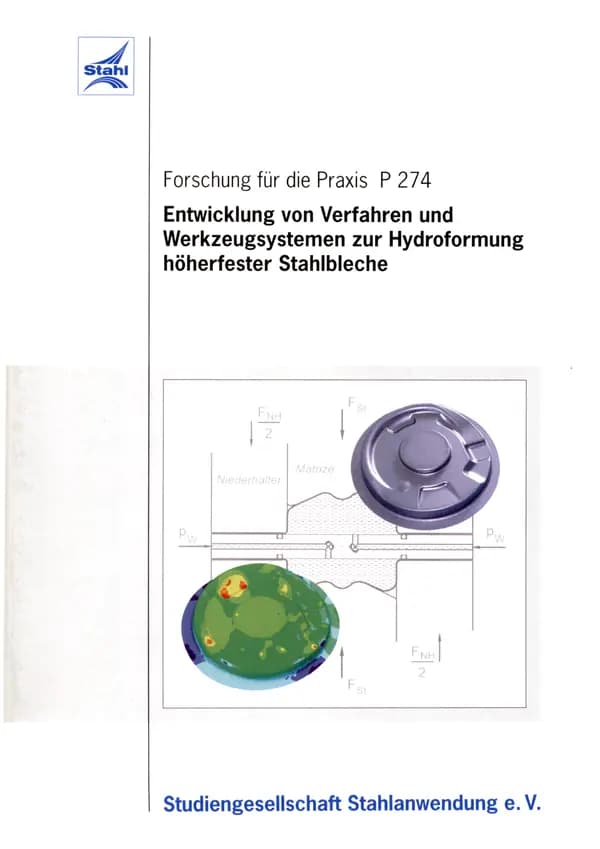
P 274: Development of processes and tool systems for hydroforming of high-strength steel sheets The aim of the research project was the further development of high-pressure sheet forming (HPF), as a new type of media-based sheet forming process, into a forming process that can be used in industrial practice specifically for the forming of high-strength steel materials. Experimental investigations and FEM simulation calculations were carried out, focussing on tool design and technology development. Based on the basic investigations initially carried out, technology components for the production of complex workpieces from high-strength steels were successfully developed in the course of the project. Of particular note here are customised sealing systems, a special multi-point hold-down system, a process control system or process control strategies and additional process functions such as process-integrated punching. The performance of the HBU in conjunction with the developed technology components was tested, among other things, on the basis of the production of a complex practical component, a so-called brake cover plate. Here it was possible to prove that a lower number of press stages is required for high-pressure sheet metal forming than for conventional deep drawing. Additional technological advantages were demonstrated on other workpiece geometries, including improved dent resistance and increased shape and dimensional accuracy. The primary area of application for high-pressure sheet metal forming is expected to be the production of moulded sheet metal parts in the structural and outer skin area of car bodies. In addition to such applications in automotive engineering, other potential areas of use are seen, for example, in rail and aircraft construction, apparatus engineering, sanitary engineering and the household appliance industry. STUDIENGESELLSCHAFT STAHLANWENDUNG e.V. Publication: 1999 Authors: Prof. Dr.-lng. em. E. von Finckenstein, Dipl.-Ing. A. Gartzke, Dipl.-Ing. W. Homberg, Prof. Dr.-lng. M. Kleiner, Dipl.-Ing. R. Kollek, Dr.-lng. E. Szücs, Dipl.-Ing. T. Weidner
available anytime
€40.00
excl. VAT
Payment by card (Stripe) or invoice (DE, AT, CH). Download link by email: automatically after ordering by card, after order approval for invoice (valid for 30 days). Terms