Consistent lightweight steel construction can be realised through the use of high-strength materials and the construction method. In the present research project, the twin sheet was investigated as a semi-finished …
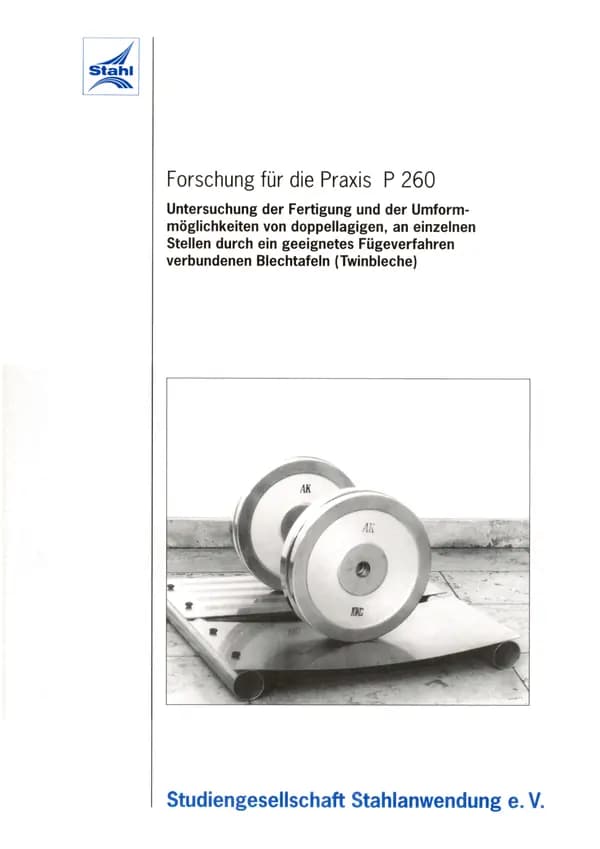
Consistent lightweight steel construction can be realised through the use of high-strength materials and the construction method. In the present research project, the twin sheet was investigated as a semi-finished product for a new construction method. The aim of this technology is to reduce the weight of the component while maintaining the same stiffness, or to increase the stiffness while maintaining the same weight. The structure of the twin sheet consists of two layers of sheet metal, which are initially joined at points in the plane of the sheet. The sheet metal composite produced in this way can be formed and is stiffened after forming in a final shot peening treatment.
In this processing step, the area near the surface of the blasted sheet metal layer is plasticised and the entire sheet metal layer is curved up towards the blasting medium. This extremely flexible shaping process creates a hollow structure with greater rigidity from two layers of sheet metal without the use of expensive shaping moulds. As part of the research project, the blasting parameters and the blasting strategy for creating such hollow structures were determined. Different geometries of the joining points and joining lines were investigated with a view to optimising the rigidity and possible forms of stress. Further investigations focussed on the formability of the sheet metal composite. A large number of variation parameters were taken into account to optimise the stiffness and strength. With the help of the finite element method, the great potential of the new construction method was demonstrated using examples and proven in practical tests. The twin-sheet design is characterised by the fact that the semi-finished product designed for this purpose can be formed by bending or deep-drawing and achieves up to 100 % increase in rigidity by means of the subsequent flexible shot peening process. The twin sheet also enables a wide range of variations for adjusting the properties of components. In addition to the material itself, for example in combination of stainless steel with an unalloyed steel, the sheet thickness of the two sheet layers and the geometry of the bulges can be varied in terms of width and height as well as the distance from one bulge to the other. The sheets can be joined either by bonding, forming or welding. The completed investigations have created a calculation basis for a new, interesting lightweight steel construction method and developed possible applications as well as information on the component properties. Possible applications for this technology are seen primarily in vehicle construction, preferably for the transport of people and goods by road and rail, as well as in shipbuilding and mechanical engineering. STUDIENGESELLSCHAFT STAHLANWENDUNG e.V.
Payment by card (Stripe) or invoice (DE, AT, CH). Download link by email: automatically after ordering by card, after order approval for invoice (valid for 30 days). Terms
Machine-translated title and description. The document itself is in German.
Digital download
Other parts and editions as well as neighbouring documents of the same series.

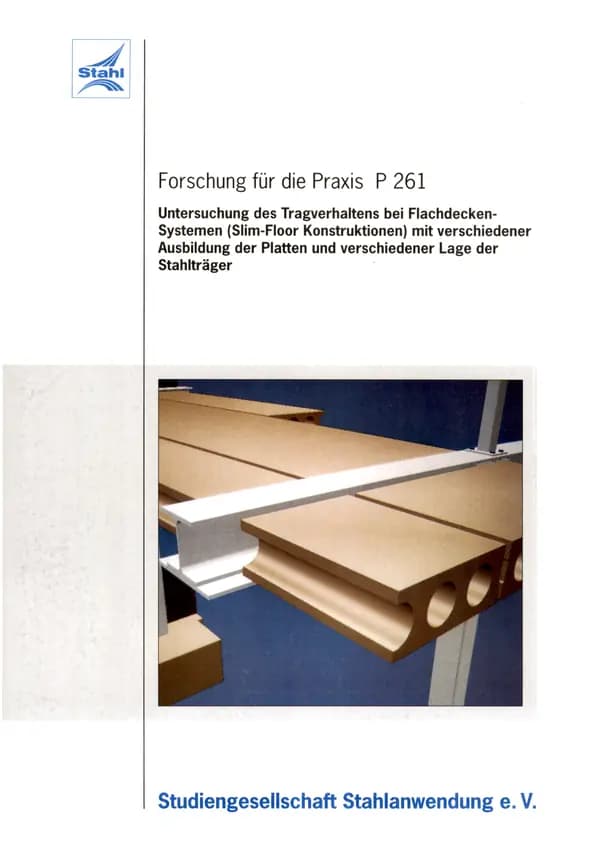
P 261: Investigation of the load-bearing behaviour of flat slab systems (slim-floor constructions) with different slab designs and different positions of the steel beams Modern flat slabs with integrated steel profile beams offer not only a favourable weight but also a reduction in storey height with a smooth ceiling soffit. In combination with quick installation, they offer a technical and economical alternative to conventional reinforced concrete solutions. The market share of these so-called slim floor systems is still comparatively low in Germany, as planners and engineers are still uncertain about the design and execution. Against this background, the aim of the present project was to draw up design proposals and supplement standards on the basis of suitable investigations. Extensive practical, experimental and theoretical investigations were carried out to establish important principles for determining the load-bearing capacity, interaction of internal forces, support conditions of the concrete slab, effects of grouting, crack distribution, concrete participation, etc. In addition, serviceability with regard to the load-bearing capacity of the concrete slab had to be analysed. In addition, serviceability with regard to the deflection and vibration behaviour of the steel flat slabs was also the subject of the investigations. It was shown that the slim floor constructions have considerable reserves with regard to the interaction in the bottom chord, the load-bearing capacity and also the stiffness. As a result of the work, new design proposals are given. The results presented relate to the so-called "cold" design. However, with regard to fire protection, the most important known findings on the state of the art and research in "hot" fire design are also discussed. The results of this work provide planners and engineers in the construction industry with additional tools and certainty when applying this pioneering technology. On this basis, the technical and economic advantages of flat slab systems in steel and composite construction will lead to wider acceptance on the market. STUDIENGESELLSCHAFT STAHLANWENDUNG e.V. Publication: 1997 Authors: Prof. Dr.-Ing. H. Bode, Dipl.-Ing. J. Stengel, Prof. Dr.-Ing. G. Sedlacek, Dr.-Ing. M. Feldmann, Dipl.-Ing. Ch. Müller
available anytime
€50.00
excl. VAT

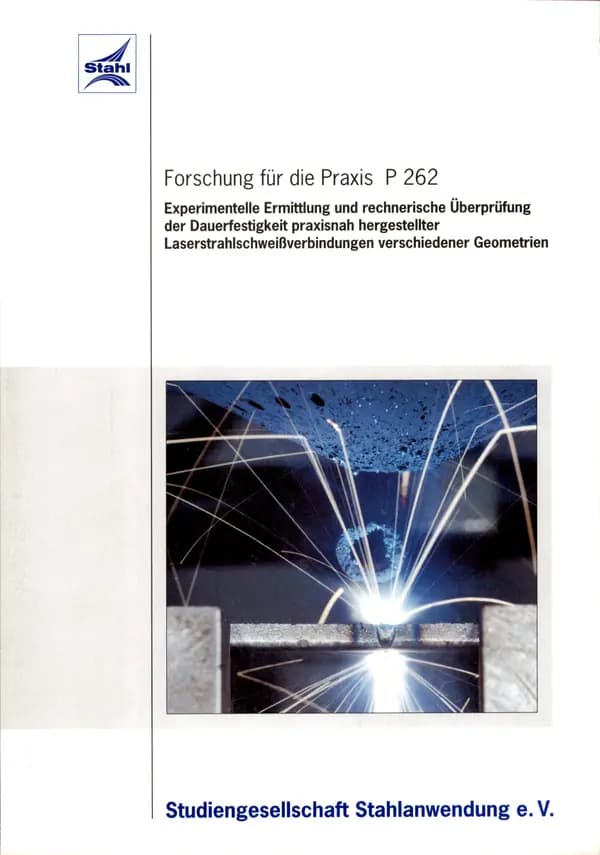
P 262: Experimental determination and computational verification of the fatigue strength of practically manufactured laser beam welded joints of different geometries Following the successful introduction of laser beam welding with up to 6 kW into large-scale production, e.g. of automotive sheet metal as tailored blanks, laser beam sources with output powers of up to laser beam sources with output powers of up to 40 kW are currently being developed for thicker sheets. Initial results from systematic fatigue strength tests on welded joints on a laboratory scale are already available. They apply to sheet thicknesses of up to 12 mm, where the joining edges have been prepared by milling and the laser weld seam is ideally formed. Compared to conventionally produced welded joints, up to 50% higher fatigue strength values were achieved and justified with the more favourable seam geometry. The aim of the present investigations was to experimentally determine the fatigue strength of laser welded joints of high-strength and high-strength structural steels from 8 - 1 2 mm, which were produced under practical conditions. A fine beam version of plasma cutting was chosen to prepare the joining edges. This process is currently used in the industry for the genetic production of steel components. The subsequent laser welding was carried out using filler wire for butt and cross joints. The fatigue strength of these joints was first estimated mathematically and then compared with the experimental results of the fatigue strength tests (Wöhler tests). The mathematical concepts developed for conventional weld seams have already been successfully applied to ideal laser welded joints. They are based on the external weld geometry and allow a satisfactory estimation of the Wöhler curve for welds that have no internal defects. For the laser weld seams produced under practical conditions, fatigue strength values were determined experimentally that lie within the scatter band for comparable conventional weld seams. Irregularities are associated with porous weld seams and varying seam geometries due to the preparation of the joining edges by plasma cutting. The simple mathematical concepts used have therefore only provided approximate values. However, the investigations made it clear that laser-welded structural steels achieve at least the fatigue strength of conventionally produced welded joints, even with unfavourably formed and porous weld seams. It was also shown that the extreme property gradients in the transition from the thermally unaffected base material to the weld seam have no negative effect. The test results will make a significant contribution to improving the acceptance of this high-performance joining process, particularly in shipbuilding, rail vehicle construction and mobile crane construction. STUDIENGESELLSCHAFT STAHLANWENDUNG E.V. Publication: 1996 Authors: Prof. Dr. rer. nat. Dr.-Ing. e.h. W. Dahl, Dipl.-Ing. P. Reinhold
available anytime
€20.00
excl. VAT

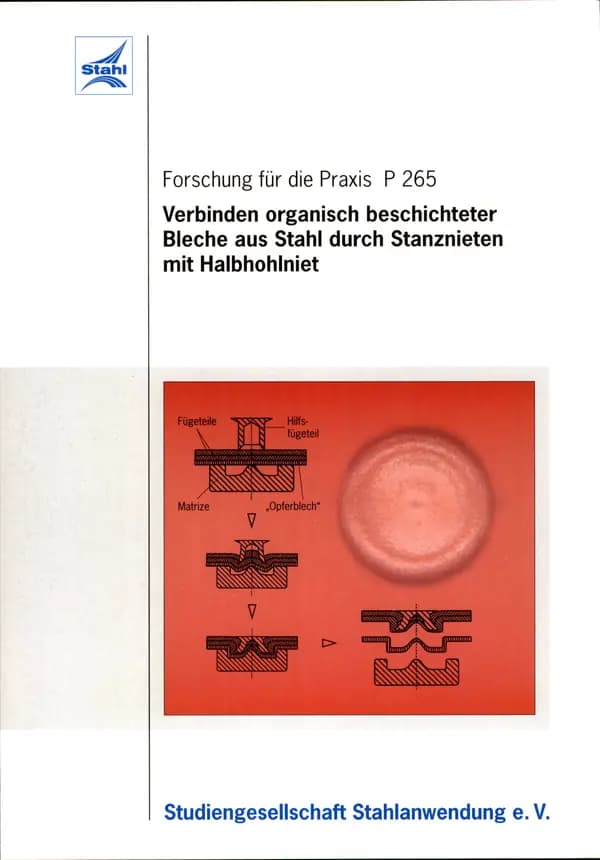
P 265: Joining organic-coated steel sheets by self-pierce riveting with semi-tubular rivets Punch riveting with semi-tubular rivets for organically coated materials was investigated as part of the research project. Basically, when joining coated semi-finished products by self-pierce riveting with semi-tubular rivets, coating destruction occurs in the closing head area. Critical zones are the contact surfaces at the transition radii of the tip and base of the mandrel. At these points of highest surface pressure, the layer cohesion is cancelled out (cracks, spalling), which even conventional forming aids (lubricants and friction-reducing foils) only counteract to a limited extent. On the basis of FEM simulations, specific tool contour changes were made with the aim of reducing stress peaks in the die and maintaining the layer cohesion of the organic coating. Although this enabled a partial improvement of the visual impression in the joining zone, it did not allow the closing head to be formed without cracks. Rivet setting tests with riveted materials show that extreme surface enlargements (approx. 180 %) occur in some areas of the die contour (especially in the die base). Cupping tests according to Erichsen showed that the layer cohesion of various organic coatings fails long before such expansions are reached. These surface enlargements in conjunction with the partially high pressure load in the mould during the rivet setting process inevitably lead to failure of the cohesion and adhesion of the coatings in commercially available coatings, which cannot be counteracted even by targeted variation of the process parameters. For this reason, a production process, the so-called "sacrificial sheet metal method", was developed which enables the pre- and post-processing-free self-pierce riveting of organically coated steel sheets. This process offers the possibility of maintaining the corrosion resistance of the semi-finished product in the closing head area in the same way as the stamp-side joining part. As a result, the sacrificial plate method in conjunction with optimisation of the die engraving significantly reduced or eliminated the damage to the coating in the closing head area. The advantages of forming the closing head when joining organically coated steel sheets using self-pierce rivets with semi-tubular rivets are offset by the disadvantage of feeding the sacrificial sheet during each joining process. The increased process engineering effort must be analysed more closely in terms of economic efficiency and technical feasibility. Every user of this process should therefore check for themselves whether the greater expense and the expected benefits of this process are in the right proportion to each other. Depending on the specific requirements profile for the component properties, the tools developed allow the pre- and post-processing-free self-pierce riveting of organically coated sheet steel. Despite often unavoidable colour changes, the corrosion resistance of the semi-finished product is also maintained in the closing head area of the die-side sheet metal, as is the case with the punch-side joining part. By using adequately coated auxiliary joining parts, the favourable joining properties of self-pierce riveted joints with semi-tubular rivets can also be transferred to the organically coated steel sheets. STUDIENGESELLSCHAFT STAHLANWENDUNG e.V. Publication: 1998 Authors: Prof. Dr.-Ing. W. Voelkner, Dipl.-Ing. M. Timm
available anytime
€20.00
excl. VAT

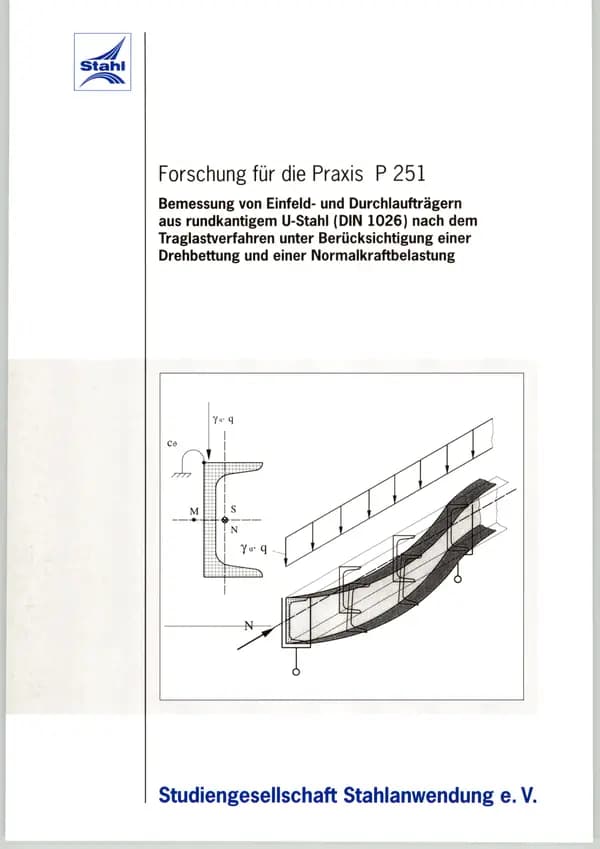
P 251: Design of single-span and continuous beams made of round-edged U-steel (DIN 1026) according to the ultimate load method, taking into account a rotational bedding and a normal force load In the basic steel construction standard DIN 18800, the ultimate load method plays an important role in the structural safety analysis, as its use in the design of steel structures enables a more economical design. Recently, maximum loads that can be absorbed (ultimate loads) have been determined for many structures and structural elements, taking into account geometric and material non-linearity, and design methods have been developed from this for engineers working in construction practice. The present work closes a gap here as far as single-span and continuous beams made of round-edged U-steel (DIN 1026) are concerned. Until now, there was no simple way to design these beams, loaded by line loads in the web plane and a compressive force with simultaneous consideration of a rotational bedding, using simple means. DIN 18800 also deals with beams with a U-section. However, they require a load in the shear centre, which cannot be realised in practice. The difficulty with these beams lies in the planar torsion that occurs in addition to the bending and normal force loading, so that this problem can only be dealt with using methods that take spatial failure into account. In contrast to beams with I-section, where the planar and the spatial failure (lateral-torsional buckling) can be analysed in separate verifications, this separation is not possible for beams with U-section, so that new ultimate loads including the spatial failure had to be determined here. The present work determines the ultimate loads of single-span and continuous beams with a U-section, loaded by a line load, a compressive force and any existing rotational bedding, and prepares these in the form of ultimate load tables and design formulae for practical application. The use of these tables provides steel fabricators, architects and users with a simple, fast and cost-effective design basis as well as a realistic statement about the safety of the structure. In addition to these investigations, an EDP programme (DOS operating system) has been developed with which the load-bearing capacity for an existing beam or the required profile for a specific system with a given load can be easily determined. This programme can be obtained for a nominal fee from the Institute for Structural Analysis at the University of Karlsruhe, Kaiserstr. 12, 76131 Karlsruhe. STUDIENGESELLSCHAFT STAHLANWENDUNG e.V. Publication: 1997 Authors: Prof. Dr.-Ing. W. Wagner, Prof. Dr.-Ing. W. Heil, Dr.-Ing. P. Höß
available anytime
€20.00
excl. VAT
Payment by card (Stripe) or invoice (DE, AT, CH). Download link by email: automatically after ordering by card, after order approval for invoice (valid for 30 days). Terms