
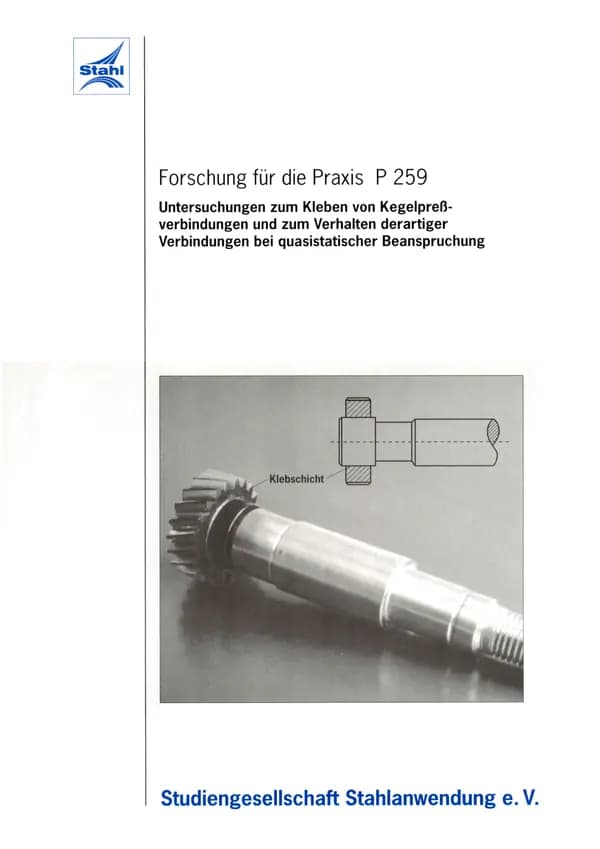
P 259 - Investigations on the bonding of conical compression joints and the behaviour of such joints under quasi-static loading
Tapered interference fits are known for their good torque transmission capability within shaft-hub connections. However, they generally require additional positive axial locking beyond the frictional interference fit. …
Content
- Publication
- 1998
- Authors
- Prof. Dr.-Ing. Hahn, Dipl.-Wirtsch. Ing. G. Hild
Tapered interference fits are known for their good torque transmission capability within shaft-hub connections. However, they generally require additional positive axial locking beyond the frictional interference fit. This production-related effort is reflected in the economic consideration, which in this case may argue against the choice of taper interference fits despite their technological advantages. The use of adhesives makes it possible to dispense with the axial securing elements. This means that a reduction in material and manufacturing costs can be realised. Furthermore, the adhesive in its liquid phase can act as an ideal lubricant when joining the joints.
Show full description
In addition to the above-mentioned savings, this also makes it possible to reduce the required press-in forces. In this report, the first systematic investigations have been carried out on the behaviour of bonded tapered compression joints during joining and in the loaded state. The joints have a taper ratio of 1:50 and were joined with two anaerobic adhesive systems. For the joining process, a process control system with integrated monitoring was initially set up to enable the recording and comparative analysis of the joining force-joint travel curves. Various disturbance variables such as angular errors, lack of degreasing, lack of adhesive application or altered surface roughness were analysed in comparison with reference curves. Significant differences were found in relation to the joining process, so that the force-displacement control allows process monitoring. With regard to the mechanical properties, it was demonstrated that higher compressive and torsional shear strengths can be achieved than with elementary taper interference fits if reference conditions are maintained. The reference conditions relate on the one hand to the elimination of the aforementioned disturbance variables and on the other hand to the selection of a system-compliant press-in force. This results as a dependent variable of different adhesives due to the different viscosities and the resulting friction conditions. The report derives an equation with which this so-called process-optimised joining force can be determined. It takes into account the elasticity limit of the outer part up to which the joint is to be optimally utilised as well as the adhesive-induced friction conditions. The latter in turn depend to a considerable extent on the process variables of joining speed, surface condition and, of course, viscosity, so that certain manufacturing recommendations have been derived. These include joining at speeds of between 1 and 2 mm/s for the geometries in question, surface roughnesses of less than 10 pm and comparatively higher viscosity anaerobic adhesives. This is in agreement with the friction theory according to AMONTONS/COULOMB, from which similar conclusions can be drawn for the friction of lubricated bodies. The present results provide a basis for the use of bonded cone interference fits. The authors describe technology-specific design and manufacturing properties as well as the mechanical behaviour of bonded joints. This makes the joining technology more calculable for the steel user and enables him to utilise the technological and economic potential. STUDIENGESELLSCHAFT STAHLANWENDUNG e.V.
Zum Zoomen hovern
€20.00excl. VAT
Payment by card (Stripe) or invoice (DE, AT, CH). Download link by email: automatically after ordering by card, after order approval for invoice (valid for 30 days). Terms
P 259 - Investigations on the bonding of conical compression joints and the behaviour of such joints under quasi-static loading—
€20.00