
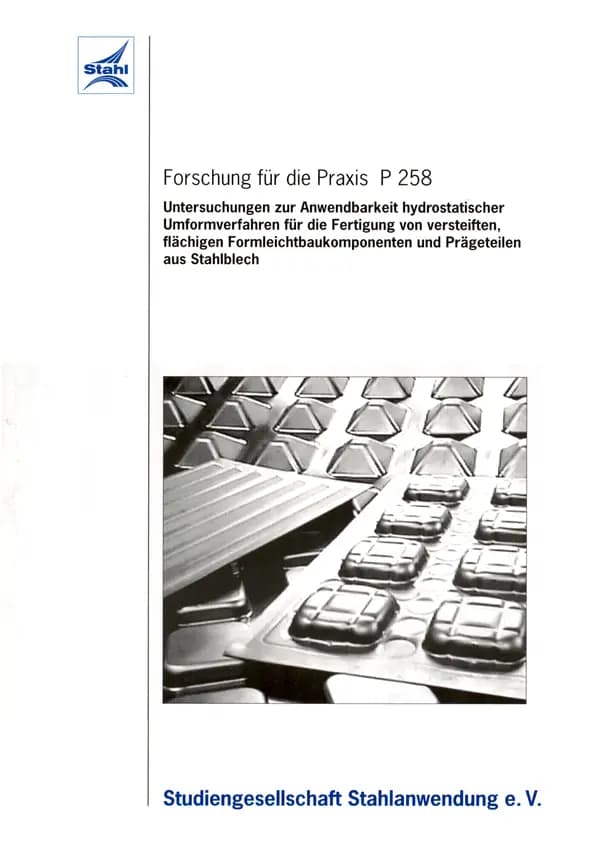
P 258 - Investigations into the applicability of hydrostatic forming processes for the production of stiffened, flat, lightweight moulded components and stamped parts made of sheet steel
An essential element of modern lightweight construction with flat steel products is the introduction of partially stiffening secondary mould elements in addition to the reduction in thickness when using higher-strength …
Content
- Publication
- 1998
- Authors
- Dr.-Ing. A. Floß, Dipl.-Ing. B.Hachmann, Prof. Dr.-Ing. A. Neubauer
P 254: Development of a hollow body model for testing corrosion protection in the joining area of car body components An essential element of modern lightweight construction with flat steel products is the introduction of partially stiffening secondary mould elements in addition to the reduction in thickness when using higher-strength steel grades. The aim of this project was to utilise the extended and at the same time gentler shaping possibilities of hydrostatic stretch forming for innovative structures compared to conventional methods. With the help of numerical and experimental methods, practice-relevant findings were to be developed for the tool design and the process sequence for the production of stiffening, flat lightweight moulded components and stamped parts made of sheet steel.
Show full description
Using 7 secondary forming elements and over 20 sheet materials in the thickness range from 0.2 to 1.5 mm - unalloyed deep-drawing sheets, stainless steels, metallic and organically coated steels as well as an aluminium alloy - the forming behaviour during hydrostatic stretch forming was investigated mathematically and practically. To determine the forming limits, certain sheet metal moulded parts and secondary forming elements such as the spherical cap, groove, square cusp, round cusp, honeycomb, kidney and conoid were selected for the tests. FEM simulation and experimental results on deformation and tearing behaviour were brought into good agreement. New technological expertise on the relationships between material characteristics and mould and process design was gained in numerous investigations. The combination of computer-aided and empirical findings on the hydrostatic stretch forming of secondary mould elements forms a technological and constructive basis for innovative product developments in lightweight construction. Possible applications for such sheet metal moulded products are seen in stiffening lightweight construction in automotive, vehicle, container and apparatus construction and, last but not least, for design products. The advantages of hydrostatic stretch forming, including increased forming capacity, surface-friendly sheet metal processing and improved component properties, make it possible to realise a wide range of new product ideas. New products already on the market based on the research carried out include structured stainless steel façade elements with a mirror finish, extractor bonnets in a new design and sheet metal moulded parts in special alloys for the aerospace industry. STUDIENGESELLSCHAFT STAHLANWENDUNG e.V.
Zum Zoomen hovern
€30.00excl. VAT
Payment by card (Stripe) or invoice (DE, AT, CH). Download link by email: automatically after ordering by card, after order approval for invoice (valid for 30 days). Terms
P 258 - Investigations into the applicability of hydrostatic forming processes for the production of stiffened, flat, lightweight moulded components and stamped parts made of sheet steel—
€30.00