
P 254 - Development of a hollow body model for testing corrosion protection in the joining area of car body components
In order to assess the protection against rust penetration from seams and flanges, which is important for the performance characteristics of a vehicle, complex test specimens with sheet metal doublings must be used with …
Content
- Publication
- 2000
- Authors
- Dr.-Ing. H.-G. Hoff
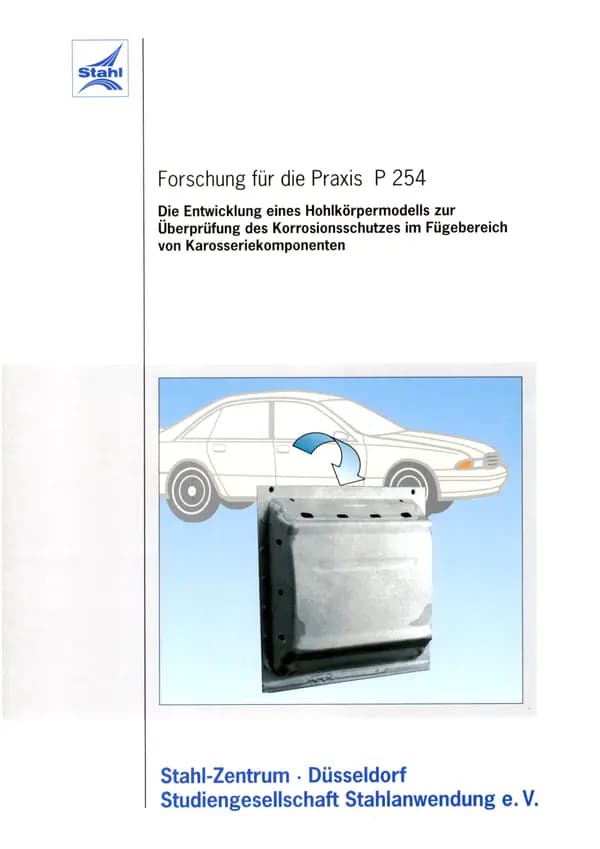
In order to assess the protection against rust penetration from seams and flanges, which is important for the performance characteristics of a vehicle, complex test specimens with sheet metal doublings must be used with different joining techniques. Against this background, the aim of the project was to test and evaluate a new static test method focussed on corrosion protection in cavities and joint areas of car body components. A door model was selected as a hollow body model for the research work in order to make the test part as practical as possible in terms of shape, production route and position for the test. Following preliminary tests on original mini-doors manufactured in the USA, a similar new mould was developed with a significantly smaller gap between the sheet metal flanges and with greater forming stress on the surface-finished steel sheets.
Show full description
Numerous variants of the base material in various forms of surface finishing in the thickness range around 0.8 mm were available for the tests. In addition to spot welding, the tests were extended to other joining techniques that are now common in modern production lines. The test specimens were subjected to typical automotive phosphating and painting in the automotive companies' paint lines. The corrosion load was determined in the cyclic short-term corrosion tests according to the VDA alternating test, the accelerated VDA outdoor exposure test and the alternating test according to P-VW. Based on the overall visual impression, the comparability of the present test method with the testing of complete car bodies in corresponding test sequences was determined. Due to similar damage patterns, the basic suitability of the new method for assessing the corrosion protection of surface-finished sheet metal in cavities and joint areas was confirmed. The existing deficiencies in the individual areas of the investigation were identified. In particular, the material behaviour in folds and flanges can be carried out in a more cost-effective way using special fold and flange models. However, the investigations have shown that the mini-door can be a suitable test specimen for corrosion protection issues under certain conditions. At the same time, the investigations have already provided indications of better corrosion protection when steel sheet with zinc alloy coatings such as galvanised sheet or additionally organically coated galvanised sheet are used in automotive engineering. The investigations involving steel manufacturers, the paint industry and car manufacturers have made an ideal contribution to the understanding of corrosion protection, testing techniques and the evaluation of corrosion protection in the various sectors and at the same time provided significant insights into improvements. STUDIENGESELLSCHAFT STAHLANWENDUNG e.V.
Zum Zoomen hovern
€20.00excl. VAT
Payment by card (Stripe) or invoice (DE, AT, CH). Download link by email: automatically after ordering by card, after order approval for invoice (valid for 30 days). Terms
P 254 - Development of a hollow body model for testing corrosion protection in the joining area of car body components—
€20.00