
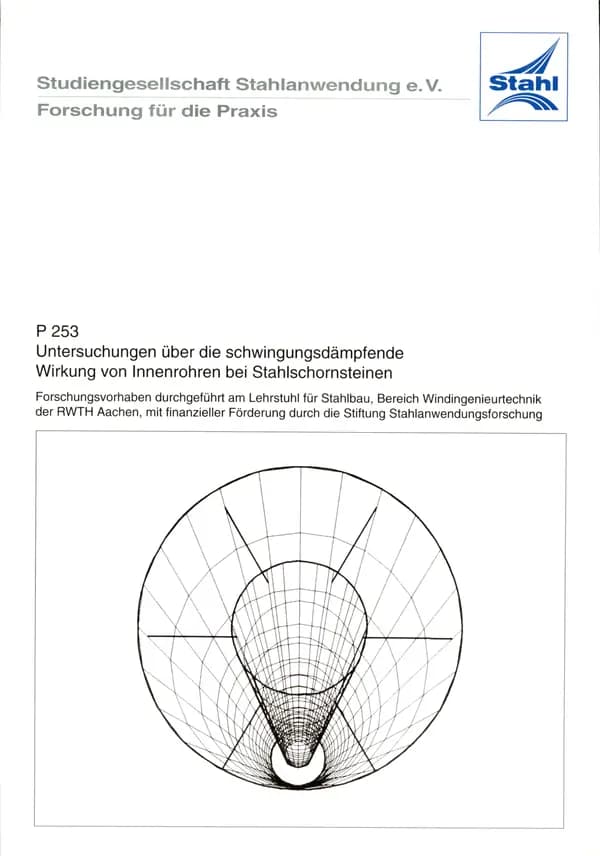
P 253 - Investigations into the vibration-damping effect of inner pipes in steel chimneys
The main stresses on steel rubble blocks with regard to stability are caused by the effects of wind. In addition to static stresses due to gust loads, dynamic stresses due to vortex-induced transverse vibrations also …
Content
- Publication
- 1995
- Authors
- Prof. Dr.-Ing. H. Ruscheweyh, Dipl.-Ing. C. Verwiebe, Dipl.-Ing. Ch. Kammel. Verwiebe, Dipl.-Ing. Ch. Kammel
The main stresses on steel rubble blocks with regard to stability are caused by the effects of wind. In addition to static stresses due to gust loads, dynamic stresses due to vortex-induced transverse vibrations also frequently occur. The stability of steel chimneys is ensured by appropriate dimensioning of the wall thicknesses and anchor bolts. To prevent unwanted vibrations, a vibration damper is often fitted as an additional component in the area of the chimney mouth. Alternatively, existing components or structural elements, in particular the interaction between the inner pipe and the supporting pipe in the case of double-walled chimneys, could be used to increase the damping of the steel chimney in a targeted and predictable manner.
Show full description
Against this background, the damping properties of the movable inner pipe were analysed and evaluated in detail as part of a research project with the aid of simulation calculations, supplemented by measurements on an original chimney. It was demonstrated that the movable inner pipe has extremely effective damping-enhancing properties if the gap between the inner pipe and the outer pipe is optimised. However, it also turned out that the parameters influencing the optimum solution are very numerous and much more complexly interlinked than had been expected. Further measurements on original chimneys are required for reliable verification of the theoretical calculations. However, the investigations have shown that this principle can be standardised in the sense of exact dimensioning for structures to be built. The results so far point the way to a method for the passive control of wind-induced vibrations that can be handled by engineers. For steel processors and users, savings in the use of materials, in production and, last but not least, in assembly costs as well as improved economic efficiency in the use of steel chimneys are then fundamentally possible. STUDIENGESELLSCHAFT STAHLANWENDUNG e.V.
Machine-translated title and description. The document itself is in German.
Zum Zoomen hovern
€40.00excl. VAT
Payment by card (Stripe) or invoice (DE, AT, CH). Download link by email: automatically after ordering by card, after order approval for invoice (valid for 30 days). Terms
P 253 - Investigations into the vibration-damping effect of inner pipes in steel chimneys—
€40.00