
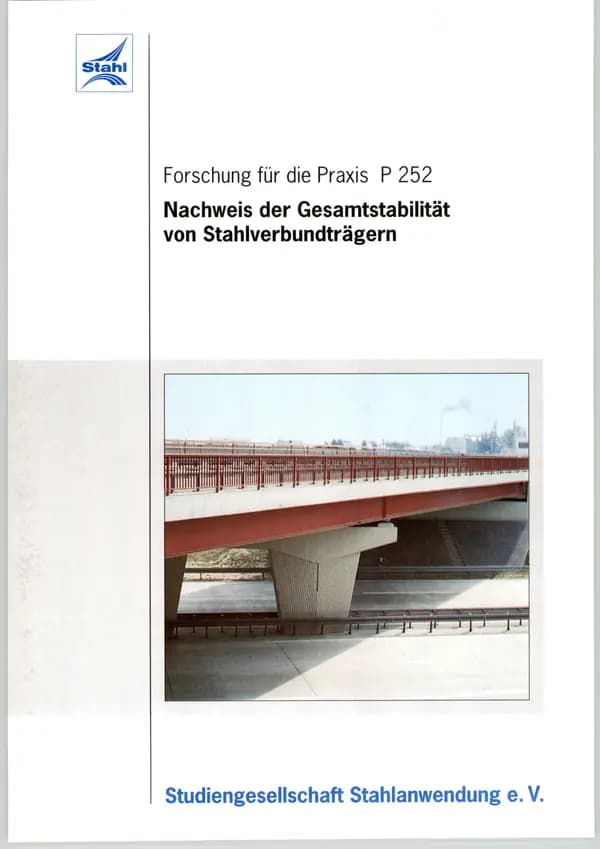
P 252 - Verification of the overall stability of steel composite beams
Composite steel construction is increasingly being used as an economical construction method in both building construction and bridge construction. An important element of composite construction are the composite beams …
Content
- Publication
- 1997
- Authors
- Prof. Dr.-Ing. M. Fischer, Dipl.-Ing. S. Berger
Composite steel construction is increasingly being used as an economical construction method in both building construction and bridge construction. An important element of composite construction are the composite beams, which are usually designed as solid wall beams. The top chords of these composite beams are the reinforced concrete slabs in building construction and the reinforced concrete carriageway slabs in bridge construction. The webs and bottom chords are made of steel. The composite dowels welded onto the structurally required steel top chord ensure that the concrete and steel parts work together. Since composite beams are not only designed as single-span beams but also as continuous beams, compressive stresses can occur in the bottom chord, particularly above the intermediate supports.
Show full description
It must therefore be verified not only that webs do not buckle under compressive and shear loads, but also that the bottom chords do not deflect laterally. Since both deflection phenomena can occur in combination, this is referred to as an overall stability problem. Proving safety against these phenomena is not easy for the engineer working in practice, as there are hardly any aids available in the standards that permit realistic proof. The only option is therefore often to carry out simplified verifications, which may be too much on the safe side and therefore do not fully utilise the economic efficiency of the composite construction method. In order to circumvent the verification of overall stability, constructive measures are sometimes taken, such as the arrangement of lateral supports, which, however, requires additional material. In the research project, the overall stability problem of composite beams with a constant height was solved for a range of parameters relevant to construction practice, both in terms of cross-section sizes and loads. The results are buckling value tables for the overall stability problem. It was also investigated which reduction curve should be used in order to be able to carry out safe and economical verifications. For this purpose, load calculations had to be carried out for the problem at hand. The verification to be carried out with the aid of the buckling value and the reduction curve corresponds to the verification of stability problems that is usual in today's standards. The practical procedure is explained in the research report by means of examples. To make it easier for practitioners to read values from the buckling value tables, the tables were saved in the "GESTAB" programme. This programme also carries out the necessary interpolations. It is a fully-fledged Windows programme with a user-friendly interface that is compatible with all current Windows versions. Stored on two discs, it is enclosed with the research report. STUDIENGESELLSCHAFT STAHLANWENDUNG e.V.
Zum Zoomen hovern
€30.00excl. VAT
Payment by card (Stripe) or invoice (DE, AT, CH). Download link by email: automatically after ordering by card, after order approval for invoice (valid for 30 days). Terms
P 252 - Verification of the overall stability of steel composite beams—
€30.00