
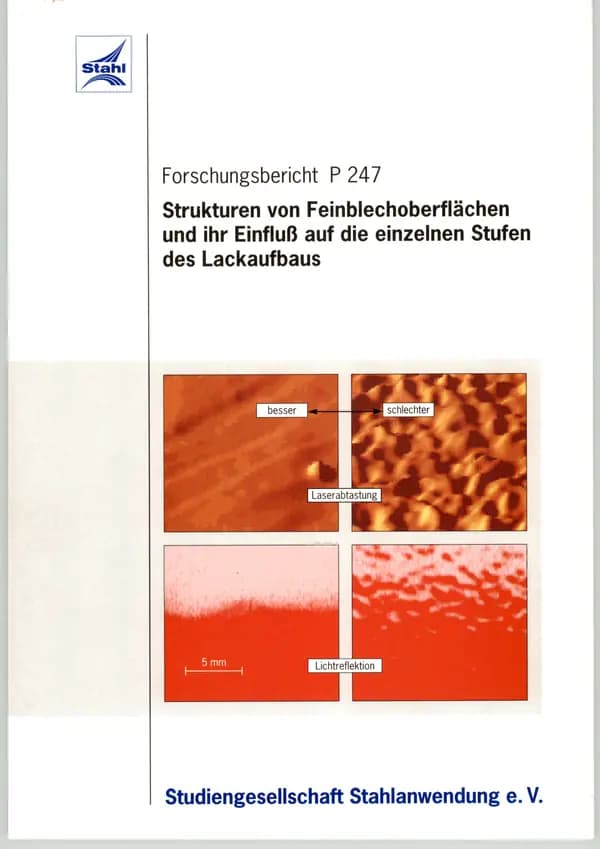
P 247 - Structures of thin sheet surfaces and their influence on the individual stages of paint build-up
So-called orange peel is undesirable in the top coat of cars, as these longer-wave structure components impair the visual impression of the product. In many cases, the customer unconsciously associates this with poor …
Content
- Publication
- 1997
- Authors
- Dr.-Ing. O. German
So-called orange peel is undesirable in the top coat of cars, as these longer-wave structure components impair the visual impression of the product. In many cases, the customer unconsciously associates this with poor topcoat quality. The aim of the project was to develop methods with which the influence of the surface structure of sheet steel on the longer-wave components in the topcoat structure can be determined and evaluated. In close cooperation with representatives of the steel, automotive and paint industries, measuring and labelling methods were developed to characterise the changes in the surface structure from the thin sheet to the top coat.
Show full description
Using laboratory and line coatings, the relationships between the sheet metal surface structure, the top coat structure and the visual appearance of painted surfaces were demonstrated. The longer wavelength top coat structures on thin sheets with a low proportion of longer wavelength structures can mainly be attributed to the coating. In the case of thin sheets with higher longer wavelength structures, the appearance of orange peel is also influenced by the structure of the sheet. From test coatings (laboratory and 6 coating lines) it follows that, depending on the coating system, the coating application and the conditions during the coating application, there are more or less clear correlations between the thin sheet surface structure and the top coat flow structure. These are described for the individual paint application by parameters for longer wavelength structure components. This also made it possible to show the clearly different relationships in the various painting lines. For thin sheets with an irregular surface fine structure, an empirically determined equation was developed, which enables an estimation of the longer-wave structure components in the thin sheet surface from the parameters according to STAHL-EISEN test sheet 1940. This means that the influence of the sheet metal surface structure on the longer wavelength components in the top coat structure can now be estimated in a practical manner from the normally recorded parameters during the production of the sheet metal. This contributes to an increase in the quality of painted steel sheets for steel users, especially in the automotive industry. STUDIENGESELLSCHAFT STAHLANWENDUNG e. V.
Zum Zoomen hovern
€20.00excl. VAT
Payment by card (Stripe) or invoice (DE, AT, CH). Download link by email: automatically after ordering by card, after order approval for invoice (valid for 30 days). Terms
P 247 - Structures of thin sheet surfaces and their influence on the individual stages of paint build-up—
€20.00