
FOSTA
Design and safety requirements in car construction have led to the positioning of the vehicle fuel tank in uncritical but geometrically very complex cavities in the car body. The requirements placed on the tank …
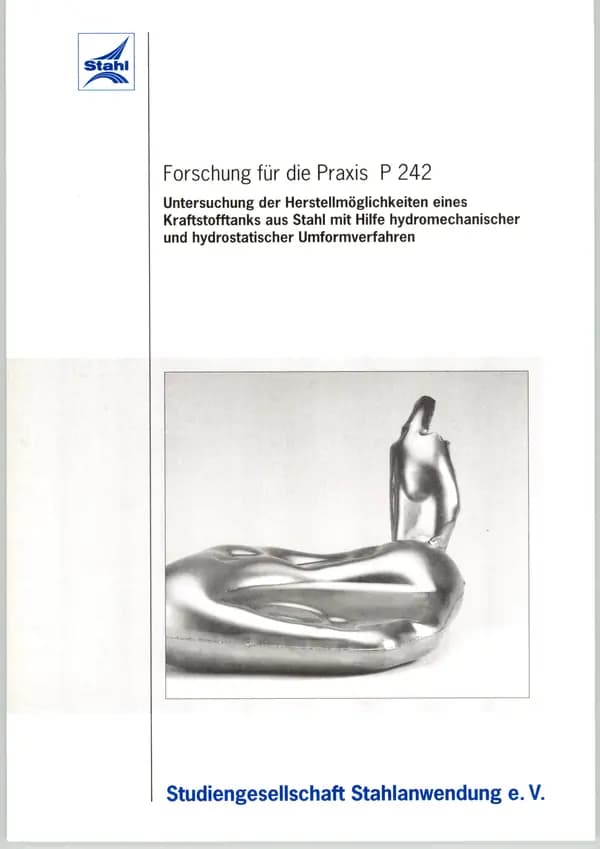
Design and safety requirements in car construction have led to the positioning of the vehicle fuel tank in uncritical but geometrically very complex cavities in the car body. The requirements placed on the tank materials with regard to shaping have so far been most easily met by plastics. The task of this research project was to use the new process of hydrostatic stretch forming of sheet metal to regain the field of application lost for steel in this area. The fuel tank of the VW Golf 3 was analysed on a scale of 1 : 2 as an example for the development of a forming and processing technology suitable for steel. The work focussed on the following steps: Hydrostatic preforming of congruent half shells for the upper and lower part of the tank directly from the sheet metal plane; cutting off the draw flange down to a circumferential remnant of 0.7 mm width with laser cutting; placing the circumferential flanges of both halves against each other and all-round welding with the TIG welding technique, using the material with the residual flange as a "welding depot".
For the final shaping, the moulded filler neck must be bent into its final shape. Prepared in this way, the hollow body is hydrostatically final moulded in a finishing die. Tests with austenitic stainless steel and unalloyed and micro-alloyed steels suitable for cold forming have shown that initial wall thicknesses of less than 0.8 mm are possible and that residual wall thicknesses of approx. 0.6 mm can be achieved. This is the first time that the suitability of hydrostatic stretch forming for the forming of flat material into free-form half-shells and further into complex hollow bodies has been demonstrated. With the same external dimensions, the steel tank formed in this way offers a 9 to 30 % (0.6 to 2.2 kg) lower weight with a 7 % (3.5 I) greater filling capacity, complete prevention of fuel diffusion through the wall and excellent recycling properties compared to the plastic tank, depending on the wall thickness. STUDIENGESELLSCHAFT STAHLANWENDUNG e.V.
Machine-translated title and description. The document itself is in German.
Payment by card (Stripe) or invoice (DE, AT, CH). Download link by email: automatically after ordering by card, after order approval for invoice (valid for 30 days). Terms
Digital download
Payment by card (Stripe) or invoice (DE, AT, CH). Download link by email: automatically after ordering by card, after order approval for invoice (valid for 30 days). Terms