
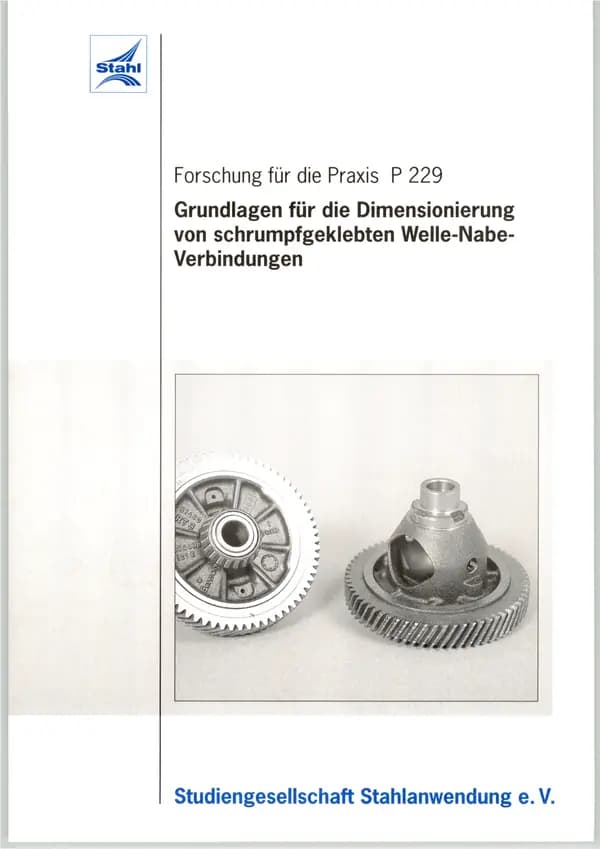
P 229 - Basics for the dimensioning of shrink-fit shaft-hub-connections
Shaft-hub connections are used in many areas of industrial practice for force and torque transmission. Typical areas of application include drive technology components, conveyor and lifting equipment, transmission …
Content
- Publication
- 1996
- Authors
- Prof. Dr.-Ing. Hahn, Dipl.-Wirt.-Ing. G. Hild
Shaft-hub connections are used in many areas of industrial practice for force and torque transmission. Typical areas of application include drive technology components, conveyor and lifting equipment, transmission elements and products within road vehicle construction and rolling mill technology. As a result, there are a large number of technical solutions that are frictionally engaged, form-fit or material-fit, depending on the type of load and the design conditions. Compared to most common shaft-hub connections - usually parallel key or elementary transverse interference fits, which only achieve a low fatigue strength due to high stress concentrations in the area of the hub seat - shrink-fit connections in particular have a whole range of economic and technological advantages.
Show full description
For example, compared to shrink-fit joints, the oversize required for force transmission can be reduced to a tenth, so that the residual stresses in the joint are significantly reduced with comparable load-bearing capacities. A systematisation of the parameters influencing the mechanical behaviour of shrink-bonded joints, their empirical determination and subsequent processing in terms of relative strength values makes it possible to calculate such joints. The calculation approach developed in the project also includes superimposed oscillating loads and is therefore highly suitable for industrial applications. By varying the adhesives and the outer hub diameter, further insights were gained into the behaviour of these connections - in particular under oscillating torsion and rotating bending with superimposed static and oscillating torsion - which are incorporated into the analytical calculation model. The design of the connections is thus also possible for areas of application for which little or no experimental basis is available. The formation of fretting corrosion is often a problem with regard to the service life of assembled machine elements under oscillating loads. With regard to the development of fretting corrosion, the use of adhesives in shrink-fit bonded joints can delay or prevent the formation of fretting corrosion mechanisms, particularly through slow cooling in the joining process, which should ensure a closed adhesive layer under otherwise optimal conditions. The joining process is of interest for a shaft diameter range from around 20 mm upwards to connections in large machine construction with diameters of over 1 metre. From an economic point of view, the production process can be considered advantageous in terms of both the actual production costs and the material costs. In addition to the necessary surface cleanliness, the prerequisite for high-quality products is above all the qualification of the employees with regard to the introduction of the bonding joining technology. The technological properties of shrink bonding allow better material utilisation of the steel and permit lightweight construction concepts without material substitution. By consistently implementing this still innovative joining technology, market positions can be secured in international competition. STUDIENGESELLSCHAFT STAHLANWENDUNG e.V.
Zum Zoomen hovern
€30.00excl. VAT
Payment by card (Stripe) or invoice (DE, AT, CH). Download link by email: automatically after ordering by card, after order approval for invoice (valid for 30 days). Terms
P 229 - Basics for the dimensioning of shrink-fit shaft-hub-connections—
€30.00