
FOSTA
The demands on lightweight profiles are increasing in all industrial sectors. Precision profiles with high dimensional accuracy and the lowest possible residual stresses are required. These increased requirements are …
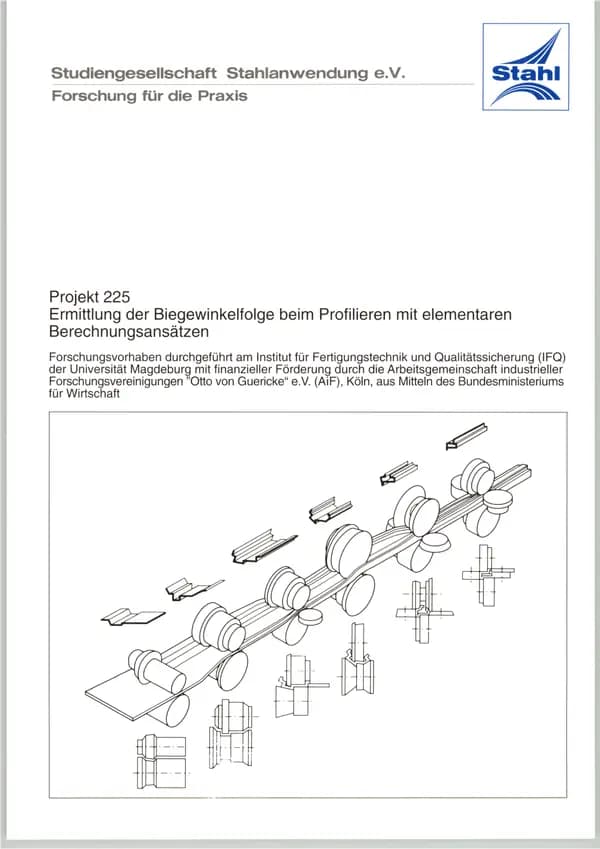
The demands on lightweight profiles are increasing in all industrial sectors. Precision profiles with high dimensional accuracy and the lowest possible residual stresses are required. These increased requirements are met by the profile manufacturing companies through a high level of expertise on the part of the employees when determining the forming stages. Nevertheless, during the design phase of roll forming tools, it is not possible to precisely determine the quality characteristics that will actually occur during the production of the profile. Based on this, the aim of the research project was to develop a model for the substantiated bending angle grading for roll forming.
As a result of this research project, a simulation device was developed on the basis of a new forming technology model. This device can be used to compare the contour of the forming zones during roll forming and the stresses on the profile occurring in this zone with good results for the real roll forming process. The starting point for the model developed was the realisation that the dominant factors influencing the quality characteristics of a profile are the longitudinal deformation occurring during the roll forming process. Specific investigations of the longitudinal deformation changes with variations in the bending angle differences for different materials, sheet thicknesses and leg widths yielded important findings for the calculation model. The modelling approach described in the research report makes it possible to determine the longitudinal deformation near the strip edge with simple means and to calculate the bending angle differences after defining limit ranges for the permissible longitudinal deformation. Further ways of including all parameters relevant to the roll forming process in the calculation model were shown. By further refining this model, it may be possible to calculate the quality of a profile, the geometric deviations and macro residual stresses while still in the stage of defining the stage plan. In addition, the research report presents a model for describing the geometry of the moulding zone at the strip edge on the basis of polynomial equations. It is shown that sufficiently accurate results can be achieved with polynomial equations of 7th order and higher with relatively low computational effort. STUDIENGESELLSCHAFT STAHLANWENDUNG e.V.
Machine-translated title and description. The document itself is in German.
Payment by card (Stripe) or invoice (DE, AT, CH). Download link by email: automatically after ordering by card, after order approval for invoice (valid for 30 days). Terms
Digital download
Payment by card (Stripe) or invoice (DE, AT, CH). Download link by email: automatically after ordering by card, after order approval for invoice (valid for 30 days). Terms