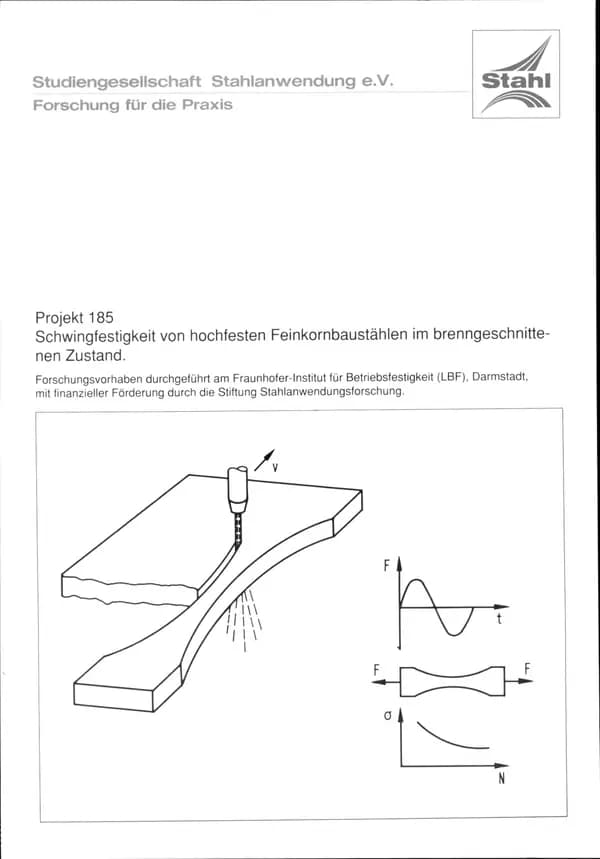
Due to their higher strength characteristics, fine-grained structural steels are increasingly being used in general steel construction as well as in crane and shipbuilding. This is particularly true in conjunction with …
Due to their higher strength characteristics, fine-grained structural steels are increasingly being used in general steel construction as well as in crane and shipbuilding. This is particularly true in conjunction with the cost-effective shaping process of oxy-fuel flame cutting. In practice, the designer is faced with the task of optimising the possible cutting speeds and process types for oxy-fuel flame cutting with regard to their fatigue strength in the flame-cut state, given the variety of steels. Similarly, improper stresses on the flame-cut surface, such as plastic deformation or even injuries caused by impact notches or errors during flame cutting, must be taken into account in the design of components.
The effects of these influencing variables on the fatigue strength behaviour of flame-cut fine-grain structural steels were previously only insufficiently known. The aim of the research project was therefore to determine the fatigue strength after flame cutting with special consideration of microstructure formation, roughness, hardness and residual stress curves as well as the detailed documentation of the individual investigations. The fine-grained structural steels StE 355, StE 460, StE 690 and StE 890 were analysed as examples. On the basis of the results and findings obtained, it is now possible to take into account the effects of the above-mentioned influences on fatigue strength at the design stage or to evaluate them in a completed structure. The provision of reliable design documents reduces the existing uncertainties in the use of flame-cut fine-grained structural steels in design practice and provides useful support for the available codes of practice. The results of the research project will lead to a wider use of fine-grain structural steels in the aforementioned fields of application and contribute to making the design of components made of fine-grain structural steels easier and more reliable for the processing industry. The findings on the processing parameters are used to shorten production times and thus reduce costs. STUDIENGESELLSCHAFT STAHLANWENDUNG e.V
Machine-translated title and description. The document itself is in German.
Payment by card (Stripe) or invoice (DE, AT, CH). Download link by email: automatically after ordering by card, after order approval for invoice (valid for 30 days). Terms
Digital download
Other parts and editions as well as neighbouring documents of the same series.

P 102 - Experimental investigation of the load-bearing capacity of steel profile columns set in concrete with special consideration of the long-term behaviour of concrete Increasingly, composite columns are being used in industrial and building construction. Due to the small cross-sectional dimensions combined with high load-bearing capacity, the special requirements of industrial construction in particular can be met. In terms of their favourable load-bearing behaviour - especially under fire stress - concrete-encased I-profiles are of particular importance. In addition, this cross-sectional design gives the column component greater rigidity than a pure steel profile; the concrete encasement can be used as impact protection and also ensures corrosion protection. Composite columns have also proven themselves in production and assembly practice. The advantages of precast concrete construction can be utilised in the production of the columns and the proven connection technology of steel construction can be used in the assembly. The design and construction of composite columns is regulated in DIN 18806 Part 1 "Composite structures, composite columns" /1/. Taking into account the design principles for reinforced concrete columns and steel columns, this standard contains a calculation method that enables the practical calculation of composite columns. Numerous tests were analysed to develop the simplified design method of DIN 18806. These were essentially short-term tests, i.e. without the influence of creep and shrinkage of the concrete. The method specified in the standard for taking into account the influence of the long-term behaviour on the load-bearing capacity was derived from the regulations for solid construction on the basis of theoretical investigations. For concrete-filled pipes, the method has already been confirmed by tests /10/. The aim of the present test programme was to check or, if necessary, modify the regulations of the standard for concrete-filled profiles as well. Publication: 1987 Authors: Prof. Dr.-Ing. K. Roik, Dr.-Ing. I. Mangerig
available anytime
€20.00
excl. VAT

P 100 - Development of characteristic values for the production of cold rolled profiles from the point of view of economical production of dimensionally accurate profiles Cold profiling using the roll forming process is a forming process that has been used industrially for over half a century. It allows the production of cold-formed profiles with consistent and high dimensional accuracy, some with sharp-edged bends, many curved sections, complicated double folds, with - if desired - targeted work hardening of the starting material and finally the combination of profile shaping with further processing steps such as punching, beading and bending. Although the diverse requirements and the general technical development of mechanical engineering have led to a wide variety of roll forming systems over the course of time, the technology of roll forming is still largely based on practical experience. This applies both to the dimensioning of production facilities and to the design of forming tools. This unsatisfactory situation can probably be explained essentially by the fact that the entire process - in addition to the rather difficult geometric relationships of forming - is governed by numerous working conditions which influence each other. For this reason, the Technical Committee of the German Cold Forming Association has been working closely with a well-known plant manufacturer for several years on the development and dimensioning of a machine and drive concept for research purposes. A machine and control technology solution was developed and realised which for the first time makes it possible to empirically investigate the interactions between the parameters of the production process and the properties of the product in a reproducible manner. This research work was carried out on behalf of the Studiengesellschaft für Anwendungstechnik von Eisen und Stahl e.V. by Prof. Dr.-Ing. D. Schmoeckel, Institute for Forming Technology at Darmstadt Technical University. In addition to confirming some of the results of earlier investigations, new findings of practical relevance were obtained. This applies in particular to the experiments on slip reduction, which resulted in a drastic saving in the energy used, and on the relationship between the quality of the finished product and the selected forming strategy. These results represent a step towards a better understanding of the complex manufacturing process, but at the same time demonstrate the need for further intensive efforts to conduct in-depth research into roll forming technology. The research project was funded by the Federal Ministry of Research and Technology (BMFT) and was supervised by Kernforschungsanlage Jülich GmbH (KFA) as the project sponsor for the raw materials research programme. STUDIENGESELLSCHAFT FÜR ANWENDUNGSTECHNIK VON EISEN UND STAHL e.V. Publication: 1986 Authors: Prof. Dr.-Ing. D. Schmoeckel, Dipl.-Wirtsch.-Ing. U. Eichler
available anytime
€30.00
excl. VAT
Payment by card (Stripe) or invoice (DE, AT, CH). Download link by email: automatically after ordering by card, after order approval for invoice (valid for 30 days). Terms