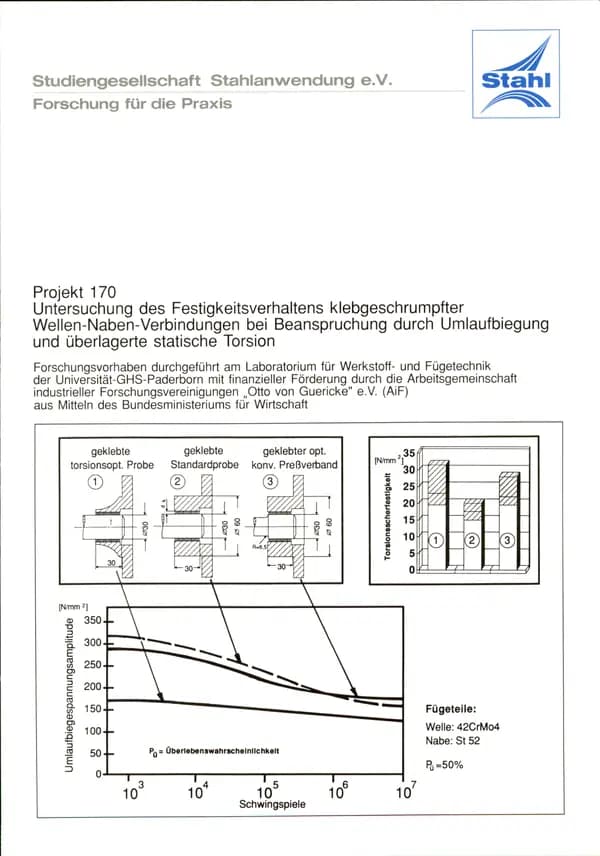
P 170 - Investigation of the strength behaviour of shrink-fit shaft-hub-connections under stress due to rotating bending and superimposed static torsion
Shaft-hub connections are used in machine, gear and automotive construction as well as in precision engineering and are used for load transmission between shaft and hub. As they are one of the most commonly used machine …
Content
- Publication
- 1992
- Authors
- Prof. Dr.-Ing. Hahn, Dipl.-Ing. U. Schuht
Shaft-hub connections are used in machine, gear and automotive construction as well as in precision engineering and are used for load transmission between shaft and hub. As they are one of the most commonly used machine elements, there are many different types, which are categorised according to the type of load transmission as positive, non-positive or material-locking connections. Bonded connections are basically material-locking connections. The material connection eliminates all degrees of freedom of relative movement between the shaft and hub. Whereas a few decades ago shaft-hub connections were mainly designed as keyway connections, nowadays the shrink-fit connection is increasingly coming to the fore.
Show full description
The advantages of this type of connection are the lack of additional connecting elements and the favourable mechanical behaviour under varying loads. Parallel key connections, on the other hand, can deflect with changing torques, so that proper operation is no longer possible. Shrink-fit connections also eliminate the additional operation of groove milling and the resulting reduction in the cross-section of the shaft. Numerous successful designs of shrink-fit shaft-hub connections demonstrate the advantages that can be achieved by combining the bonding and shrinking joining processes. In particular, the reduction in residual stresses resulting from the joining process, due to the small excess dimensions required compared to conventional interference fits, opens up a wide range of industrial applications for this joining method. With regard to the dimensioning of shrink-fit shaft-hub joints, the results of experimental investigations into the fatigue strength behaviour under rotating bending and combined rotating bending and torsional loads have not yet been available. This report presents the main test results on the strength and deformation behaviour of the adhesive-shrinked specimens under rotating bending and torsional loading. In addition to the investigation of different adhesives, various sample geometries were examined and the failure behaviour documented. The correlation of the strength behaviour of the specimens and the relative displacements of the bonded parts in relation to each other with the specimen geometry provides clear indications for the design of the bonded parts. STUDIENGESELLSCHAFT STAHLANWENDUNG e.V.
Zum Zoomen hovern
€30.00excl. VAT
Payment by card (Stripe) or invoice (DE, AT, CH). Download link by email: automatically after ordering by card, after order approval for invoice (valid for 30 days). Terms
P 170 - Investigation of the strength behaviour of shrink-fit shaft-hub-connections under stress due to rotating bending and superimposed static torsion—
€30.00