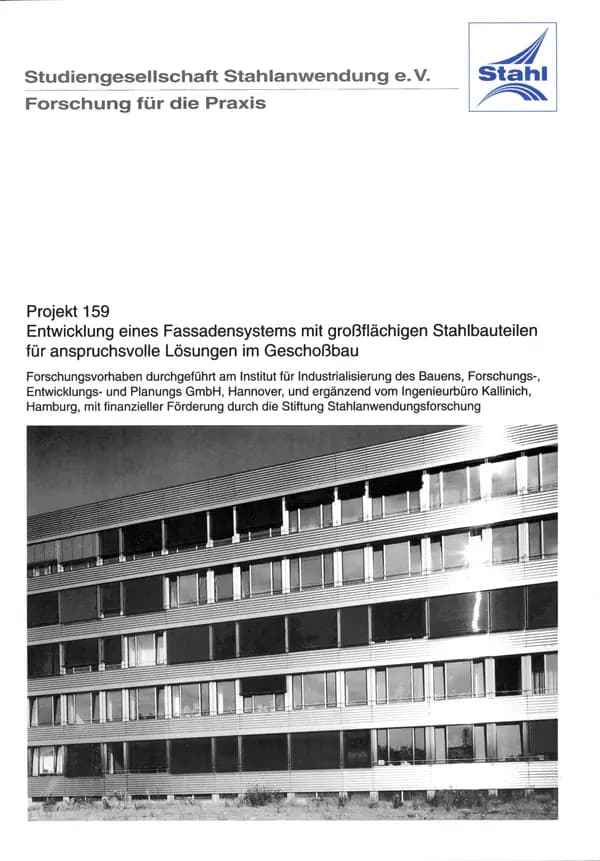
P 159 - Development of a façade system with large-area steel components for sophisticated solutions in multi-storey buildings
Steel as a material has become very familiar from its use in many areas of human life and has proved its worth. Many steel solutions have set the tone in building technology. Modern tasks and the solutions we have to …
Content
- Publication
- 1995
- Authors
- Prof. Dr.-lng.habil. Dr.h.c. H. Weber, Prof. Dr.-lng.habil. H. Hullmann, Dr.-lng. W. Willkomm, Dipl.-Ing. M. Pfeiffer, Dipl.-Ing. D. Kallinich
Steel as a material has become very familiar from its use in many areas of human life and has proved its worth. Many steel solutions have set the tone in building technology. Modern tasks and the solutions we have to provide for them show tendencies to become more and more complex. Holistic considerations have become necessary for the life cycle of material-dependent product or construction choices. This ecological balance, which includes the load as well as the introduction of the dismantled material into a new utilisation cycle, is a primary requirement. Combining these basic requirements is not optimally solved in many cases.
Show full description
Essential for the fulfilment of both tasks is the creativity and implementation potential of people. We all hope that all of these skills will be even more pronounced in future generations. This report is a contribution to this comprehensive area of environmental, energy and economic problems. The perspectives have been chosen in such a way that the present steel applications provide further starting points. The advantage of the transition from steel to stainless steel applications is that thinner cross-sections can be selected for the same performance ranges. This applies in particular to large-format elements that are larger than cassette size. From an economic point of view, this results in only minor cost differences for the basic materials in relation to skylight and façade constructions. Stainless steel also has advantages in terms of the ecological balance, which are particularly noticeable when it comes to utilisation, operation and recycling. The essence of technical publications that deal with development trends is the keyword-like "enumeration" of the various solution approaches. This report should be seen as a kind of stocktaking. From this point of view, it is an aid for interested readers to find information and, above all, suggestions for their work. STUDIENGESELLSCHAFT STAHLANWENDUNG e.V.
Machine-translated title and description. The document itself is in German.
Zum Zoomen hovern
€20.00excl. VAT
Payment by card (Stripe) or invoice (DE, AT, CH). Download link by email: automatically after ordering by card, after order approval for invoice (valid for 30 days). Terms
P 159 - Development of a façade system with large-area steel components for sophisticated solutions in multi-storey buildings—
€20.00