
FOSTA
In recent years, extensive research projects have been carried out at national and international level on the subject of "Fire protection of steel structures" with a focus on material behaviour, fire development and …
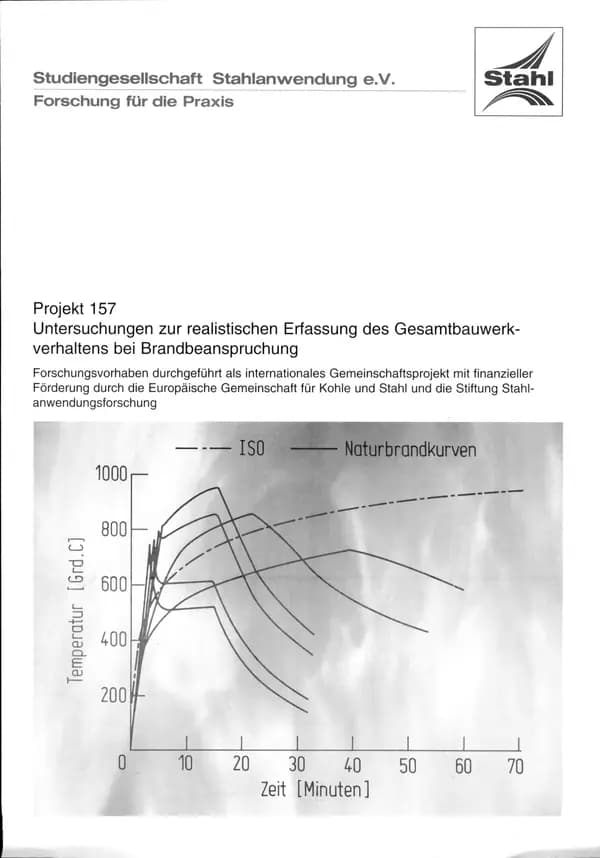
P 157 - Investigations for the realistic recording of the overall structural behaviour under fire exposure In recent years, extensive research projects have been carried out at national and international level on the subject of "Fire protection of steel structures" with a focus on material behaviour, fire development and component behaviour. By summarising these activities, it is possible to create economic benefits for steel construction by simultaneously considering all partial aspects and consistently recording the interactions that occur. The aim of this research project was to review and improve input data and calculation models for the design of steel and composite structures under fire exposure.
The mechanical models for describing the load-bearing behaviour at high temperatures and the thermal models for determining the temperature development and its effects in natural fires, particularly in multi-storey buildings, were worked on. This research report is divided into two parts: 1. the general report, which provides an overview of all the sub-projects and the work carried out and briefly outlines the conclusions. 2. the technical guidelines, in which the results of the project are summarised for practical application. They are primarily aimed at structural engineers and are also intended as a basis for standardisation. The 20 technical guidelines are brief and always begin with a principle or rule, followed by an explanation and - depending on the topic - information on the area of application, explanations and basic principles. These technical documents provide the planner with easy-to-use design aids. STUDIENGESELLSCHAFT STAHLANWENDUNG e.V.
Machine-translated title and description. The document itself is in German.
Payment by card (Stripe) or invoice (DE, AT, CH). Download link by email: automatically after ordering by card, after order approval for invoice (valid for 30 days). Terms
Digital download
Other parts and editions as well as neighbouring documents of the same series.
P 100 - Development of characteristic values for the production of cold rolled profiles from the point of view of economical production of dimensionally accurate profiles Cold profiling using the roll forming process is a forming process that has been used industrially for over half a century. It allows the production of cold-formed profiles with consistent and high dimensional accuracy, some with sharp-edged bends, many curved sections, complicated double folds, with - if desired - targeted work hardening of the starting material and finally the combination of profile shaping with further processing steps such as punching, beading and bending. Although the diverse requirements and the general technical development of mechanical engineering have led to a wide variety of roll forming systems over the course of time, the technology of roll forming is still largely based on practical experience. This applies both to the dimensioning of production facilities and to the design of forming tools. This unsatisfactory situation can probably be explained essentially by the fact that the entire process - in addition to the rather difficult geometric relationships of forming - is governed by numerous working conditions which influence each other. For this reason, the Technical Committee of the German Cold Forming Association has been working closely with a well-known plant manufacturer for several years on the development and dimensioning of a machine and drive concept for research purposes. A machine and control technology solution was developed and realised which for the first time makes it possible to empirically investigate the interactions between the parameters of the production process and the properties of the product in a reproducible manner. This research work was carried out on behalf of the Studiengesellschaft für Anwendungstechnik von Eisen und Stahl e.V. by Prof. Dr.-Ing. D. Schmoeckel, Institute for Forming Technology at Darmstadt Technical University. In addition to confirming some of the results of earlier investigations, new findings of practical relevance were obtained. This applies in particular to the experiments on slip reduction, which resulted in a drastic saving in the energy used, and on the relationship between the quality of the finished product and the selected forming strategy. These results represent a step towards a better understanding of the complex manufacturing process, but at the same time demonstrate the need for further intensive efforts to conduct in-depth research into roll forming technology. The research project was funded by the Federal Ministry of Research and Technology (BMFT) and was supervised by Kernforschungsanlage Jülich GmbH (KFA) as the project sponsor for the raw materials research programme. STUDIENGESELLSCHAFT FÜR ANWENDUNGSTECHNIK VON EISEN UND STAHL e.V. Publication: 1986 Authors: Prof. Dr.-Ing. D. Schmoeckel, Dipl.-Wirtsch.-Ing. U. Eichler
available anytime
€30.00
excl. VAT
Payment by card (Stripe) or invoice (DE, AT, CH). Download link by email: automatically after ordering by card, after order approval for invoice (valid for 30 days). Terms