P 156 - Development of a technology of combined rotary swaging and axial upsetting for the production of lightweight steel hollow bodies
In vehicle, machine and apparatus construction, great efforts are being made to bring units onto the market that can be operated in an energy-saving and environmentally friendly manner. One way to achieve this goal is …
Content
- Publication
- 1992
- Authors
- Prof. Dr.-Ing. D. Schmoeckel, Assoc. Prof.Dr. Sh. Sheljaskow, Dipl.-Ing. Th. Ruhland
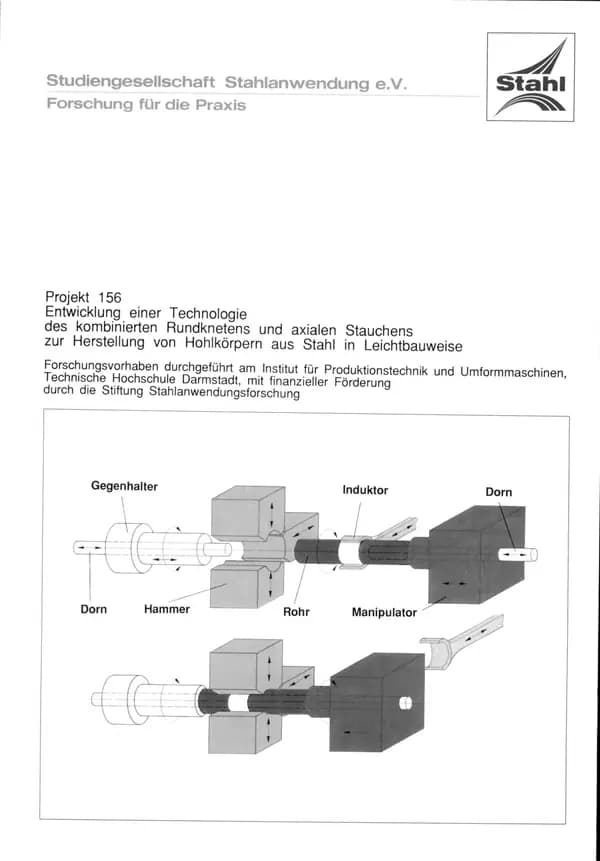
P 156 - Development of a technology of combined rotary swaging and axial upsetting for the production of hollow steel bodies in lightweight construction In vehicle, machine and apparatus construction, great efforts are being made to bring units onto the market that can be operated in an energy-saving and environmentally friendly manner. One way to achieve this goal is to optimise component manufacture in order to reduce weight without sacrificing stability. A good example of this is gear shafts, axles, steering spindles and spinning spindles. In order to fulfil these requirements, a new technology of combined axial and radial forming for the production of workpieces with a pronounced longitudinal axis was developed as part of this research project from an economic point of view.
Show full description
While workpieces of this type are still largely manufactured as solid bodies today, it would be a step forward if hollow bodies in the form of tubes could be used instead of solid bodies in order to save weight. Part of the research work was the testing of a newly developed forming system for axial and radial machining operations, in which inductive heating and stroke position adjustment for machining stepped shafts with different external diameters was integrated; this device enables axial upsetting to produce localised wall thickening. This made it possible to demonstrate the dependencies of the parameters that have a decisive influence on the forming process in a rotary swaging machine. Using the prescribed parameters, the dimensional accuracy and component behaviour of the test specimens made of cold-drawn precision steel tube made of St 37 2 and alloyed steels (e.g. 16 MnCr 5) were investigated and documented. The basic investigations carried out as part of this research project showed that wall thicknesses can be increased and cross-sections widened in a targeted manner. This means that the shape of the formed part can already be largely adapted to the final geometry of the finished part, which means a reduction in the amount of machining required. Furthermore, the expectation was confirmed that this process allows the combined use of cold and hot forging for the production of components with complex geometry in integral design. Depending on the steel grade, a specific combination of hot forming and heat treatment is possible, and thus a defined customisation of the material properties from the forming heat. Compared to conventional process sequences, the new technology is expected to result in advantages for a significantly more rationalised production process and reduced costs in steel forming. In addition, the process offers possibilities for lightweight construction with steel, especially for newly developed high-strength steel grades in conjunction with completely new design guidelines. It is to be expected that this new development will enable steel to maintain and secure its market share compared to substitute materials. STUDIENGESELLSCHAFT STAHLANWENDUNG e.V.
Zum Zoomen hovern
€20.00excl. VAT
Payment by card (Stripe) or invoice (DE, AT, CH). Download link by email: automatically after ordering by card, after order approval for invoice (valid for 30 days). Terms
P 156 - Development of a technology of combined rotary swaging and axial upsetting for the production of lightweight steel hollow bodies—
€20.00