In order to enable users and manufacturers to produce components made of steel materials for high thermal, corrosive and abrasive stresses in a cost-effective and stress-resistant manner, and to expand the range of …
In order to enable users and manufacturers to produce components made of steel materials for high thermal, corrosive and abrasive stresses in a cost-effective and stress-resistant manner, and to expand the range of applications for steel, a joint project has been carried out by Clausthal University of Technology and BAM on the subject of wear protection. By modifying the alloy of the welding additives for nickel-based hardfaced wear-protection layers, it is possible to achieve more favorable machinability without reducing the wear-protection potential. In addition to substituting conventional Co alloys with Ni alloys, this also meets the increasing demand from industry for costeffective milling for defined high-quality surfaces and functional surfaces. In order to cover a wide range of applications, two temperature ranges and/or purposes were examined for various steel base materials and alloy modifications to the corresponding wear protection materials.
For highly heat-resistant steels, the wearresistant alloy (T400) was used, which protects against wear in the temperature range up to 750 °C due to the Laves phase in the Co matrix with high corrosive resistance. For nitriding steels typically used in screw machines, NiCrSiFeB alloys (C 56) can be used for high tribological and corrosive stress in a temperature range of up to 300°C by incorporating carbides and borides into the structure. In addition to the machinability and analyses for ultrasonic-assisted milling, the influences of the modifications using Nb, Hf, Al, Mo and Ti (0,1 % to 1,0 %) on the bonding to the steel material, as well as the metallurgical and manufacturing influences and stresses for the entire component and the effects on the wear protection potential were the focus of the investigations. The experimental investigation and material analysis with regard to the influences on melting, bonding, microstructure and precipitates, as well as the investigation of abrasive and adhesive wear of the alloy modifications, provided comprehensive knowledge for combined production using cladding and finishing milling. By modifying the powder for the PTA processes, microstructures with a finer distribution of the hard phases could be achieved, which led to improved machinability (reduction of cutting forces and tool wear, higher surface quality). The ultrasonic milling process allowed the loads on the tool cutting edges to be reduced further. The adequate wear resistance of these alloy modifications was demonstrated by appropriate wear tests. SMEs benefit from highly economical production and repair of cost-intensive components through component testing, recommendations for action and cooperation with the respective standardization bodies.
Payment by card (Stripe) or invoice (DE, AT, CH). Download link by email: automatically after ordering by card, after order approval for invoice (valid for 30 days). Terms
The objective of this research project was accomplished.
Published in: 2026
Digital download
Payment by card (Stripe) or invoice (DE, AT, CH). Download link by email: automatically after ordering by card, after order approval for invoice (valid for 30 days). Terms
Other parts and editions as well as neighbouring documents of the same series.

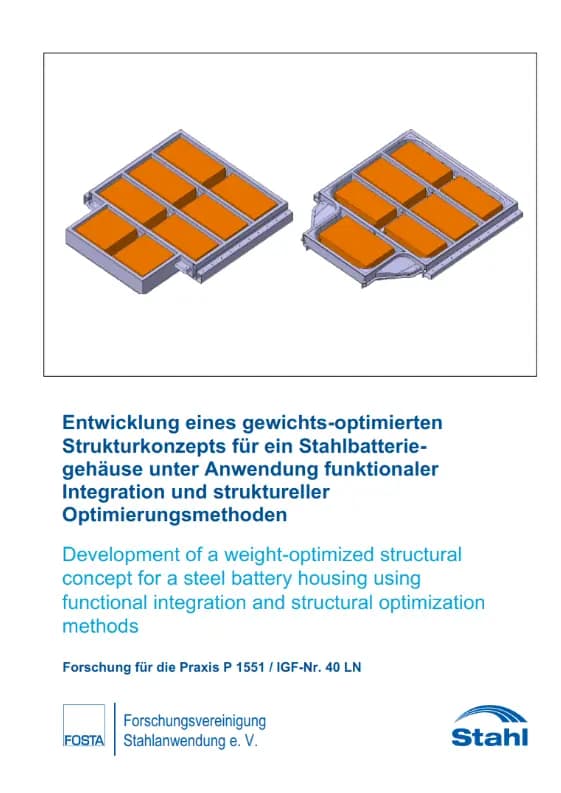
P 1551 - Development of a weight-optimised structural concept for a steel battery housing using functional integration and structural optimisation methods Due to current ecological, economic and social changes, a rethink is currently taking place in the development and design of future vehicles. Many manufacturers are pursuing the development of battery electric vehicles due to one or more of these factors. In today's electric vehicles, the energy storage system accounts for a large proportion of the total weight. This component consists mainly of lithium-ion cells, which are combined into modules and then inserted into a housing structure. The requirements for this structure are diverse and sometimes conflicting. One example of this is the high requirements in terms of crash safety with minimal installation space. It is therefore not uncommon for compromises to have to be found during development, which often result in an increased weight of the housing. In this sub-project, a weight-optimised concept for a steel battery housing was developed, which takes into account the requirements from the overall project with regard to corrosion protection, tightness and joining technology. The concept was considered at system and overall vehicle level in order to take functional requirements into account during development and achieve a high degree of functional integration. The lightweight construction objective was also pursued through the use of virtual optimisation methods. In addition, a sustainability assessment was carried out in the form of a carbon footprint analysis with a comparative reference in order to ecologically assess the battery housing developed. Finally, based on the findings of this sub-project, a sample battery housing was assembled, on which the basic manufacturability and tightness properties were analysed. The objective of the research project was achieved. Publication: January 2025 Authors: S. Spohr, Ch. Krüger, M. Korten, L. Eckstein
available anytime
€30.00
excl. VAT

P 1559 - Integrated planning tool for cost and 3D structural planning for offshore wind farms for H2 generation Due to climate change, there is an acute need for action to switch from fossil fuels to renewable energy sources. Offshore wind farms offer the opportunity to provide large quantities of electricity from renewable energy sources. However, there are periodic fluctuations in electricity production due to the dynamic environmental conditions. In order to enable intermediate storage of the converted energy, it makes sense to produce hydrogen from offshore wind energy. The process used for this is known as electrolysis. This makes it possible to decouple the production and consumption of green energy over time. The problem To date, offshore wind farms with integrated hydrogen infrastructure have only had a low technology readiness level (TRL) due to their novelty. There is a lack of experience in design, planning and project realisation. Flexible planning procedures are required, as the range of configuration options is broad. The various types of electrolysis and transport technologies, with their respective strengths and weaknesses, must be considered and evaluated for the specific application. In addition, the system costs and energy production depend on the environmental parameters, which can vary for each scenario. These influencing variables also have an impact on each other, which increases the complexity of planning the overall system and means that an assessment of feasibility based on economic indicators can currently only be realised with a great deal of effort. Objective and solution The aim of this research project was therefore to create a planning methodology and develop a tool for the 3D structural and cost planning of offshore wind farms with integrated hydrogen infrastructure. In addition, a system dynamics model was created to visualise the relationships between influencing factors. Various system structure options were considered in the project and an application scenario was defined. With the help of configurable parameters (technical, oceanographic, etc.), key figures for the economic efficiency analysis could be created, whereby a scenario-analytical approach was implemented. Geographic information system data (GIS data) was integrated into the system as the data basis for the environmental parameters in order to incorporate environmental parameters and site-specific factors into the planning process (distance to the coast, water depth, etc.). These parameters were used to calculate the hydrogen produced and offset it against the system costs. Benefits The planning tool developed supports companies in the offshore wind industry in the holistic planning and cost assessment of offshore wind farms with a hydrogen infrastructure. Individual scenarios and system designs can be visualised and economically evaluated using an interactive environment. It thus reduces the planning effort for these large-scale projects and supports decision-making in the planning phase. The objective of the research project was achieved. Publication: February 2025 Authors: M. Hayduk, O. Kühn
available anytime
€30.00
excl. VAT