P 151 - Residual stress reduction in roll-formed cold-formed profiles due to vibration superposition during profiling
According to DIN 8586, roll forming is a bending forming process with rotating tool movement. It is a very common manufacturing process in profile production. The cold profiles produced in this way offer the following …
Content
- Publication
- 1989
- Authors
- Prof. Dr.-Ing. D. Schmoeckel, Dipl.-Ing. D. Busse
P 151 - Residual stress reduction in roll-formed cold-formed profiles due to superimposed vibration during profiling According to DIN 8586, roll forming is a bending forming process with rotating tool movement. It is a very common manufacturing process in profile production. The cold profiles produced in this way offer the following main advantages with an almost unlimited variety of shapes: - Consistent product quality, even over large production batches; - targeted utilisation of the production-related increase in strength in lightweight construction and - sensible combination options between profile moulding and further processing steps. One characteristic of roll forming is the inhomogeneity of the changes in shape produced and the resulting residual stresses.
Show full description
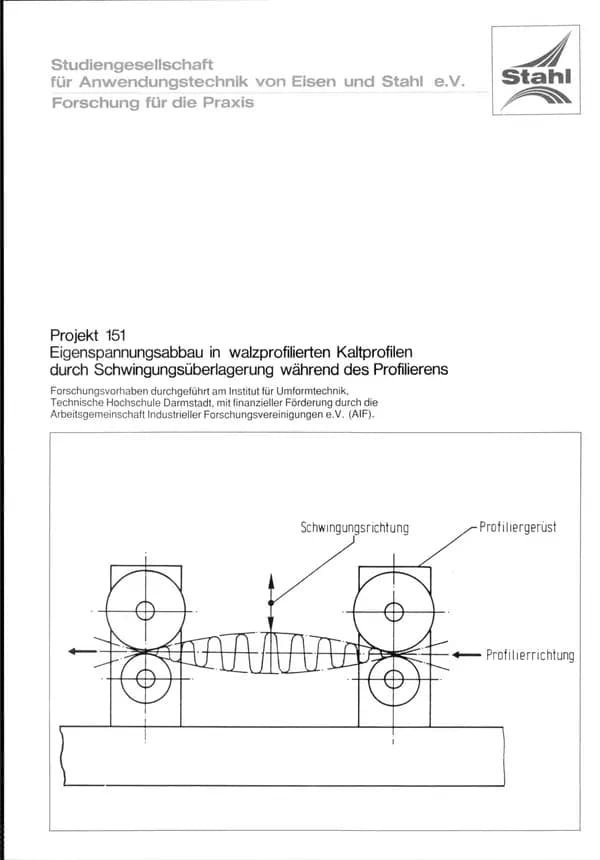
The research project presented here focussed on reducing these process disadvantages while retaining the process advantages. As part of the research project, the fundamental suitability of superimposing bending vibrations for reducing residual stresses was investigated. For this purpose, the running cold profile was subjected to vertical vibrations with variable frequency and variable amplitude between two profiling stands. Furthermore, a largely automated process for recording the residual stress relief was developed as part of the research project. These investigations demonstrated the fundamental suitability of the process of residual stress relief in roll-formed cold-rolled profiles by superimposing vibrations during the profiling process. The decisive parameter of this process is the amplitude and thus the degree of plasticisation over the cross-section of the profile. Amplitudes that are too low can lead to a deterioration of the situation due to residual stress redistribution. Amplitudes that are too high can lead to buckling of the profile leg (formation of waviness at the strip edges). The shape deviation tests carried out as part of the research project made it clear that the process can improve certain shape accuracy criteria if the vibration amplitude is selected appropriately. D. Schmoeckel, Institute for Forming Technology at Darmstadt Technical University, in co-operation with the Fraunhofer Institute for Structural Durability, Darmstadt, with financial support from the Arbeitsgemeinschaft Industrieller Forschungsvereinigungen e.V. (AIF), Cologne, on behalf of the Studiengesellschaft für Anwendungstechnik von Eisen und Stahl e.V., Düsseldorf.
Zum Zoomen hovern
€30.00excl. VAT
Payment by card (Stripe) or invoice (DE, AT, CH). Download link by email: automatically after ordering by card, after order approval for invoice (valid for 30 days). Terms
P 151 - Residual stress reduction in roll-formed cold-formed profiles due to vibration superposition during profiling—
€30.00