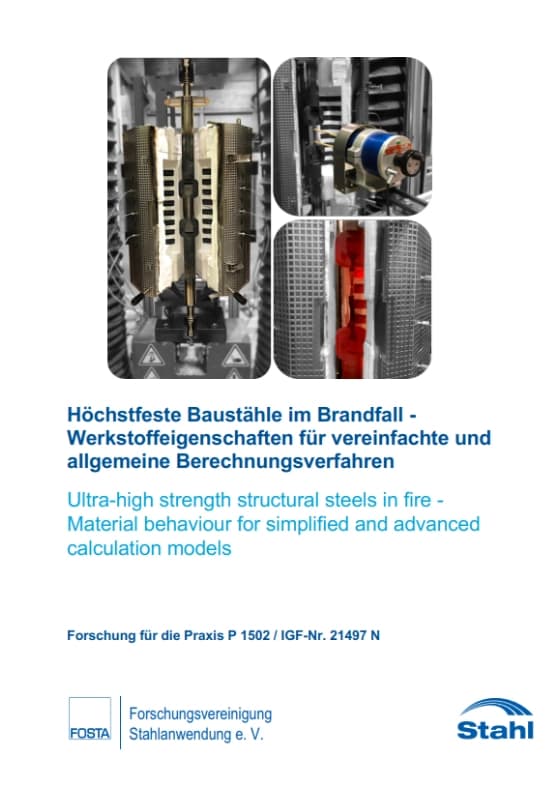
P 1502 - Ultra-high strength structural steels in fire - Material behaviour for simplified and advanced calculation models
Fire hazards represent one of the most important threats to the built environment with significant economic consequences for society and most dangerous threats to life. According to the mortality valuation of the WHO …
Content
- Publication
- 2026
- Authors
- Prof. Dr. sc. techn. M. Knobloch, M.Sc. Sara Uszball
Fire hazards represent one of the most important threats to the built environment with significant economic consequences for society and most dangerous threats to life. According to the mortality valuation of the WHO, fire causes the highest death toll of all types of damage to building structures. Fire engineering is the key discipline to improve fire safety in the built environment in a cost-effective manner. Comprehensive knowledge of the material behaviour in case of fire is the major requirement for a thorough understanding and a realistic modeling of the load-bearing behaviour of structures. High- and ultra-high-strength steels are increasingly used in construction.
Show full description
Because of their good strength-to-weight ratio, they can contribute to resource and energy efficiency of steel structures. Particularly in multi-story and industrial buildings, arenas and high-rise buildings the use of components made of high-strength steels is appealing. A striking obstacle to the use of high-strength steels in such buildings with existing fire protection requirements is a current lack of knowledge regarding the material behaviour and the behaviour of structures made from them during and after a fire exposure. In the context of the research project AiF/FOSTA P 1502; IGF No. 21497 N scientifically and technically suitable approaches for the constitutive description of ultrahigh-strength steels should be made using appropriate theoretical and experimental studies of the material behaviour of ultra-high-strength structural steels. Proposals for their practical engineering and normative implementation should be developed and tools for an efficient protection-oriented fire assessment should be provided. The results of the research project should enable the use of ultra-high-strength steels for buildings with fire protection requirements. To achieve the research objectives, the temperature-, time- and rate-dependent material behaviour of ultra-high-strength structural steels under fire conditions was systematically investigated in an extensive tensile test program. Based on the results, phenomenological material models were developed to describe the experimentally determined material behaviour and the effects of the material behaviour on the behaviour of component and structures in case of fire were analysed with numerical case studies. The developed material models were provided in a practice-oriented manner for the use in fire design of steel structures within the framework of simplified and advanced fire design methods.
Zum Zoomen hovern
€30.00excl. VAT
Payment by card (Stripe) or invoice (DE, AT, CH). Download link by email: automatically after ordering by card, after order approval for invoice (valid for 30 days). Terms
P 1502 - Ultra-high strength structural steels in fire - Material behaviour for simplified and advanced calculation models—
€30.00