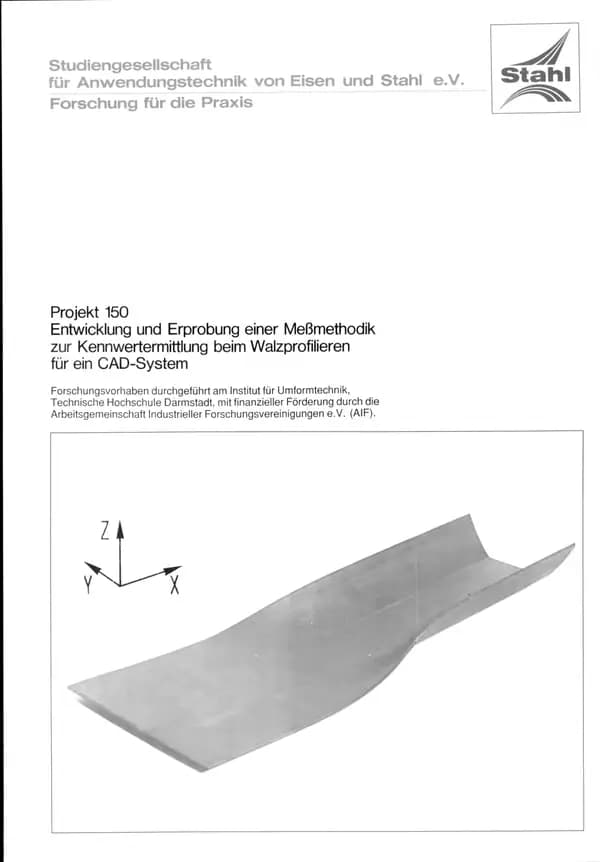
P 150 - Development and testing of a measurement method for determining characteristic values during roll forming for a CAD system
According to DIN 8586, roll forming is one of the bending forming processes with rotating tool movement. It is a very common manufacturing process for profile production. The desired shape is produced by pairs of …
Content
- Publication
- 1989
- Authors
- Prof. Dr.-Ing. D. Schmoeckel, Dipl.-Ing. K. Damm
According to DIN 8586, roll forming is one of the bending forming processes with rotating tool movement. It is a very common manufacturing process for profile production. The desired shape is produced by pairs of bending rolls arranged one behind the other without any desired change in sheet thickness. The number of pairs of bending rollers required depends on the shape to be produced, the material and the specific quality requirements placed on the finished profile. As the material is fed from the coil without additional heat input, homogeneous product properties can be achieved across entire batch sizes. The stationary roll forming process enables high output quantities per time unit.
Show full description
Roll forming is characterised by its continuous process sequence, in which the rolling tools of each forming stand change the position of individual profile elements in relation to other profile elements. So-called forming zones are created before each forming stand. These are areas in which the inclination of the profile legs changes smoothly. As a result, contours are formed that cannot be described analytically. In addition to the desired transverse bending shape changes in the bending edges, undesirable longitudinal shape changes also occur in the legs in the moulding zones, which have a central influence on the shape and dimensional deviations of the finished profile. As part of the present research project, moulding zone sequences with defined parameter settings were generated. These were analysed with regard to homogeneous longitudinal shape changes and longitudinal bending shape changes. Homogeneous longitudinal shape changes were determined by digitising and mathematically approximating selected longitudinal fibres. Longitudinal bending deformation was calculated from local curvature values measured using a three-point spherometer. The findings obtained in this way on longitudinal shape changes in the moulding zones during roll forming as a function of different parameters can be incorporated into a CAD system as characteristic values if this also takes process-related information into account in addition to purely geometric data. D. Schmoeckel, Institute for Forming Technology at Darmstadt Technical University, with financial support from the Arbeitsgemeinschaft Industrieller Forschungsvereinigungen e.V. (AIF), Cologne, on behalf of the Studiengesellschaft für Anwendungstechnik von Eisen und Stahl e.V., Düsseldorf. STUDIENGESELLSCHAFT FÜR ANWENDUNGSTECHNIK VON EISEN UND STAHL e.V.
Zum Zoomen hovern
€30.00excl. VAT
Payment by card (Stripe) or invoice (DE, AT, CH). Download link by email: automatically after ordering by card, after order approval for invoice (valid for 30 days). Terms
P 150 - Development and testing of a measurement method for determining characteristic values during roll forming for a CAD system—
€30.00