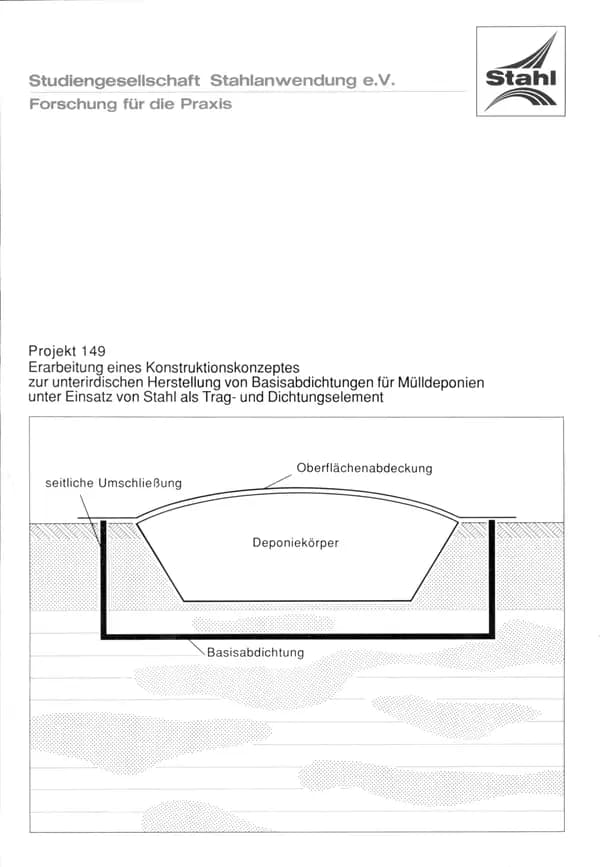
P 149 - Development of a design concept for the underground construction of base seals for landfills using steel as a load-bearing and sealing element
According to the latest surveys, there are around 105,000 suspected contaminated sites in the Federal Republic of Germany, of which the Federal Environment Agency estimates that 10 to 20% are in need of remediation. Due …
Content
- Publication
- 1993
- Authors
- Prof. Dr.-Ing. Maidl, Prof. Dr.-Ing. D. Stein
According to the latest surveys, there are around 105,000 suspected contaminated sites in the Federal Republic of Germany, of which the Federal Environment Agency estimates that 10 to 20% are in need of remediation. Due to improper dumping or incorrect construction and operational designs, many landfill sites have a considerable environmental impact, which can jeopardise the supply networks of residential areas in the form of contaminated leachate via the groundwater. The surface sealing of old landfills and the lateral enclosure of these landfills can be solved satisfactorily with the technology available today. In contrast, shielding the contaminated sites from the subsoil poses considerably greater problems.
Show full description
Methods developed to date are only suitable for use in the construction of new landfills. There is no tried and tested system for the remediation of existing contaminated sites. The Studiengesellschaft Stahlanwendung e.V. has taken up this problem in order to demonstrate the extent to which the use of steel is possible in the remediation of contaminated sites. In two separate studies, carried out by Kocks Consult GmbH, Koblenz, and Ingenieursozietät Technologie Consult, Bochum, possibilities are shown for retrofitting basic sealing of landfills using steel as a load-bearing and sealing element. The paper by Kocks Consult GmbH deals with the following topics: - General tasks in waste disposal, - the use of steel in the remediation of contaminated sites, - Concept for subsequent base sealing, - Recommendations on necessary future investigations, - Listing of further areas of application for steel in environmental engineering projects. The following points were dealt with in the study by lngenieursozität Technologie Consult: - Contaminated sites and contaminated sites, - possible remediation techniques and their application limits, - Encapsulation of old landfills, - geological-hydrogeological boundary conditions, - Ingredients of contaminated sites, - Selection of the mineral sealing material (backfill material) as a basis for the development of an installation method and its testing, - Design of a basic sealing system, - Pipe jacking in the non-accessible nominal diameter range including all ancillary conditions and requirements, - Production of a steel composite shield, - Selection of a suitable cross-section for a steel base seal, - technical construction measures to achieve a high level of positional accuracy during tunnelling, - Summary and assessment of the cross-sectional shapes for a steel base seal, - earth static calculations in the area of a landfill site, - Static calculation of a base sealing made of steel, - economic investigations into the feasibility of a retrofitted base sealing for landfill sites using steel as a load-bearing and sealing element. Extracts from the study are summarised in this report. The complete documentation can be requested from the Studiengesellschaft Stahlanwendung e.V. on request. These studies show the problems that can arise when dealing with contaminated sites. It shows in detail which remediation options currently exist for contaminated sites and where their limits lie. The results of the work were presented to experts from industry, science and the authorities and discussed in detail with them. This crystallised problems that could not be dealt with in the studies or whose final discussion would have gone beyond the scope of the studies. The following questions arise in terms of deepening the research topic: - How can the technical problems that remain unresolved in the execution of a base waterproofing system made of steel elements to be installed subsequently be solved? The following topics are particularly worthy of mention here: 1. the corrosion protection of the installed steel 2. the tightness of the installed base seal and 3. the expected service life of the planned base sealing, taking into account the aforementioned points. - How are the proposed base seals using steel as a load-bearing and sealing element to be assessed economically? In particular, a price comparison of the proposed solutions with other competing alternatives should be carried out. It must be taken into account that the proposed solutions will only be applicable to a limited number of landfills to be encapsulated. - How to ensure compliance with the constantly changing legal regulations (e.g. the TA-Abfall has changed since the study was finalised). The above points show that, in principle, further research into the possible applications of steel in the field of remediation, encapsulation and securing of landfills, including for subsequent base sealing, would be welcome. The irrefutable advantages of steel as a material should be given special consideration. These include above all - the elasticity of a steel link chain in the event of an earthquake, - the possibility of bridging soil disturbances in the area of a base sealing with steel structures, - the possibility of repairing a landfill base sealing under the protection of a steel shield using mining methods - The resulting research work for each individual case will open up material- and technology-optimised applications for steel in the field of landfill technology. STUDIENGESELLSCHAFT STAHLANWENDUNG e.V. Düsseldorf, September 1993
Zum Zoomen hovern
€40.00excl. VAT
Payment by card (Stripe) or invoice (DE, AT, CH). Download link by email: automatically after ordering by card, after order approval for invoice (valid for 30 days). Terms
P 149 - Development of a design concept for the underground construction of base seals for landfills using steel as a load-bearing and sealing element—
€40.00