The aim of the project was to extend the range of applications for hot-dip galvanised components and to increase the cost-effectiveness of infrastructure projects through the advantages of laser beam welding in a vacuum …
The aim of the project was to extend the range of applications for hot-dip galvanised components and to increase the cost-effectiveness of infrastructure projects through the advantages of laser beam welding in a vacuum (LaVa). The aim of this study was to determine the extent to which laser beam welding is suitable for joining large hot-dip galvanised components. The key point here was to first galvanise and then weld the components by modifying the process, which is only possible with laser beam welding in a vacuum. The motivation of the project was therefore to model the welding and galvanising process as precisely as possible and to validate the numerical models.
It was found that the combination in the new process sequence produces favourable residual stress states. A further objective was to optimise the welding process, including the prevention of contamination of the coupling window of the vacuum chamber and the development of integrated corrosion protection. This serves as an alternative to thermal spraying. Subsequently, welds and tests were carried out on components from different process chains in order to investigate the occurrence and influence of residual stresses. The results of the welding investigation show that the joining of galvanised sheets up to 20 mm sheet thickness with zinc up to 200µm in the joining gap is only possible to a limited extent, whereas solid welded joints can be produced in accordance with the standard up to sheet thicknesses of 40 mm when welding without zinc in the joining gap, only on the surface with up to 400µm. The limited weldability is shown by the fact that the weld seam has a pronounced seam collapse, as there is no material in the joint gap due to the evaporating zinc. A model was developed and validated from experimental tests and their numerical calculations. This allowed the stress and strain states after galvanising, laser welding and their combination to be investigated. It was found that the thermal process does not leave any noticeable restrictions in the component after the production steps. Due to the restrictions imposed by the joining process on butt joints, only these can be considered validated for the time being. Fillet welds and other welded joints should therefore be considered in future investigations. The aim of the research project was achieved.
Payment by card (Stripe) or invoice (DE, AT, CH). Download link by email: automatically after ordering by card, after order approval for invoice (valid for 30 days). Terms
Machine-translated title and description. The document itself is in German.
Digital download
Other parts and editions as well as neighbouring documents of the same series.

P 1415 - Innovative load capacity analysis of welded steel components using damage mechanics In this project, the load-bearing behaviour of welded joints, in particular with high-strength steels, was investigated experimentally and using damage mechanics simulations. To this end, a methodology was first developed that allows damage mechanics parameters to be derived for the heat-affected zone and the weld metal. An approach was developed to take into account the mesh size dependency, prepared for application and implemented in commercial FE software. The numerical models were validated in laboratory and component tests. In addition, numerical studies on geometric and material influences on the load-bearing behaviour were carried out. The result of the experimental and numerical investigation is that the influence of soft zones (softening) in the heat-affected zone and also of undermatching in welded joints on the bearing loads is significantly lower than the differences in strength would suggest. The soft zones (softening zones) are forced into softening by high strains, which changes the load-bearing effect. The design rules for welded joints were also scrutinised. This revealed potential for optimisation. Using the findings on the minor influence of softening zones on the load-bearing capacity, a weighted approach to the tensile strength of weld metal and base material for undermatching joints was derived, which means an improvement in the design rules. The results will promote the use of high-strength steels in the future, which will benefit in particular the planning companies, e.g. engineering offices, as well as manufacturers, which predominantly come from the SME sector. In addition, Germany will be strengthened as a business location, as qualifications in the production of welded joints of high-strength steels are available here. The results enable more economical steel constructions, which reduces the consumption of resources and promotes the use of steel as a material. The objective of the research project was achieved. Publication: October 2023 Authors: M. Sc. F. Eyben, M. Sc. H. Bartsch, Dr.-Ing. S. Schaffrath, Univ.-Prof. Dr.-Ing. M. Feldmann, Ch. Häffner, M. Sc., M. Sc. D. Lenz, Dr.-Ing. M. Könemann, Univ.-Prof. Dr.-Ing. S. Münstermann
available anytime
€30.00
excl. VAT

P 1418 - Profile straightening by partial rolling during roll forming As part of the AiF project with the number 20960N, a new and efficient method for straightening defective profiles is being investigated for the established mass production process of roll forming. The aim of the project is to determine the relationship between the longitudinal strain distribution and the profile defects. Based on these findings and the relative longitudinal strain distributions, countermeasures are to be introduced in order to straighten profiles by partially rolling out selected cross-sectional areas. In the first work package, the influencing variables that affect profile defects and longitudinal strains during roll forming are identified. In the second work package, the preparations for numerical modelling and preliminary experimental investigations such as material characterisation are carried out. In the third work package, numerical investigations are carried out on the U and hat profile. Based on the numerically obtained findings on the longitudinal strain curves, partial rolling is investigated. To determine the influence of various parameters on the method of partial rolling, investigations are carried out for both the U-profile and a hat profile. In particular, an asymmetrical geometry is used, as in this case there is a superposition of vertical and horizontal deflection as well as torsion. In parallel, experimental investigations with properties equivalent to the numerical models are carried out for validation. Subsequently, partial rolling for straightening is investigated experimentally. In the first step, partial rolling is applied to the U-profile and then continued with the hat profile. The profile errors can be eliminated by the new method for both the U-profile and the top-hat profile. Equivalent to the numerical and experimental investigations, an analytical calculation model is set up to determine the longitudinal strain distribution based on the profile errors that occur. This analytical calculation model is validated with the numerically determined results for both profiles from the simulation models. The final step is the implementation of the novel method for industrially used profiles. Experimental and numerical investigations are carried out with a complex profile from a project partner. The measured profile errors for the roll-formed profiles are influenced by applying partial rolling and prove that profile errors can also be influenced for more complex geometries. The aim of the research project was achieved. Publication: March 2023
available anytime
€30.00
excl. VAT

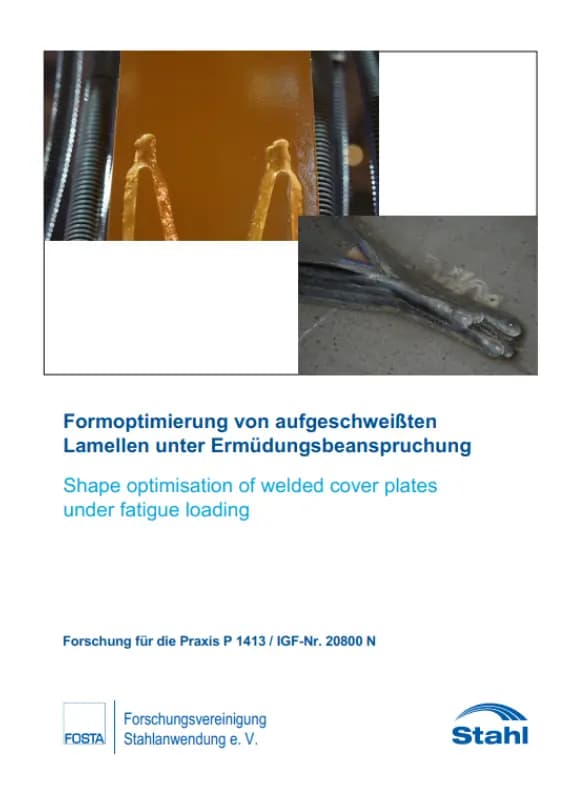
P 1413 - Shape optimisation of welded-on lamellae under fatigue loading A weight-optimised design to avoid an unnecessarily increased consumption of resources is becoming more and more important in terms of economic efficiency and especially against the background of significantly increased procurement prices. Localised reinforcement measures, so-called reinforcement lamellas, are used for this purpose in the construction industry and also in other steel processing sectors. These locally increase the cross-section to match the external stress. In the case of alternating stresses, such as those caused by traffic passing over steel bridges, these structures must be designed to withstand fatigue failure. Here, the very notch-sharp end of the lamella leads to a poor notch case classification, which represents the resistance side in the fatigue analysis. The aim of the research project was therefore to make the end of the lamella significantly less notchy by optimising its shape and production. To this end, various disc shapes and designs were analysed numerically in a first step as part of the preliminary investigations. Experimental investigations were then carried out on selected variants. By varying the disc shape and different designs with, for example, tapered weld seams, the two most promising shapes and designs were then selected for the main tests as part of the preliminary investigations. Influencing factors such as the material quality, the design and the installation situation were analysed experimentally as part of the investigations. In addition, the transferability of the small component tests to larger dimensions was checked by means of large component tests. The design of the tapered lamellae with tapered weld seams proved to be very notch resistant and led to a significant increase in fatigue strength in both the untreated and post-treated states compared to conventional standard moulds. In addition, the parameter range of the experimental tests was extended by a comprehensive numerical parameter study and the design of the lamella shapes was additionally optimised by accompanying numerical models. As part of the project, a design recommendation for tapered weld seams with tapered lamellae was developed on the basis of the nominal and notch stress concept. In order to enable applicability in practice, additional design recommendations were developed that contain quality requirements with regard to the design. The aim of the research project was achieved. Publication: February 2024 Authors: A. Dürr, J. Roth, M. Mensinger, N. Rausch, M. Wilnhammer
available anytime
€30.00
excl. VAT

P 1410 - Extension of DIN EN 1993-1-10 to offshore conditions for notch cases on hollow section connections for jacket construction To date, there are no standardised rules for the design of jacket foundations in offshore applications with regard to material selection and toughness requirements. The aim of this project is therefore to transfer the concept of toughness verification established in civil engineering to jacket foundations in offshore applications on the basis of rules for material selection. Using fracture mechanics concepts for brittle fracture resistant component design, a reference geometry is first identified, crack assumptions are made and a crack propagation calculation is carried out based on the determined load spectrum. This results in the fracture mechanics limit state analysis, which is used to derive toughness requirements. This also takes into account the influences of strain rate, cold forming and the specific offshore operating conditions. The fracture mechanics concept of material selection established in the field of building and bridge construction is thus successfully transferred to jacket foundations. In addition, the project is the first to develop a method for deriving toughness requirements for the component in a specific application with the aid of a damage mechanics model. The modified Bai-Wierzbicki model is used, which can model plasticity, ductile damage and brittle failure as a function of stress state, strain rate and temperature. To ensure comparability between fracture mechanics and damage mechanics, the same boundary conditions are considered. Damage mechanics also derives toughness requirements, confirms the results of fracture mechanics and demonstrates its conservative calculation method. Publication date: November 2022 Authors: Prof. Dr.-Ing. Kühn, P. Krahl, M.Eng, Univ.-Prof. Dr.-Ing. S. Münstermann, D. Lenz, M.Sc.
available anytime
€30.00
excl. VAT
Payment by card (Stripe) or invoice (DE, AT, CH). Download link by email: automatically after ordering by card, after order approval for invoice (valid for 30 days). Terms