Economical crane concepts for the erection of wind turbines reach their limits from hub heights of 140 m, as from this height special crawler cranes have to be used, the rental costs of which are considerable. Their …
Economical crane concepts for the erection of wind turbines reach their limits from hub heights of 140 m, as from this height special crawler cranes have to be used, the rental costs of which are considerable. Their indirect costs should not be neglected either: for example, bridges and roads have to be reinforced to allow the crane transport lorries to pass through and the site itself may have to be prepared at great expense in order to create a level surface large enough for the large crane structure. For this reason, intelligent solutions have been sought for some time that make the use of large specialised cranes superfluous.
In this research project, a self-erecting wind turbine with a steel hybrid tower was therefore developed, which does not require the use of special crawler cranes. The tower of the example system consists of an 80 m high lattice mast tower with a special transition piece, through which the 100 m high tubular steel tower including nacelle and rotor is lifted into its final position with the aid of a strand lifting system. Firstly, sensible size ranges for the lattice mast tower and the tubular steel tower to be analysed are defined, which result on the one hand from the requirements of the lifting process and on the other hand from the turbines currently in use for low-wind locations and in the medium term. The required hub height and rotor diameter, which are taken into account in the design, should be mentioned here in particular. The requirements from the point of view of the turbine manufacturers as well as from the point of view of the specialists for the strand lift are presented in detail and the resulting solutions are harmonised. In the next step, an example system is presented, which is used to illustrate all further design and dimensioning steps. This is followed by the definition of the loads for the final state and for the erection process, whereby the maximum wind loads to be applied during erection require special consideration. Here, too, the experience of the lifting company and the plant operators is taken into account. A specially developed stabilisation system is used to stabilise the tubular steel tower during the lift, which absorbs the tower bending moment via rotating, tracked cylinders that are arranged in two levels in the transition piece and keep the tubular tower vertical. The hydraulic concept for the cylinders is developed and validated using simulations, taking into account the rigidity of the tower shell. The design and dimensioning of the tubular steel tower is initially carried out in the conventional manner for the final state. However, specially developed software is used to optimise the lattice tower, which designs a weight-optimised lattice tower structure based on probabilistic methods. This software is made available to the user. Wind tunnel tests are also carried out to determine the force coefficients required for the design. For the tubular steel tower, it is shown that the transverse loads acting from the hydraulic cylinders can be absorbed. For this purpose, parameter studies are carried out in order to completely cover all phases of the stroke and the previously defined size range for the tubular steel tower. Furthermore, the transition piece is designed and weight-optimised. To this end, requirements from the installation process and the operation of the system are first defined and taken into account in the design. Based on the example turbine analysed, it can be shown that the erection and operation of the self-erecting wind turbine is economically feasible.
Payment by card (Stripe) or invoice (DE, AT, CH). Download link by email: automatically after ordering by card, after order approval for invoice (valid for 30 days). Terms
Machine-translated title and description. The document itself is in German.
Digital download
Other parts and editions as well as neighbouring documents of the same series.

P 1395 - Design of building envelopes in lightweight metal construction for German and European earthquake zones, taking into account load-bearing properties and damage minimisation Building envelopes in lightweight metal construction, such as sandwich elements or multi-shell constructions with trapezoidal profiles, primarily only have a space-enclosing function. For use in industrial and commercial construction, the building envelope is designed for loads resulting from the effects of wind, snow and temperature. This research project investigated the extent to which the wall and roof elements also assume a stiffening and co-supporting function in relation to the main load-bearing structure in the event of an earthquake. Roof and wall elements and their connections with the substructure are analysed experimentally and numerically with regard to their cyclic behaviour, energy dissipation capacity and functionality after seismic events. Firstly, individual connections were tested monotonically and cyclically in the fastener tests. Cut-outs of sandwich elements and trapezoidal profiles were used as test specimens. The parameters sheet thickness of the trapezoidal profiles, sheet thickness of the substructure, component thickness of the sandwich elements and the contact pressure of the screws were varied. In the next step, the load-bearing effect of the sandwich elements and trapezoidal profiles as a wall or roof panel was determined experimentally in the form of shear panel tests. The focus was on analysing the load-bearing behaviour under load at component level. The parameters sheet thickness and component height were varied for the trapezoidal profiles, while the component thickness and core material were varied for the sandwich elements. The numerical model of the reference structure (industrial hall) was used to analyse the contribution of the building envelope to the load transfer of the supporting structure based on the test results. In addition to non-linear push-over analyses, time step analyses were carried out for earthquake loads of different intensities. The experimentally determined monotonic and cyclic behaviour of the elements was also recalculated using analytical approaches. Here, the resulting load-bearing capacity and stiffness of a wall of an industrial hall was determined on the basis of the load-bearing properties of individual fasteners and compared with the test results for wall elements. In addition, building physics tests were carried out on sandwich elements to assess the extent to which sandwich elements would continue to fulfil their function of sealing off rooms after an earthquake event. In particular, the airtightness of the building envelope was analysed. The research results were discussed within the European standardisation committee during the project and used for the new version of EN 1993-7, Annex D. The objective of the research project was achieved. Publication: December 2024 Authors: Prof. Dr.-Ing. Hoffmeister, L. Bittner, Univ.-Prov. Dr.-Ing. T. Ummenhofer, A. Wallner, Univ.-Prof. Dr.-Ing. M. Kuhnhenne, M. Lüdecke
available anytime
€30.00
excl. VAT

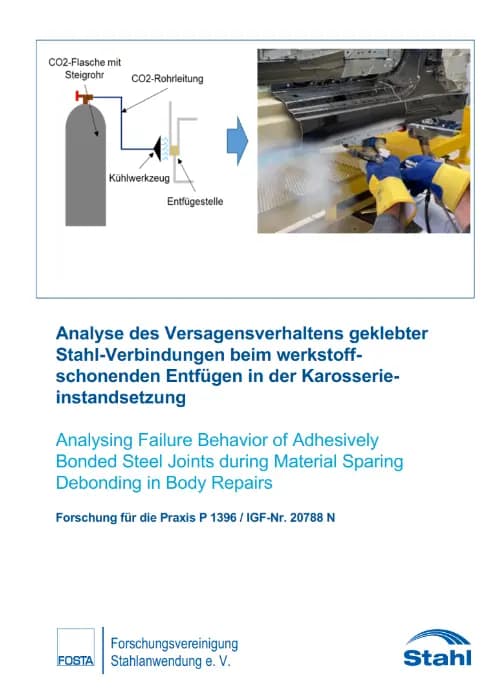
P 1396 - Analysis of the failure behaviour of bonded steel joints during material-conserving debonding in car body repair Current steel-intensive car body concepts are based on the combination of different materials in order to utilise the advantages of the different mechanical properties. These high-performance materials are joined together using adhesive bonding technology to form a lightweight body. Based on a typical product life cycle, many research projects are largely concerned with the research and development, production and operation phases. This research project, on the other hand, focuses on the repair and maintenance of bonded vehicle structures, which are largely carried out in small and medium-sized companies. The increasing requirements for safety and comfort lead to the demand for practicable and sustainable repair methods that produce the same mechanical properties of the joint as the original structure. In repair workshops, bonded joints are often weakened by applying heat in order to reduce the required demoulding force. However, this process, which is difficult to control, has a damaging effect on the components to be bonded and neighbouring adhesive layers and leads to severe component deformation. A process that allows bonded steel joints to be removed gently and efficiently offers a decisive advantage and promotes the circular economy and conservation of resources. In tests, the embrittlement of the adhesive due to low temperatures proved to be very promising for component-friendly separating. In DMTA tests, structural adhesives show a secondary glass transition below the usual application temperature of -40 °C. This is due to the viscoplasticity of the adhesive. This is due to the viscoplasticising particles in the adhesive. The hypothesis that cooling below this secondary glass transition greatly reduces the energy absorption of the adhesive and that this can lead to the realisation of a component-friendly debonding process for the steel materials was confirmed in this work. The possibilities and limitations of this process were successfully investigated and the failure behaviour of the adhesive was analysed. Publication: April 2022 Authors: Prof. Dr.-Ing. G. Meschut, Dr.-Ing. D. Teutenberg, N. Chudalla, Prof. Dr.-Ing. M. Wibbeke, Dr. A. Bartley
available anytime
€30.00
excl. VAT

P 1397 - Model-based life cycle engineering for the development of eco-efficient components and structural parts for vehicle applications This final report describes the work carried out and project results of the research unit Institute for Machine Tools and Production Engineering (IWF) of the Technical University of Braunschweig in the IGF research project "Model-based life cycle engineering for the development of eco-efficient components and structural parts for vehicle applications (MBLCE)" for the period from 01 October 2021 to 30 September 2023. The MBLCE project focussed on the development of a methodology for conducting a life cycle analysis of automotive parts/components and the transfer of the methodology into a suitable tool. As a web application, this tool developed in the project supports users in carrying out life cycle assessments for individual components, determining the break-even point for alternative materials and evaluating the effects of the material and process efficiency of various production processes on life cycle emissions. In addition, the tool facilitates scenario analyses by enabling users to change the electricity mix in the production and use phase and also to understand the emissions from raw material extraction to the recycling of a component. For decision-making purposes, the tool can assist in selecting the most suitable material or an alternative component design made from the same material. This approach enables users to both minimise environmental impact and maximise process efficiency. These objectives of the research project were achieved. Publication: April 2024 Authors: J. Haupt, St. Blömeke, Prof. Dr.-Ing. Ch. Herrmann
available anytime
€30.00
excl. VAT

P 1398 - Forecast models for the service life and continued operation of wind turbines The energy transition is a global challenge. Energy generation with renewable energies, and wind energy in particular, plays a key role here. For an economical design of tubular steel towers of wind turbines, the proof of operational stability is relevant and often decisive. Local concepts enable an improved proof of fatigue strength and a realistic prediction of the service life for typical construction details of wind turbines, such as the horizontal butt weld. They also allow the decisive influencing variables to be explicitly taken into account and contribute to reliable decisions regarding the extended continued operation of existing turbines. In this research project, the existing experimental investigations in the literature were initially analysed in a targeted manner and the need for additions was determined. Compared to structural engineering structures, wind turbines differ from them in key aspects with regard to the type and extent of stress. These include the total number of cycles during the service life (~108 to ~109) and the specifics of the sequence of stresses, which is difficult to predict. At present, the nominal stress concept, the structural stress concept and the notch stress concept are usually used, which essentially differ in terms of the effort required and the mapping of the notch geometry. On the basis of the investigated input variables, e.g. material behaviour and geometry of the weld seam, the two-phase model was extended to construction details typical for wind turbines in order to explicitly and accurately capture the crack initiation phase and crack propagation. The two-phase model makes it possible to take into account a large number of input variables, which were determined as part of the research project by means of experimental investigations, FE calculations and analytical approaches and whose influence on the fatigue strength was analysed as part of sensitivity investigations. The experimental investigations include material characterisation, notch detail and component tests. The existing database in the VHCF range (up to 108 cycles) was expanded using notch detail tests with a sheet thickness of 10 mm. In addition, notch detail tests were carried out with a thickness of 20 mm and 35 mm in order to be able to record any influence of the sheet thickness. The findings of the notch detail tests were confirmed by three component tests with pipes with an outer diameter of 610 mm and a wall thickness of 14.3 mm. The input variables determined from the experimental investigations, FE calculations and analytical approaches served as the basis for a probabilistic prediction model and Monte Carlo simulations. Simplified models for engineering practice were derived on the basis of the nominal stress concept using our own tests and the Monte Carlo simulations. With the help of the methodology described above, a basis for a resource-saving and targeted fatigue strength verification of horizontal butt welds was created for engineering practice. The objective of the research project was achieved. Publication: August 2023 Authors: Prof. Dr sc. techn. habil. M. Knobloch, H. Bissing, Prof. Dr.-Ing. M. Rauch
available anytime
€30.00
excl. VAT
Payment by card (Stripe) or invoice (DE, AT, CH). Download link by email: automatically after ordering by card, after order approval for invoice (valid for 30 days). Terms