According to the current state of the rules and regulations for steel construction (Eurocode 3, /1/), the use of high-strength steels with yield strengths above 450 N/mm is severely restricted or excluded. This is due …
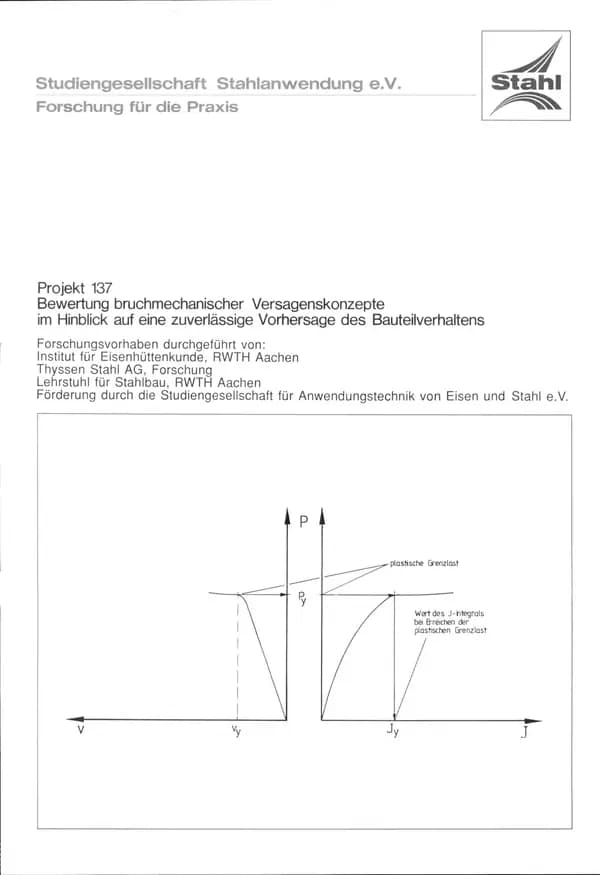
According to the current state of the rules and regulations for steel construction (Eurocode 3, /1/), the use of high-strength steels with yield strengths above 450 N/mm is severely restricted or excluded. This is due to the conventional assessment criteria and safety philosophies. However, several concepts have been developed in recent decades to assess the failure behaviour of components, which are based on fracture mechanics approaches and thus enable the component behaviour to be quantified. These methods have not yet found their way into design regulations for steel construction and are to be tested for their applicability as part of this research project.
This research project also aims to show whether a fracture mechanics assessment of material and component behaviour can provide advantages for the application of high-strength steels. The results should encourage a reconsideration of the currently valid regulations and, if necessary, the use of fracture mechanics methods as a basis for assessing the failure behaviour of materials and components, so that high-strength steels can be included in the regulations. We would like to briefly explain the following about the research work carried out: The base material and welded joints of two steels of different toughnesses of the grades StE 355, StE 460, StE 690 as well as a St 37-3 and X8 Ni9 were analysed. Initial investigations into the suitability of these materials were carried out using tensile and notched bar impact tests. To check the existing fracture mechanical failure concepts, tests were carried out with large tensile specimens similar to components at - 20 " C (- 160 ° C for X8 Ni9). These specimens were provided with centre flaws with flaw lengths that are just permissible according to Eurocode 3 (draft 1983) for tensile structures and also with a significantly greater flaw length. The fracture mechanics tests were confirmed by the large tensile tests with regard to the toughness properties in the base material and in the HAZ. An evaluation of the results of the large-scale tensile tests using fracture mechanics concepts led to reliable estimates of the failure behaviour of the large-scale specimens, with the smallest deviations occurring between prediction and experiment when finite element calculations were used to determine the fracture mechanical stress. The simplified ultimate load model of Eurocode 3 can be applied to tensile bars made of high-strength steels on the basis of the test results and opens up the possibility of designing and building economically with high-strength steels. STUDIENGESELLSCHAFT FÜR ANWENDUNGSTECHNIK VON EISEN UND STAHL e.V.
Payment by card (Stripe) or invoice (DE, AT, CH). Download link by email: automatically after ordering by card, after order approval for invoice (valid for 30 days). Terms
Machine-translated title and description. The document itself is in German.
Digital download
Other parts and editions as well as neighbouring documents of the same series.

P 130 - Ensuring high quality of welded steel structures by means of statistically assessed quality control and welding simulation Notched bar impact toughness tests on heat-affected zones of welded micro-alloyed fine-grained structural steels often show considerable scatter in the notched bar impact energy values despite identical production conditions. On the one hand, these scatters are due to geometric influences such as sampling locations, notch positioning, crack progression in the HAZ etc. as well as process-related influences such as the width of the HAZ, non-linear progression of the fusion line, grain size differences after the growth phase within the HAZ, inaccurate test conditions. On the other hand, the deviations are due to different base material conditions caused by different batches and small differences in the thermomechanical rolling process. These variations have not yet been recorded statistically, i.e. neither qualitatively nor quantitatively. Similarly, there is still no criterion for predicting the impact strength values of the HAZ of welded joints from the mechanical-technological properties of the base material. The mechanical-technological properties of micro-alloyed fine-grain structural steels depend largely on the choice of alloying elements, the degree of impurity, the existing precipitation state, the cooling conditions and, if carried out, on thermomechanical treatment. In the large-scale production of these fine-grained structural steels, however, it is not always possible to adhere exactly to the specified target values and treatments. This inevitably results in different material properties. The more complicated the manufacturing process of a micro-alloyed fine-grained structural steel is, the more likely it is that the resulting mechanical-technological properties, especially with regard to weldability, will be significantly worse than the target specification due to a random sequence of treatment steps during production that leads to negative quality values. The failures of notch impact energy values on welded joints observed particularly on micro-alloyed fine-grained structural steels, which are due to a lack of toughness properties in the HAZ despite the prescribed heat treatment during welding, cannot yet be predicted before the weld is completed. Detailed studies on this subject do not yet exist. As predicting the toughness properties of the HAZ of a welded joint before processing is not yet state of the art, quality values can only be determined after welding has been completed. If a statistically validated method for predicting toughness were determined, costly and time-consuming subsequent testing procedures could at least be limited. In addition, the early detection of bad batches is also a way of ensuring high product quality and thus avoiding considerable quantities of rejects. Publication: 1988 Authors: Prof. Dr.-Ing. F. Eichhorn
available anytime
€30.00
excl. VAT

P 100 - Development of characteristic values for the production of cold rolled profiles from the point of view of economical production of dimensionally accurate profiles Cold profiling using the roll forming process is a forming process that has been used industrially for over half a century. It allows the production of cold-formed profiles with consistent and high dimensional accuracy, some with sharp-edged bends, many curved sections, complicated double folds, with - if desired - targeted work hardening of the starting material and finally the combination of profile shaping with further processing steps such as punching, beading and bending. Although the diverse requirements and the general technical development of mechanical engineering have led to a wide variety of roll forming systems over the course of time, the technology of roll forming is still largely based on practical experience. This applies both to the dimensioning of production facilities and to the design of forming tools. This unsatisfactory situation can probably be explained essentially by the fact that the entire process - in addition to the rather difficult geometric relationships of forming - is governed by numerous working conditions which influence each other. For this reason, the Technical Committee of the German Cold Forming Association has been working closely with a well-known plant manufacturer for several years on the development and dimensioning of a machine and drive concept for research purposes. A machine and control technology solution was developed and realised which for the first time makes it possible to empirically investigate the interactions between the parameters of the production process and the properties of the product in a reproducible manner. This research work was carried out on behalf of the Studiengesellschaft für Anwendungstechnik von Eisen und Stahl e.V. by Prof. Dr.-Ing. D. Schmoeckel, Institute for Forming Technology at Darmstadt Technical University. In addition to confirming some of the results of earlier investigations, new findings of practical relevance were obtained. This applies in particular to the experiments on slip reduction, which resulted in a drastic saving in the energy used, and on the relationship between the quality of the finished product and the selected forming strategy. These results represent a step towards a better understanding of the complex manufacturing process, but at the same time demonstrate the need for further intensive efforts to conduct in-depth research into roll forming technology. The research project was funded by the Federal Ministry of Research and Technology (BMFT) and was supervised by Kernforschungsanlage Jülich GmbH (KFA) as the project sponsor for the raw materials research programme. STUDIENGESELLSCHAFT FÜR ANWENDUNGSTECHNIK VON EISEN UND STAHL e.V. Publication: 1986 Authors: Prof. Dr.-Ing. D. Schmoeckel, Dipl.-Wirtsch.-Ing. U. Eichler
available anytime
€30.00
excl. VAT
Payment by card (Stripe) or invoice (DE, AT, CH). Download link by email: automatically after ordering by card, after order approval for invoice (valid for 30 days). Terms