As part of the project, arc brazing was investigated as a replacement for conventional welding of secondary attachments on dynamically loaded structures in order to reduce the notch effect without additional post-weld …
As part of the project, arc brazing was investigated as a replacement for conventional welding of secondary attachments on dynamically loaded structures in order to reduce the notch effect without additional post-weld treatment in addition to the necessary static strength. Various brazing materials were analysed with regard to their suitability for brazing and, in view of the results and material costs, the copper-based alloy CuAl7 was selected for the main tests. All brazing alloys exhibit good strength properties, even for heavy plate joints, some of which can be above the base material level of normal-strength structural steels.
In the majority of the compounds, LMPs (liquid metal penetration) occurred in the diffusion zones, whereby no negative influence on the mechanical-technological properties could be proven. Based on parameter studies and numerous test solderings, best practice framework conditions and preliminary soldering instructions (pBPS) were formulated for the respective processing. The seams of the test specimens were characterised microscopically and in terms of hardness curves, residual stresses and distortion. Despite the significantly lower energy input compared to welding, soldered joints exhibit a similar residual stress level at the weld toe and a similarly strong tendency to warp. This is due to the significantly higher coefficient of linear thermal expansion of the Cu alloy with comparable high-temperature strength. As part of the fatigue strength tests, the geometries of the brazed components, base plate thicknesses, base material strengths and load conditions were systematically varied on arc-brazed samples and compared with welded reference test specimens. A total of 11 Wöhler lines were recorded for this purpose. The brazed-on or welded-on details used were discs/doubles and the welded bushings typical for wind turbine towers. The observed failure characteristics of the details with brazed attachments are comparable with welded details. Starting from the weld seam transition, a fatigue crack develops in the base material, which ultimately leads to the failure of the component. The slope of the Wöhler curve is comparable to that of welded details ( m ≈ 3). The fatigue strength is significantly higher for the arc-brazed details. A general notch case Δσc = 100MPa was determined from the tests for the brazed bushings. The brazed-on discs and lamellae provided a notch drop Δσc = 80MPa. No sheet thickness influence could be observed on the 20 mm thick and 40 mm thick base plates analysed. The numerical investigations suggest that no geometric sheet thickness influence is to be expected in the range above 40 mm sheet thickness either. The geometry of the brazed-on plates only influences the fatigue strength for geometries with very small diameters. The discs with a longitudinal diameter of 500 mm show no statistically significant difference in fatigue strength compared to the components with a longitudinal diameter of 75 mm. The experimental investigations were unable to prove any correlation between the fatigue strength of brazed add-on parts and the strength of the base material. In order to be able to formulate a static design approach for arc-brazed joints, small-scale tensile specimens were taken from brazed seams on steel and copper blocks. The strength values determined varied considerably in some cases between the brazing details taken (fillet weld, application bead) and the substrate used (steel, copper) with the same energy input. This suggests that the cooling conditions and the degree of mixing have a significant influence on the seam strength. It was found that high cooling rates and mixing with iron substrate, which acts as a fine-grain former in copper, lead to high strengths. The results obtained were compared with the static pull-off and shear-off tests. Component tests on fillet welds to determine the static strength of the CuAl7 brazing material showed that failure occurs in the seam, as with weld details. The strength of the filler metal is comparable to filler metals made from normal-strength steel. A method for weld seam design was presented that is based on an existing verification format in the Eurocode. Finally, an economic analysis using the example of welded / brazed bushings showed that the use of arc brazing is considerably more favourable than the combined use of welding process and weld seam post-treatment process to increase the fatigue strength. This is due to the fact that no additional post-treatment step is necessary and the resulting labour costs are saved as a cost driver.
Payment by card (Stripe) or invoice (DE, AT, CH). Download link by email: automatically after ordering by card, after order approval for invoice (valid for 30 days). Terms
Machine-translated title and description. The document itself is in German.
Digital download
Other parts and editions as well as neighbouring documents of the same series.

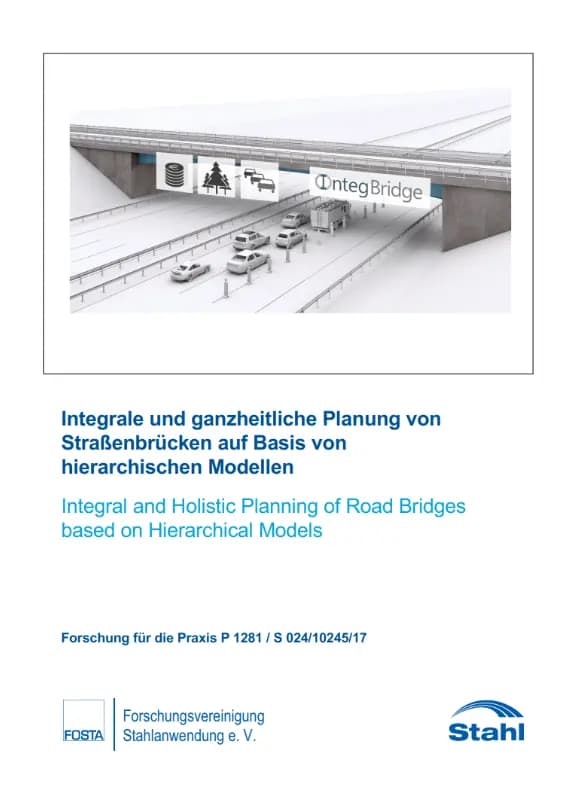
P 1281 - Integral and holistic planning of road bridges based on hierarchical models The IntegBridge research project provides a solution for the semi-automated and computer-aided holistic assessment of bridge variants. To this end, algorithms are used for the holistic, life cycle-orientated calculation of the life cycle assessment, economic and macroeconomic effects of a bridge variant. The input data comes from different data sources, which are linked to each other and to construction models using a linked data approach. BIM models can be used as the basis for determining quantities for the quantitative calculations to be carried out. Components of the BIM models are linked with pre-balanced elements and stored in a database so that cost estimates, life cycle assessment effects and construction times are available as input data for the calculations. In order to enable application in different planning phases, the pre-balanced elements are provided in various levels of detail. To map the entire life cycle of a bridge structure, different maintenance strategies can be selected, which are automatically integrated into the model via subsequent elements and represent the various maintenance measures in the life cycle. After being linked to the pre-balanced elements, the BIM models can be transferred via proprietary interfaces (ODBC) or open data exchange formats (IFC) to the IntegBridge software prototype, in which the holistic calculations are carried out. Some additional input data must be defined there that cannot be provided in the components. These are, for example, the traffic routes, the discount rate, the maintenance strategy to be used and information on the traffic load. The construction-related costs, life cycle assessment effects and economic costs of a variant can then be calculated. Economic costs are mainly caused by construction-related traffic disruptions and the resulting time lost by road users. A deterministic queueing model is stored in the algorithm for the calculation. The workflow developed (see Figure 1) makes it possible to evaluate bridge variants holistically. In this way, different bridge variants can be compared with each other at an early stage and the preferred variant can be continuously optimised in terms of its economic, ecological and macroeconomic effects by means of an analysis accompanying the planning process. The aim is to realise the most advantageous bridge variant for the specific location rather than the cheapest in terms of construction costs. Authors: M. Müller, Dr.-Ing. T. Zinke, Dipl.-Ing. M. Hermann, Prof. Dr.-Ing. T. Ummenhofer
available anytime
€30.00
excl. VAT

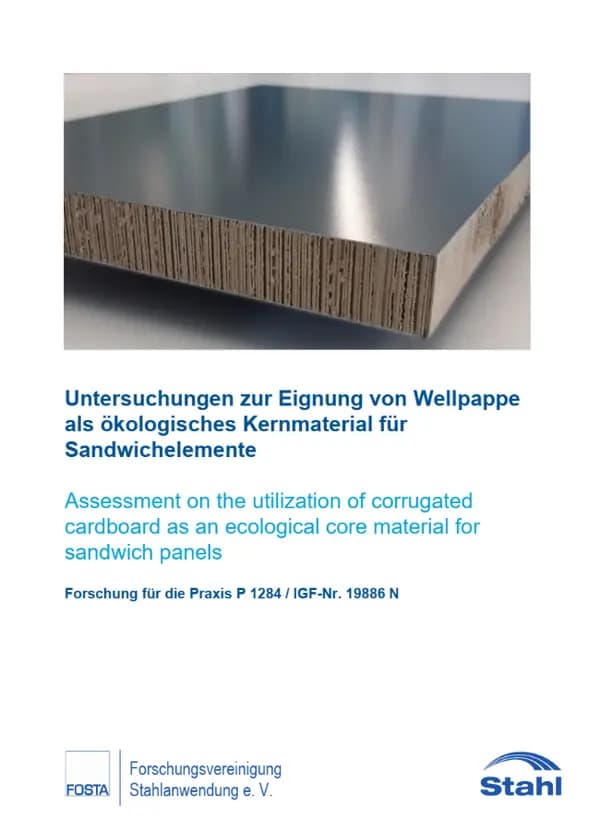
P 1284 - Investigations into the suitability of corrugated board as an ecological core material for sandwich elements This project investigated the suitability of corrugated board as an alternative core material for sandwich elements for cladding roof and wall surfaces. For this purpose, the most important fundamentals of paper and corrugated board on the one hand and sandwich construction on the other were compiled. Based on this, a suitable material model was found and the elastic material parameters and strengths were determined for a total of 10 different types of corrugated board. The tests to determine the elastic material model could not be statistically analysed due to the insufficient number of tests. However, despite some large scatter, the tests allow a basic evaluation of the load-bearing behaviour of corrugated board. In bending tests on sandwich samples in the form of beams and components, the composite load-bearing behaviour was investigated for four selected types of corrugated board and three different core orientations. The influence of the inhomogeneity of a core made of prefabricated lamellas was also analysed. The bending tests of the elements with the weakest core orientation, in which the flat papers lie parallel to the cover layers of the components, resulted in load-bearing properties comparable to those of sandwich elements with conventional core materials when using high-quality corrugated cardboard. For the elements of the other two core orientations, the flat papers are in the XZ plane of the sandwich elements. These provide such good support for the surface layers to prevent them from moving out of their plane that even steels with yield strengths of up to 500 N/mm² can be stressed to the point of yielding. Similar to conventional materials, the elements with the weakest core orientation exhibit such high creep coefficients that a planned continuous loading of elements with flat surface layers is not compatible with the serviceability requirements. The other element types, on the other hand, showed such small time-dependent increases in deformation that it may be possible to open up further areas of application for these elements with planned continuous loading. Investigations into the thermal conductivity of selected boards showed that the best thermal insulation properties were achieved in the core orientation of the type 1 tested. The insulating properties are close to those of mineral wool elements. For elements of types 2 and 3, the measurements showed similar thermal conductivities for both types. However, these are so high that the use of this type of element for heated residential buildings would hardly be feasible in practical construction terms. Investigations into moisture protection have shown that condensation cannot form in a sealed core. Long-term experiments on components with one side edge each, which was not protected and exposed to high ambient humidity, have shown that moisture from the air slowly penetrates into an element. Element sides that are unprotected from the environment should therefore be avoided. Publication: January 2021 Authors: Prof. Dr.-Ing. J. Lange, Dipl.-Ing. A. von der Heyden
available anytime
€30.00
excl. VAT

P 1285 - Integral solutions for energy-plus buildings 2.0 in lightweight steel construction Until now, research into the sustainability and energy efficiency of buildings has mostly focussed on residential and administrative buildings. Industrial and commercial buildings have received little attention. This type of building also falls under the EU's Energy Efficiency Directive 2012/27/EU and must be operated in an energy-neutral manner in future. Yet these buildings in particular offer a great deal of potential for saving CO2, as they combine large volumes and surfaces with an efficient, industrialised construction method. In the research project, a holistic approach to the planning and construction of commercial buildings is being developed with the aim of constructing grid-friendly plus-energy buildings and providing corresponding planning recommendations. The possibilities of operating heating and cooling on the basis of renewable energy and generating both electrical and thermal energy on site are being analysed. Based on a comprehensive analysis of the building typology of a commercial building with an office extension, design recommendations are developed and a model building is planned. Steel-based components are being developed for this, which are being analysed in the laboratory and in long-term tests to determine their performance and interaction in a TGA concept. Radiation-based surface heating and cooling elements using thermally activated trapezoidal profiles proved to be a sustainable solution for transferring heat to the room in terms of performance, efficiency and design. The regenerative energy used for this can be obtained using the innovative steel energy piles analysed. Compared to conventional systems, clear advantages in terms of performance were demonstrated. The invisible and façade-integrated solar collectors developed can also be used as a further regenerative source. This can also be used to prevent undercooling or overheating of the ground. The investigated façade application of organic photovoltaics can help to supplement the electricity yield from a classic silicon-based system on the roof. As part of the project, it was shown that the technologies described can be used efficiently and that plus-energy buildings in lightweight steel construction are possible. Publication: 2021 Authors: Prof. Dr.-Ing. M. Kuhnhenne, Dipl.-Ing. V. Reger, Prof. Dr.-Ing. H. Hachul, Prof. Dr.-Ing. Bernd Döring, M. Sc. T. Blanke
available anytime
€30.00
excl. VAT

P 1287 - Concrete-filled hollow section composite columns for multi-storey buildings - Innovation and design Composite columns are used in building and industrial construction due to their many favourable properties. On the one hand, columns with smaller cross-sectional dimensions can be realised with high load-bearing capacities at the same time. On the other hand, high fire resistances can be realised without additional fire protection measures. This is made possible by the targeted combination of the material properties of steel and concrete, in particular the high strength and rigidity of steel and the low thermal conductivity of concrete. Concrete-filled hollow section composite columns using high-performance materials have the potential to exhibit even greater load-bearing resistance or slimmer column cross-sections and thus open up further markets. As part of the FOSTA research project Concrete-filled hollow section composite columns for multi-storey buildings Innovation and design (IGF project no.: 19677), the stability behaviour of hollow section composite columns was investigated using experimental, numerical and analytical methods. The current version of Eurocode 4, Part 1-1 Design of composite steel and concrete structures contains verification methods for various types of composite columns. However, there are currently no standardised simplified verification methods for standard temperatures and fire design for concrete-filled hollow section composite columns with a solid steel core and double hollow section composite columns. This is where the research project came in. The experimental investigations comprised a total of 24 column tests with different cross-sections, dimensions, steel grades and concrete strengths. So-called stub column tests were carried out to experimentally analyse the cross-section capacity. In addition, one-storey (4m) and two-storey (8m) columns with practical cross-sectional dimensions were tested in order to evaluate the use of high-strength materials (structural steel S770 and S890 as well as concrete C100/115) in practice. Based on the ultimate load tests at normal temperature, a numerical model was developed which implies experimental material properties, composite effect, geometric imperfections and residual stresses. Numerical simulations and parameter studies were used to describe and investigate the basic structural-mechanical behaviour of the composite column cross-sections. In addition, an FE model for fire simulations was developed, validated using external tests and simulation studies on fire behaviour under a standard temperature-time curve with utilisation levels relevant to construction practice were carried out. Based on experimental and numerical results, a simplified analytical model was developed for verification in accordance with Eurocode 4. In addition, the scientific basis for a simplified verification procedure for the design of innovative concrete-filled hollow section composite columns in the event of fire was developed. Publication: 2021 Authors: Prof. Dr sc. techn. habil. M. Knobloch, M.Sc. P. Schurgacz
available anytime
€30.00
excl. VAT
Payment by card (Stripe) or invoice (DE, AT, CH). Download link by email: automatically after ordering by card, after order approval for invoice (valid for 30 days). Terms