A sharp increase in traffic loads has led to extensive fatigue damage to existing orthotropic steel carriageway slabs. Although reinforced concrete bridges and conventional composite bridges are less susceptible to …
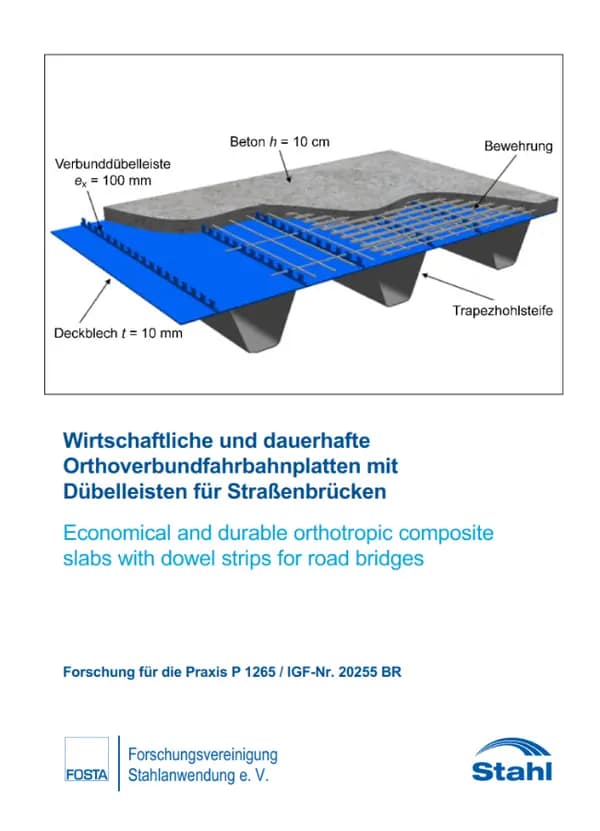
A sharp increase in traffic loads has led to extensive fatigue damage to existing orthotropic steel carriageway slabs. Although reinforced concrete bridges and conventional composite bridges are less susceptible to fatigue, they are considerably heavier. The so-called orthocomposite deck slab is a lightweight and robust alternative construction method that retains the advantages of the aforementioned construction methods but eliminates their disadvantages. In this research project, the construction of the bridge deck is being developed using dowel bars as a composite material with high load-bearing capacity and fatigue strength.
In contrast to conventional steel composite construction, the dowel bars in the ortho-composite slab create a two-dimensional bond. The transverse and biaxial loading of the strips has not yet been investigated. In addition, a strip geometry outside the parameter range covered by the general type approval (aBG) Z-26.4-56 was designed for the orthocomposite carriageway slab. The experimental, analytical and structural-mechanical investigations focus on the load-bearing effect of the carriageway slab under local wheel loads as well as the load-bearing capacity and fatigue strength of the dowel bars under loading in the transverse direction and under combined loading in the longitudinal and transverse directions. The test programme includes static shear tests on composite dowel bars in their longitudinal and transverse directions as well as static and cyclic beam and segment tests. As a result of the shear tests, the validity of aBG Z-26.4.-56 for the longitudinal direction of the dowel bar can be confirmed and the design value and damage mechanism for the transverse shear load-bearing capacity and the deformation behaviour in the transverse direction can be determined. Based on the beam tests, the local load transfer as well as the redistribution potential of the dowel bar in the transverse direction is emphasised and the approach of the notch case 80 at the seam transitions at the connection of the composite dowel bar to the cover plate is confirmed as sufficiently safe. The segment tests provide information on the load-bearing and deformation behaviour under local and global load transfer and confirm the high fatigue safety of the orthocomposite deck slab. Numerical FE models are developed and validated on the basis of the tests. They serve to extend and confirm the experimental results and as a basis for extensive numerical parameter studies with variable geometric parameters and material strengths. In conjunction with the test results, verification methods for the structural safety and fatigue strength of the orthocomposite carriageway slab are derived. Finally, further optimisation potentials for the orthocomposite slab and the orthocomposite principle are identified on the basis of the knowledge gained in the research project. The objective of the research project was achieved.
Payment by card (Stripe) or invoice (DE, AT, CH). Download link by email: automatically after ordering by card, after order approval for invoice (valid for 30 days). Terms
Machine-translated title and description. The document itself is in German.
Digital download
Other parts and editions as well as neighbouring documents of the same series.

P1266 - Influence of manufacturing and assembly-related imperfections on the load-bearing behaviour of bolted slip-resistant connections in steel construction Bolted slip-resistant connections are traditionally used in steel and plant construction whenever slip and deformation in the bolted connections must be minimised. The current test procedure of DIN EN 1090-2, Annex G is limited to the basic load-bearing behaviour under laboratory conditions. The industry frequently raises questions about the extent to which production, installation and operational influences need to be taken into account in the design of slip-resistant connections, as these affect the cost-effectiveness of this type of connection. In this research project, systematic investigations were carried out on slip-resistant prestressed bolted connections of categories B/C in accordance with EN 1993-1-8, whereby the various imperfections that can typically be observed on construction sites were simulated under laboratory conditions. For this purpose, reference tests were first carried out without imperfections in order to determine an initial value. Artificial imperfections were then introduced into the joint in the form of design-related (edge misalignment, lining sheets), weather-related (moisture, icing, temperature fluctuations), logistical (transport damage, ageing of coatings) and production-related influences (layer thickness fluctuations) as well as assembly (various tightening methods). In addition, accompanying numerical parameter studies were carried out on the influence of sheet thickness variation, the tightening sequence and the lining sheet. The test results obtained made it possible to evaluate the imperfections with regard to the load-bearing behaviour of slip-resistant prestressed joints and the currently existing regulations. Considering the influence of different layer thickness ranges, it was shown that low layer thicknesses (25 µm to 40 µm) lead to up to 30 % lower static friction coefficients compared to the normative reference layer thickness (40 µm to 80 µm). As expected, a reduction in the static friction coefficient of up to approx. 20 % was observed with the investigated edge offsets of 1 mm and 2 mm compared to standard test specimens. Surface-damaging imperfections, dirt or ageing of the coating, but also damp and wet surfaces lead to up to 16 % lower static friction coefficients. It was also shown that tightening using the combined prestressing method (KV) leads to a significant increase of up to 30 % compared to prestressing in accordance with Annex G of DIN EN 1090 2. However, this favourable influence of prestressing with KV is currently not taken into account in the standards. With the present test results, the influence of imperfections caused by production and assembly as well as operational influences on the load-bearing behaviour of slip-resistant bolted connections in steel construction was recorded. The objective of the research project has therefore been achieved. Publication: March 2022 Authors: Prof. Dr.-Ing. habil. N. Stranghöner, L. Makevičius M.Sc, Prof. Dr.-Ing. W. Flügge, Prof. Dr.-Ing. habil. K.-M. Henkel, Prof. Dr.-Ing. R. Glienke, Dipl.-Ing. M Dörre, M. Schwarz M.Sc.
available anytime
€30.00
excl. VAT

P 1263 - Determination of the intrinsic threshold value and its validation as a material parameter The application of fracture mechanics methods for damage-tolerant component design is state of the art for cyclic loads in the Paris straight line range. However, lower loads in the threshold value range of the d푎/d푁-Δ퐾 curve are often technically relevant. However, due to the major influence of crack closure effects, its determination is not only complex, but also potentially error-prone. It is advisable to design the component on the basis of effective, i.e. crack propagation data corrected for crack closure. The intrinsic threshold value, below which crack propagation no longer occurs, is also of great importance. In this research project, the influence of different test methods and environmental conditions on the determination of the threshold value against fatigue crack propagation Δ퐾th was investigated. Statistically validated recommendations for the experimental determination of the intrinsic threshold value Δ퐾th,eff were derived. This also serves as an input parameter for a further developed procedure for component design based on effective crack propagation data determined at a load ratio of 푅 ≈ 0.8. It was found that the threshold values determined at a load ratio of 푅 ≈ 0.8 in laboratory air at higher test frequencies (≥90 Hz) allowed a conservative estimation of the intrinsic threshold value. At load ratios 푅 ≪ 0.8, a partially pronounced influence of extrinsic effects on the crack propagation behaviour was determined. An examination of the fracture surfaces revealed oxide layer thicknesses in the order of several hundred nanometres. By reducing the test frequency to ≈55 Hz and testing in humid air (60 % RH and 80 % RH), crack closure was also observed at 푅 = 0.8. However, the further developed procedure for component design based on effective crack propagation data always delivered conservative results within a tolerable error range and is therefore suitable for use. The knowledge gained in the project contributes to a robust component design based on fracture mechanics. The greatly reduced scope of testing when using effective crack propagation data compared to the determination of stress ratio-dependent crack propagation curves accelerates and simplifies component design based on fracture mechanics methods. Publication date: January 2023 Authors: Prof. Dr Matthias Oechsner, Dr Marcus Klein, Josef Arthur Schönherr, M.Sc., Prof. Dr Uwe Zerbst, Dr Mauro Madia, Larissa Duarte, Dipl.-Ing.
available anytime
€30.00
excl. VAT

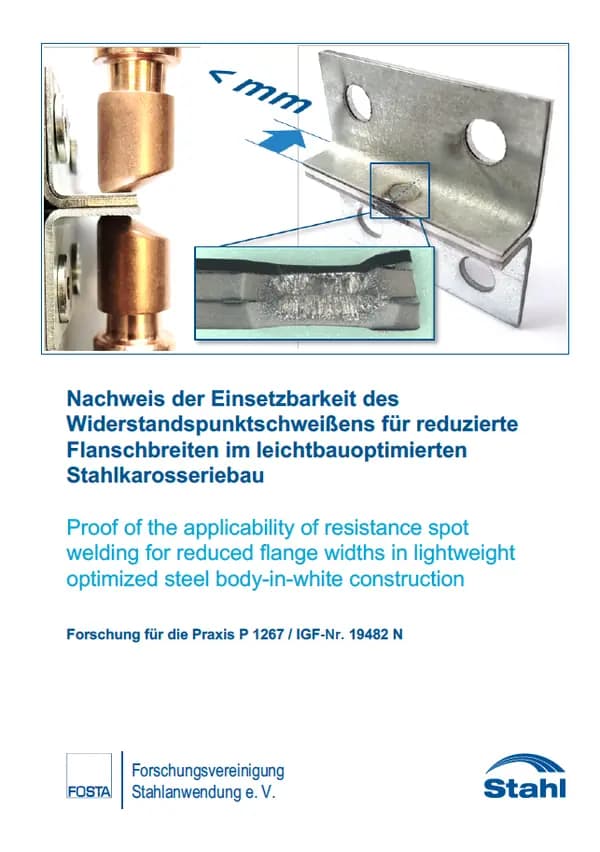
P 1267 - Proof of the applicability of resistance spot welding for reduced flange widths in lightweight-optimised steel body construction Lightweight construction concepts made of modern high-strength sheet steel materials play an important role in the realisation of resource-saving, affordable mobility. To increase customer benefits (door entry, "slim A-pillar", etc.) and to reduce weight, there is also increasing interest in reducing the flange widths commonly used today in car body construction. The reliable and cost-efficient joining of components made of high-strength steels with reduced flange widths using the highly efficient resistance spot welding process, which is widely used in the sheet steel processing industry, presents a challenge. While OEMs and Tier 1 suppliers can use investment-intensive technologies such as laser beam welding, SMEs lack the necessary user information for the reliable joining of narrow flanges with resistance spot welding technology. In this project, the applicability of resistance spot welding for reduced flange widths was systematically investigated by means of experimental and numerical studies on joining tasks that are realistic for car body construction and go beyond the current state of the art. At the same time, the boundary conditions to be observed and economic compromises for a process capability suitable for production were determined. Against the background of the application-oriented project objective, in addition to investigations under "idealised" laboratory conditions, experiments were also carried out under production-related conditions in the form of a systematic investigation of influences and disturbance variables. This also took account of the advancing development of ultra-high-strength high-performance steels (3rd generation steels) by specifically analysing them. A 3D welding process simulation was set up using freely available software in order to increase scientific and process-related knowledge in the WPS of reduced flange widths, e.g. with regard to temperature distribution and weld lens growth. The results can be used directly by users, for example to determine optimisation potential, e.g. of alternative electrode cap geometries. The results and methods generated as part of the project thus help to save costly and time-consuming experimental validation within the company and to be able to offer corresponding lightweight products on the global markets. The derivation of user-friendly guidelines as well as design and production instructions based on the research results obtained supports a wide range of users, particularly from the SME sector, in the realisation of the joining tasks assigned to them and thus increases the overall competitiveness of SMEs. Publication date: August 2020 Authors: Ch. Böhne M.Sc., Prof. Dr.-Ing. G. Meschut
available anytime
€30.00
excl. VAT

P 1262 - Influence of production-related tolerances on the failure and deformation behaviour of mechanically joined joints under crash load Mechanical joining technology is becoming increasingly important in the manufacture of modern vehicle bodies. In contrast to conventional thermal joining processes such as resistance spot welding, mechanical joining technology enables the joining of mixed structures. Against the background of the increasing demand for resource-saving complete vehicles, the production of mixed structures represents an effective way of reducing the overall vehicle weight. Mechanical joining technology is usually fully automated in industrial applications, whereby tolerances can occur in the design of the joint. These tolerances have an influence on the load-bearing and failure behaviour of the joined joint. The aim of this project is to investigate experimentally and numerically the influence of production-related tolerances on the load-bearing and failure behaviour of mechanically joined joints. A methodology was developed with which it is possible to take the observed effects into account in the crash simulation of vehicle structures. Different manufacturing influences (rivet length, rivet head end position, orthogonality, lateral offset and flange overlap) were investigated for several joining methods (semi-tubular self-pierce riveting, bolt setting and flow punch moulding). For this purpose, corresponding connections were created taking into account the individual manufacturing influences. The effects of the individual manufacturing influences on the load-bearing and failure behaviour of the joint were then investigated using LWF-KS-2 specimens. The findings obtained at single-element specimen level were then validated using a sample component in the form of a T-joint under longitudinal and transverse loading for complex loading conditions. To supplement the experimental database, numerical process simulations were carried out for further characteristics of the investigated manufacturing influences, which were used to create load-bearing capacity simulations in the form of detailed models. Based on these investigations, functional relationships were derived for the characteristics of the individual manufacturing influences and their effects on the load-bearing and failure behaviour of the connection. These functional relationships were used to consider the effects of the individual manufacturing influences in the form of reduction factors in the equivalent modelling of joints. Finally, the developed procedure was validated by simulating the sample component tests for complex load conditions. The knowledge gained in this project enables users to take into account the effects of production-related tolerances on the load-bearing and failure behaviour of mechanically joined joints in the development of vehicle components and to investigate their influence on the crash behaviour of the overall structure Publication: 2022 Authors: Prof. Dr.-Ing. G. Meschut, Prof. Dr. rer. nat. P. Gumbsch
available anytime
€30.00
excl. VAT
Payment by card (Stripe) or invoice (DE, AT, CH). Download link by email: automatically after ordering by card, after order approval for invoice (valid for 30 days). Terms