Against the background of constantly dwindling resources and very high production volumes in the billions, the issue of material savings is of central importance in the packaging steel industry. The entire packaging …
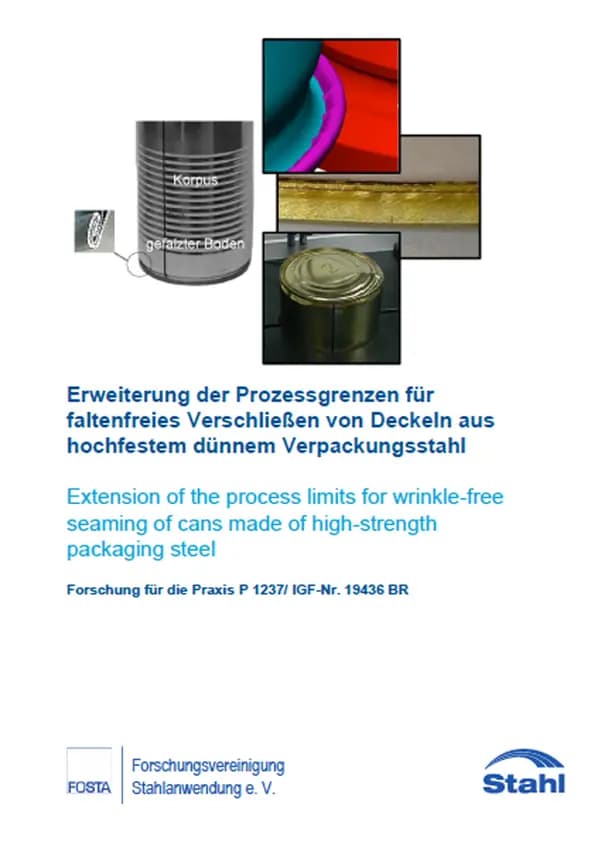
Against the background of constantly dwindling resources and very high production volumes in the billions, the issue of material savings is of central importance in the packaging steel industry. The entire packaging steel processing industry is therefore faced with the economic and technical challenge of having to process high-strength tinplate alloys reliably. This research project investigated the extent to which thinner, higher-strength metal packaging materials can be reliably processed and used to increase the functionality of cans (in this case, three-piece food cans). Based on extensive research into the seaming technology of metal packaging and the expert discussion (interview) within the project-accompanying industrial working group, the main influences on the seaming process were analysed, weighted and evaluated.
The main influences were analysed with the aid of an FEM process model for the roll capping technology and then an optimisation was carried out for the main parameters. Using a derived criterion for crease assessment (waviness and maximum crease height) in the FEM results, comparability was established and made assessable. As part of the process optimisation, the profile geometry of the OP1 capping roller was changed in particular. The profile height and the profile radii proved to be significant influences. The values achieved for these parameters within the optimisation showed significantly better wrinkle behaviour in the FEM model and were subsequently verified in experimental tests on industrial machines. Within the experimental tests at three machine manufacturers and one can manufacturer, the improvement of the crease behaviour with the new tool geometries for the OP1 seaming operation could be practically proven. The cans produced by the industrial participants were sent in small quantities to the industrial measuring partner, who analysed them in terms of wrinkling using a new non-destructive measuring principle. The analysis of the results for all the materials investigated showed that the optimised process settings and tool geometries resulted in a significant improvement in wrinkling for all manufacturers. The dent test was carried out on a random basis as part of investigations into the functionality of the sealed cans. From this sample it can be deduced that all materials with a higher strength have the potential to improve functionality. However, it can also be emphasised that materials with a high strength and a high elongation have a greater potential for improving the component function than materials with a pure increase in strength.
Payment by card (Stripe) or invoice (DE, AT, CH). Download link by email: automatically after ordering by card, after order approval for invoice (valid for 30 days). Terms
Machine-translated title and description. The document itself is in German.
Digital download
Other parts and editions as well as neighbouring documents of the same series.

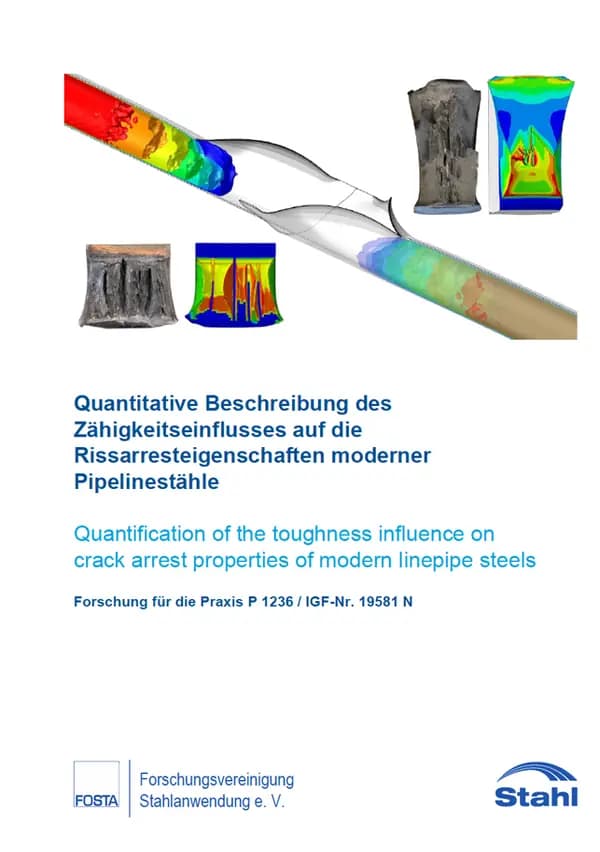
P 1236 - Quantitative description of the influence of toughness on the residual cracking properties of modern pipeline steels Resistance to long-running cracks while ensuring crack arrest is one of the most important safety requirements for gas transport pipelines. Pipeline steels with excellent toughness properties have been developed to fulfil these requirements. However, due to the fracture phenomena occurring during experimental toughness characterisation in notched bar impact bending tests and Battelle drop weight tests to rule out brittle crack initiation, the conventional design methods for extensive use of these outstanding properties must be questioned. The phenomena include so-called separations and inverse fracture behaviour. In addition to the exclusion of brittle crack initiation, ductile crack arrest must be ensured. Sufficient material resistance to crack propagation is defined as the high layer energy value from notched bar impact tests. Studies in the past have shown non-conservative design results for modern pipeline steels, which are countered with corresponding safety factors. In this project, damage mechanics modelling approaches were therefore developed and parameterised on the basis of extensive experimental work in the low position and at RT. The ductile and brittle damage models were verified by simulating notched bar impact bending tests and Battelle drop weight tests and then used to predict the pipe behaviour. Separation and inverse fracture behaviour were simulated for the first time in the Battelle drop weight test. At component level, the simulations showed an increase in the crack propagation velocity as a result of the separations, but in the laboratory tests and in the pipe, less critical stress conditions in the area in front of the crack front with regard to the initiation of the split fracture. With regard to the inverse fracture behaviour, it could be concluded that this is due to the stress conditions in the laboratory samples in the high position and is not to be expected in the pipe. In parallel, a coupled FSI pipe model was developed to estimate the interactions between the crack propagation in the pipe wall, the fluid decompression inside the pipe and the soil backfill in onshore applications. During the simulation of the bursting process, the three-dimensional FSI model is used to calculate the pressure fields inside the pipeline, which differ greatly depending on the fluid. In comparison with measurements from bursting tests, accurate predictions were achieved and the approach verified for single-phase and two-phase natural gases and CO2 mixtures. The project results obtained support the safe handling of ultra-high-toughness piping materials and extend their range of applications. Based on the numerical predictions, sometimes applied correlations between the material behaviour at laboratory and component level can be evaluated. Furthermore, the damage-mechanical and multi-physical modelling concepts represent innovative tools for the design of other pressurised components. Publication: January 2021 Authors: Prof. Dr.-Ing. S. Münstermann, David Lenz, M.Sc., Prof. Dr.-Ing. A. Nonn, V.Keim, M.Sc.
available anytime
€30.00
excl. VAT

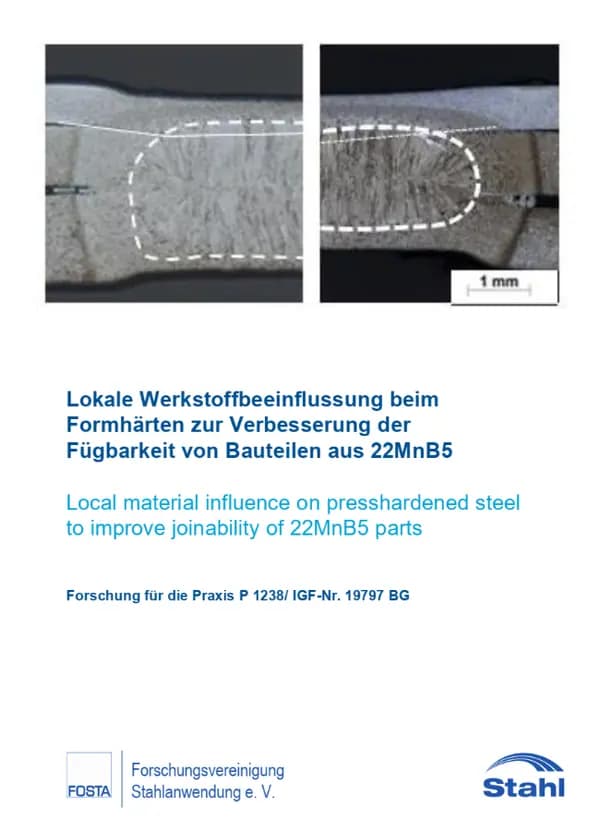
P 1238 - Local material influence during mould hardening to improve the joinability of components made of 22MnB5 The aim of the research project was to improve the joinability of mould-hardened components made of 22MnB5 through the targeted introduction of local thinning with the associated formation of deformation-induced ferrite (DIF). In addition to the localised reduction in material thickness, the material properties were also influenced by the targeted introduction of DIF. To this end, the IFUM Hannover carried out investigations into the mould hardening of locally softened blanks. The IWF Magdeburg focussed on expanding the joinability of material combinations with 22MnB5 through resistance spot welding and semi-tubular punch riveting. At the beginning of the project, extensive tests were carried out on the forming dilatometer to determine the process window for the formation of DIF. The findings from the dilatometer tests were then validated by means of experimental thinning tests. For this purpose, tests were carried out on a hydraulic double-column press in which embossing was applied to the blanks using a deformation plate during a conventional mould hardening process. The tests carried out showed that it was not possible to produce sufficient embossing points with the formation of DIF using conventional mould hardening due to the long contact time of the deformation tools with the blanks used. For this reason, model tests were carried out on a spindle press from Weingarten, in which very short contact times were possible due to the abrupt punch movement. The tests on the screw press were used to investigate the generation of DIF in a forming process. As it was not possible to transfer the objective pursued to a mould hardening process, the potential of DIF generation was finally investigated in a numerical simulation. Publication: May 2021 Authors: Prof. Dr.-Ing. B.-A. Behrens, Prof. Dr.-Ing. S. Jüttner
available anytime
€30.00
excl. VAT

P 1239 - Improving the predictability of thermal component distortion during press hardening A parameter study was carried out to determine the process parameters that have the greatest influence on the final hardness profile and the component distortion of a C-profile during graded press hardening. Three press hardening materials were analysed for this purpose. Material A is the typical press hardening steel 22MnB5. Material B is a press hardening steel optimised for high energy absorption in the event of a crash. In addition, material C is a press hardening steel with an increased carbon content. In order to determine the influence of various process parameters, the furnace temperature and the holding time in the mould were varied. As a result, material A produces parts with graded component properties and a high hardness in the cooled area of the part. The parameter variation does not lead to a significant influence on the hardness. In contrast, the hardness profile of material B in the cooled area is clearly influenced by the furnace temperature. The higher furnace temperature causes a greater difference in hardness values between the cooled and heated areas. As expected, material C delivers the highest hardness values, with the higher furnace temperature leading to the highest hardness values. The geometric analysis shows the greatest deviations in the flange of the heated area. However, there is no clear trend as to how the furnace temperature and the holding time affect the geometric deviations. The clear deviation in geometry between material C in relation to the other two materials is striking. The forming simulation maps the thermal process sequence in detail. The locally different cooling rates result in areas with different microstructural proportions and corresponding mechanical properties. The differences in hardness typical of partial press hardening could be reproduced. After component removal, distortion occurs, which is made up of elastic springback and thermal shrinkage. The shape deviation is suitably predicted by the finite element model. However, a change in the process parameters has only a limited influence on the component distortion in the intervals under consideration, analogous to the real tests. Publication: 2021 Authors: Prof. Dr.-Ing. M. Dix
available anytime
€30.00
excl. VAT

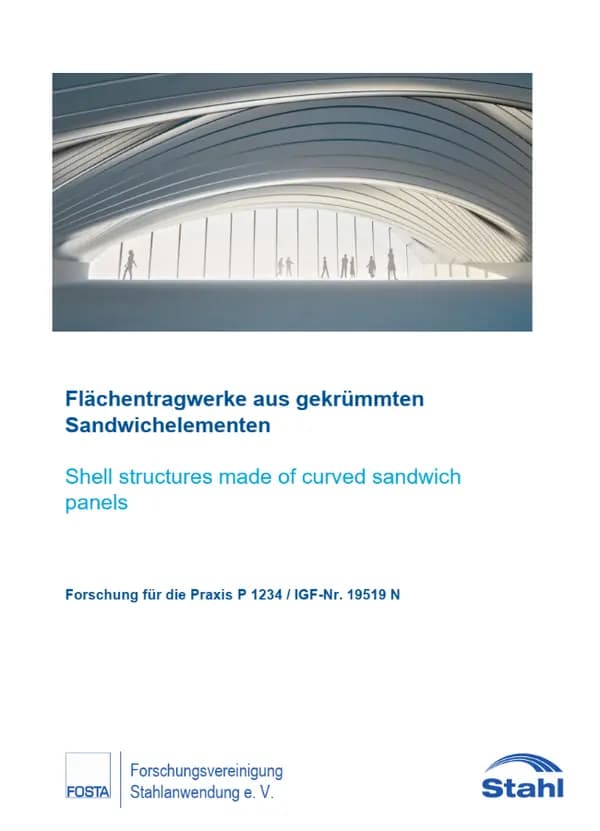
P 1234 - Surface structures made of curved sandwich elements As expected, the present research project very quickly confirmed that the manufacturing costs of curved sandwich panels are higher than those with a flat surface. However, the strategy of limiting the scope of possible geometric variations in favour of better manufacturing conditions on the one hand and maximising them on the other hand through upstream, design-specific optimisation was successful. By using a developed design tool for curved sandwich elements, unrestricted design freedom in the development of sophisticated building geometries can be ensured and at the same time the undesirable and costly manufacturing complexity of curved sandwich panels can be sensibly limited. The planner is provided with sensible design corridors at an early design stage, within which subsequent production will be economically feasible. This linking of planning and production ensures the desired research success. It has also been shown that the geometric classification into four levels of complexity is completely sufficient to adequately describe all common building geometries with surfaces that are not completely flat. Furthermore, it has been shown that up to and including complexity level 3, a sufficient number of building geometries are possible and can be visualised, which can nevertheless be produced comparatively easily. It was shown how geometrically non-planar surfaces can be strategically subdivided so that they can be optimally produced with the given boundary conditions (e.g. restrictions due to existing production machines). With the right approach, the factors "roll width" and "number of forming steps" can be optimised comparatively easily. The downstream work steps of design - optimisation - geometric subdivision - production can also be iteratively improved in repeatable work steps, supported by the knowledge now available. As an open source tool, the software tool itself remains open for development in the future and can be easily adapted to meet future requirements. For the user, it remains straightforward and easy to use even without in-depth programming knowledge. For digitalisation in the construction industry, this consistent process chain optimisation remains a very good way of realising future building designs in a sophisticated yet economical manner. In theoretical, numerical and experimental investigations into the load-bearing behaviour and load-bearing capacity of curved sandwich elements, the great structural potential of the new construction method developed as part of this project was demonstrated. The investigations also created the basis for realistically modelling the load-bearing behaviour of curved sandwich elements. The stability failure of the compressed surface layer is also the decisive failure mode in structures made of curved sandwich elements. It could be shown that a curvature of the sandwich elements in the developed application area has no significant influence on their crumple stress. Publication: January 2021 Authors: Prof. Dr.-Ing. J. Lange, M. Sc. S. Grimm, Prof. Dr.-Ing. P. Groche, M. Sc. M. Moneke, Prof. Dr.-Ing. Schäfer, Dipl.-Ing. J. Reising
available anytime
€30.00
excl. VAT
Payment by card (Stripe) or invoice (DE, AT, CH). Download link by email: automatically after ordering by card, after order approval for invoice (valid for 30 days). Terms