
FOSTA
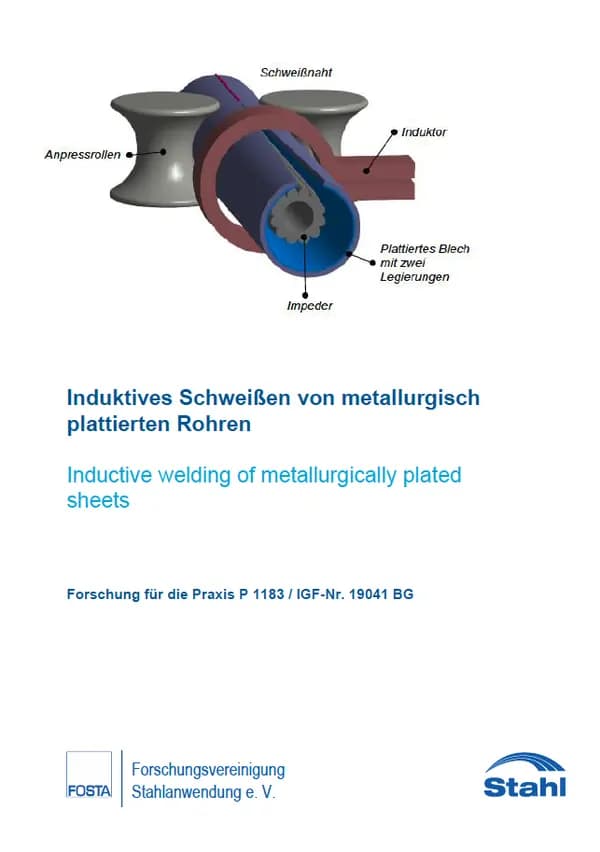
The aim of the project is the inductive longitudinal seam welding of metallurgically clad sheets for the production of multi-layer steel pipes. This is the first time that the inductive welding process has been …
The aim of the project is the inductive longitudinal seam welding of metallurgically clad sheets for the production of multi-layer steel pipes. This is the first time that the inductive welding process has been qualified for multi-material joints with steel. For a full connection and to adjust the alloy distribution across the joining zone, individual materials of the layer composite must be specifically heated and their mixing in the heat-affected zone controlled. Simultaneous multi-frequency technology for selective heating of individual materials, specific weld edge geometries for controlling the molten pool movements and a multiple simulation approach are used for this purpose.
The multiple simulation approach combines numerical FEM simulation as well as conductive and inductive test welds. The result of the simulation work is the first module for the inductive welding of multi-materials and multi-frequency technology. The conductive sheet metal test welding system simulates the complex inductive tube welding process on flat samples. Inductive tube welding tests reference and qualify the results of conductive tests and the FEM simulation. By comparing the methods, knowledge is gained about their suitability for modelling industrial manufacturing processes and industrial pipe welding processes are mapped outside the production facilities at an economically justifiable cost. This makes it much easier to introduce new materials and their combinations. The ability to process clad starting materials with highly economical inductive tube welding processes offers enormous cost-cutting potential in existing applications such as pipeline tubes. Furthermore, completely new applications such as corrosion-resistant flue gas pipes for heating boiler construction or welding filler materials in which the alloy composition can be adjusted via the cladding.
Machine-translated title and description. The document itself is in German.
Payment by card (Stripe) or invoice (DE, AT, CH). Download link by email: automatically after ordering by card, after order approval for invoice (valid for 30 days). Terms
Digital download
Other parts and editions as well as neighbouring documents of the same series.
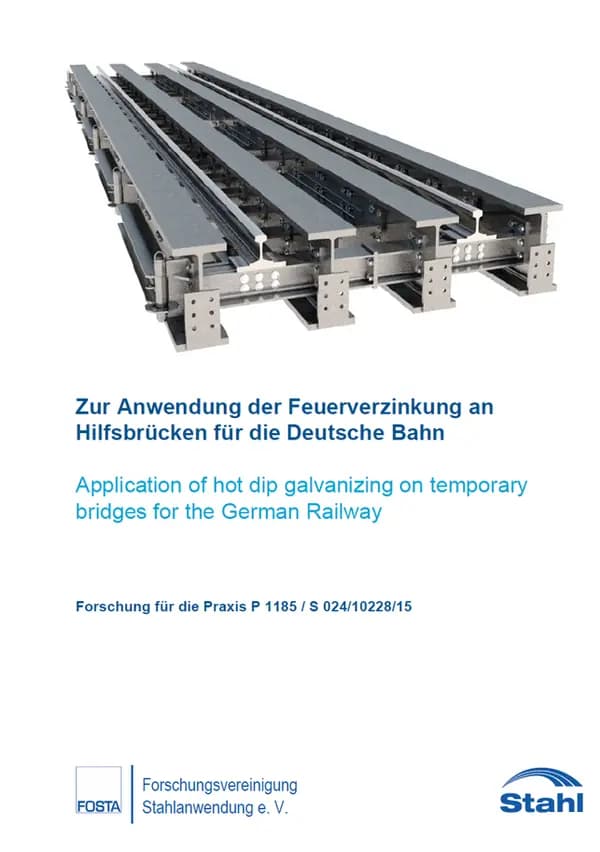
P 1185 - On the application of hot-dip galvanising on auxiliary bridges for Deutsche Bahn Auxiliary bridges with different spans and construction methods are used by DB Netz AG for temporary construction work on and next to railway lines to support the tracks. The bridges are generally used for periods ranging from several days to a maximum of three years. There is a great need for temporary bridges, as many bridges are currently in need of repair and many new ones are to be built in the near future. The corrosion protection currently used consists of an organic coating, which often has to be repaired due to the high mechanical stress caused by assembly and transport in order to prevent corrosion damage such as undermining or pitting and the associated weakening of the material. A high repair rate is also associated with high costs and a high consumption of resources. Hot-dip galvanising is a well-known corrosion protection method that offers considerable advantages in terms of durability and resistance. Research results in recent years on the influence of hot-dip galvanising on the fatigue strength of components have created the basis for application under cyclic loads. It was found that although the use of hot-dip galvanising has a negative effect on the fatigue strength of steel, this only results in a reduction of up to one notch for the design. On the basis of these results, this short study examined whether hot-dip galvanising can also be used on Deutsche Bahn auxiliary bridges and whether it makes sense to do so. The different framework conditions of the bridge systems of the construction types twin girder auxiliary bridge and small auxiliary bridge as well as the boundary conditions to be observed for hot-dip galvanised constructions, such as galvanising lengths and weights, suspension points or ventilation openings, were examined. From this, hot-dip galvanised variants were developed for some auxiliary bridge systems and tested for load-bearing capacity, fatigue and serviceability in accordance with current standards. It was found that a recalculation of the structures according to the current Eurocode standard would already lead to adjustments, as some of the valid type statics were already drawn up in 1990. From a structural point of view, the twin girder auxiliary bridges with a span of 9.60 m and 12.00 m in particular can be hot-dip galvanised. In addition to the addition of ventilation and flow openings, the end cross girders would have to be adapted and all holes enlarged by one millimetre due to possible zinc deposits. Galvanising main girders with a span of more than 12.00 m was considered problematic due to the lamella-reinforced design of the structures and excessive component lengths and weights. Although the classification of the auxiliary bridges as temporary structures means that proof of fatigue strength in accordance with Guideline 804 cannot be provided, an estimated service life of 50 years could be verified for the galvanised twin girder auxiliary bridges. The use of hot-dip galvanising for small KHB-KW auxiliary bridges is dependent on the galvanising capability of the cross girders, which should be checked on the basis of previous test galvanising without additional ventilation holes. However, it was not possible to achieve a service life of 50 years for the cross girders of the small auxiliary bridges in terms of fatigue, but this was not exclusively due to a hot-dip galvanised design. All investigations and results are presented in detail in the report using the example of the ZH 9.6 m twin girder auxiliary bridge. The other systems investigated are summarised in the appendix. Finally, the hot-dip galvanised auxiliary bridge structures were also examined from an economic point of view. The low initial costs of hot-dip galvanising and the reduction or even avoidance of maintenance and renewal measures were highlighted. The overall analysis led to the conclusion that the use of hot-dip galvanising for twin girder auxiliary bridges was economically viable, especially in the span range up to and including 12.00 m. Publication: May 2020 Authors: Prof. Dr.-Ing. D. Ungermann, S. Holtkamp M.Sc., M. Ant M.Sc.
available anytime
€30.00
excl. VAT
P 1180 - Modelling of multiple transformations in tool steels in additive processes Additive manufacturing is characterised by a cyclical heat input through the build-up of the individual layers and the subsequent quenching through heat dissipation via the base body. In laser powder build-up welding, the heat input is particularly high and at the same time the build-up frequency is significantly higher than in powder bed-based processes. In the additive manufacturing of martensitic hardenable steels, cyclic heating and quenching can lead to multiple austenite ? martensite transformations and significant annealing. martensite and to significant tempering effects of the martensite. Depending on the process parameters, considerable microstructural and thus hardness gradients occur within a component. For the hot-work tool steel X40CrMoV5-1, the resulting microstructure after laser powder cladding was intensively investigated experimentally and conclusions were drawn about the formation mechanisms. Based on this, a model for the cyclic transformation of austenite ? martensite and the tempering effects of the martensite. This model was integrated into an FE programme for the simulation of additive manufacturing. Simple model components were simulated and compared with experimental results regarding the hardness distribution. Publication: 2020 Authors: Prof. Dr.-Ing. F. Vollertsen, Prof. Dr.-Ing. H.-W. Zoch, Prof. Dr. A. Schmidt
available anytime
€30.00
excl. VAT
P 1188 - Qualification of a new Cu-St material system for use in chassis components Highly stressed chassis components in automotive engineering are currently often manufactured from multiphase steels if yield strengths above 600 MPa are required. These steels combine high strength with a high degree of ductility, making them increasingly interesting for the production of thin-walled lightweight structures with high degrees of deformation. Thin-walled semi-finished products are usually manufactured from cold-rolled strip, whereby multiphase steels require the use of continuous annealing lines (continuous annealing), as this is the only way to achieve the corresponding temperature-time cycles. However, the majority of existing cold rolling mills use a bell annealing process, as this offers high flexibility at low cost. There is enormous potential for the cost-effective production of highly stressed lightweight structures in the processing of a new, low-alloy steel grade SP-800. Through a targeted combination of work hardening and precipitation hardening with copper, a wide-ranging grading of the material system is possible, so that yield strengths in the range of 600 MPa to 1000 MPa can be set in combination with elongation at break of between 10 % and 20 %. As part of the FOSTA research project Qualification of a new Cu-St material system for use in chassis components, various tests were carried out to characterise the material. The reference material CPW800 was also tested for comparison. The tests on various heat-treated samples showed that the material behaviour could be adjusted via the heat treatment (strength / elongation at break). A possible negative effect of the copper precipitations on the fatigue behaviour assumed in the run-up to the research project could not be proven. Although the fatigue behaviour of the copper-steel alloy was worse in the tests than that of a CPW800 material used in series production, the fracture surface analyses showed that the crack growth originated from the sample surface and not from internal defects. In summary, it can be stated that the material produced in the laboratory already shows competitive material behaviour compared to the CPW800 material based on the material characterisation, which must be evaluated depending on the application. Further optimisation potential seems possible through industrial production. Due to its good mechanical properties, the material shows fundamental potential for future chassis applications. Publication: 2017 Authors: Prof. Dr rer. nat. T. Tröster
available anytime
€30.00
excl. VAT
P 1189 - Increasing the corrosion fatigue strength of steel wheelset shafts by inductive surface hardening As part of the research project, it was shown that inductive surface layer hardening carried out with optimised process parameters significantly increased both the fatigue strength and the corrosion fatigue strength (corrosive medium 5 % NaCl solution) of the material 25CrMo4 (EA4T). Using the optimised hardening parameters, a hardening depth of approx. 3 mm at 45° to the shank in the notch could be set for the specified sample geometry. Furthermore, the surface layer post-treatment resulted in residual compressive stresses of ?ES ? -600 MPa and the hardness in the edge area was significantly increased with values of >500 HV1. All these factors led to the surface layer developing a certain robustness against damage caused by various conditions in the track bed, such as stone impacts or corrosion. Further investigations showed that neither artificially milled notches with a depth of 0.3 mm nor precorrosion had a negative impact on the fatigue strength of the induction-hardened samples. Furthermore, investigations into the corrosion resistance of the material in the initial state and with an induction-hardened surface layer state were carried out in the form of electrochemical tests and ageing tests. The results showed that induction hardening does not have a negative effect on the corrosion behaviour of the material. Induction hardening meant that corrosion had no negative influence on the long-term strength. A strategy was developed to qualify the effectiveness of surface-hardened wheelset shafts under fatigue crack corrosion fatigue conditions using the field-relevant damage parameters. Based on this strategy, the samples for the fatigue tests were specifically pre-corroded. In addition, the corrosion protection coating currently in use was analysed in terms of its protective capacity. A transferability concept was developed to transfer the fatigue strength values determined on a sample basis to components. This concept makes it possible to estimate the fatigue strength for the long-term strength range as a function of component-specific, highly stressed material volumes. Publication: 2021 Authors: Prof. Dr.-Ing. T. Melz, Prof. Dr.-Ing. M. Oechsner, Prof. Dr.-Ing. H.-W. Zoch
available anytime
€30.00
excl. VAT
Payment by card (Stripe) or invoice (DE, AT, CH). Download link by email: automatically after ordering by card, after order approval for invoice (valid for 30 days). Terms