The development in offshore wind energy towards larger, more powerful turbine types and the simultaneous increase in water depths of the projected wind farms poses growing challenges for designers and manufacturers of …
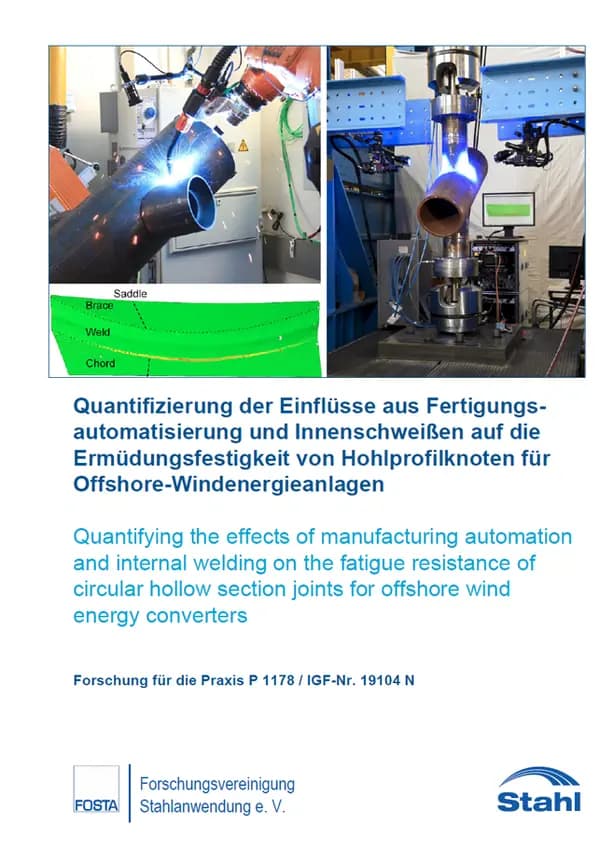
The development in offshore wind energy towards larger, more powerful turbine types and the simultaneous increase in water depths of the projected wind farms poses growing challenges for designers and manufacturers of the foundation structures of wind turbines, among others. In addition to the foundation concept of XL monopiles, jacket foundations are also coming into focus due to the combination of comparatively low material consumption and high rigidity. The production costs of jackets are high compared to monopiles, but can be reduced by using standard pipes with automatically produced jacket nodes. Against this background, this research report describes the manufacturing process for the automated welding of X-shaped hollow profile nodes for jacket foundation structures of offshore wind turbines.
Another key objective of this project was the consistent digitalisation of the welding production chain during the automated welding of the X-nodes. The process parameters stored in this way can serve as a basis for quality control on the one hand and enable complete traceability of the automatically produced pipe nodes on the other. The second key aspect dealt with in this report involves quantifying the influences of production automation and internal welding on the fatigue strength of the hollow section nodes on the basis of serial fatigue tests. For this purpose, two series of 16 fatigue tests each were carried out on single and double-sided automatically welded X-nodes and corresponding structural stress-strain curves were determined for the automatically manufactured X-nodes. The results of these fatigue tests are then compared in numerical analyses based on the structural stress and notch stress concepts in order to evaluate the predictive capability of both concepts for the fatigue-critical areas of the X-node. The welding, experimental and numerical analyses carried out in the research project made it possible to quantify the potential of automatically manufactured pipe nodes in terms of reproducibility and fatigue behaviour. In addition, the influence of the inner weld seam on the fatigue strength could be evaluated.
Payment by card (Stripe) or invoice (DE, AT, CH). Download link by email: automatically after ordering by card, after order approval for invoice (valid for 30 days). Terms
Machine-translated title and description. The document itself is in German.
Digital download
Other parts and editions as well as neighbouring documents of the same series.

P 1175 - Study on the joining protection and technical design of welded joints with martensitic chromium steels The aim of the project is to develop the weldability of constructions made of press-hardened 1.4034. The focus of the welding investigation is on optimising the parameters with regard to crack resistance, the application to contour weld seams and the improvement of the strength and toughness of the joint. For this purpose, sheets of martensitic chromium steel of the same and dissimilar types are joined with established and modern materials. Joints are made in all joint types. The load-bearing capacity is tested under quasi-static and impact loads. The focus is on testing contour-welded seams. The understanding of the relationship between joint characteristics and load direction is to be improved. An analysis should provide information about the mechanics of the failure. Fatigue strength tests are carried out on butt and lap joints with a given variation of welding parameters. Cyclic strength data for optimum parameters are derived from this. The investigation is extended to the fatigue strength of the reference material in dissimilar butt and lap joints. The results serve as a basis for the structural design of welded joints with ultra-high-strength steels. Process diagrams for production and specifications for the design of processes and tools are derived. The characteristic values for load-bearing capacity and fatigue strength provide material-specific guide values for the calculation of welded joints. Processes and construction are incorporated into the design and manufacture of a test component. In this way, the validity of the determined data is checked. The main area of application is sheet metal processing. Target applications are primarily to be found in vehicle construction for road and rail. In the area of profile processing, the solution approaches can be used in lifting conveyors, ship decks and aircraft parts. The results of the process development are used in the design of tools for production. Publication: 2021 Authors: Prof. Dr rer. nat. R. Poprawe, Prof. Dr.-Ing. T. Melz, Prof. Dr.-Ing. G. Meschut
available anytime
€30.00
excl. VAT

P 1172 - Mechanically joined steel structures in vehicle construction and civil engineering The research project shows that it is possible to predict the tool geometries for clinching thick sheet metal by means of numerically generated diagrams with accuracies in the range of approx. ± 10 % of the geometric variables neck thickness and undercut. However, in order to make the diagrams manageable for the user, it is necessary to restrict the input parameters and thus the solution space, so that the transfer of the results into a software solution appears promising at this point. The use of a software solution would also make it possible to define different materials for the punch and die-side sheet and to vary other mould parameters, which is not manageable with the help of simple diagrams due to the unmanageable number of influencing parameters. The corrosion behaviour of hot-dip galvanised and subsequently clinched semi-finished products was investigated for the sheet thickness range typical of commercial vehicles. These samples were tested in accordance with VDA 233-102, even though short-term tests do not represent the corrosion behaviour under real conditions and are therefore not suitable for making statements regarding the protective effect and duration of zinc coatings and alloyed zinc coatings. The alternating corrosion test is therefore only used for the relative comparison of the tested configurations. As damage to the zinc coating caused by clinching had already occurred in preliminary tests, additional options for post-treatment of the clinching points were investigated in order to fully restore the corrosion protection. The potential for hydrogen-induced material failure of the clinch points was also investigated. The strip-galvanised samples for the construction industry were only exposed to outdoor weathering and subsequently evaluated. For the application of joining techniques in the construction industry, it is necessary to be able to clearly determine the load-bearing and deformation behaviour of the joining points for the respective load, which is usually done using standardised design specifications. However, there is currently no standardised regulation for the clinching joining process. The aim of the research project was therefore to determine the decisive influencing variables on the shear tensile strength, the stress distribution and the deformation behaviour of the joint and, in addition, to develop a design approach with which the limit shear force can be determined for the clinching point geometries investigated in the research project. Experimental investigations on clinched stud frames and a comparison of the results with bolted constructions showed that the low-deformation clinching joining technique has a favourable effect on the deformations and stiffness of the integral structure due to the slip-free design. Publication: 2020 Authors: Prof. Dr.-Ing. W.-G. Drossel, Dipl.-Ing. T. Kropp, Dr. J. Gehrke, Prof. Dr.-Ing. D. Ungermann, Dipl.-Ing. G. Kleemann
available anytime
€30.00
excl. VAT

P 1170 - Design method for elastic bonded joints Δα-Problems caused by the combination of steel frame constructions with dissimilar materials with different thermal expansion coefficients are leading to the increasing use of elastic adhesives across all industries. In the project P985 Qualification of assembly adhesives as well as in existing methods, the deformation-based design method was qualified as suitable for designing joints with elastic adhesive layers. However, this method does not yet take into account the time-dependent influencing variables, such as the rate or frequency dependency in combination with complex environmental conditions. The aim of the research project is to extend a deformation-based design method for elastic bonded joints to include the rate and frequency dependence of the mechanical characteristics, taking into account the ambient conditions, described by humidity and temperature. Based on the design method developed in the P985 Qualification of Assembly Adhesives project, the rate- and frequency-dependent material characteristics of the various polyurethane adhesives are analysed, taking into account the ambient temperature and humidity, and these influencing variables are then implemented in the existing deformation-based design method. Due to incomplete design methods with regard to the time-critical variables, the positive effects of stress relaxation are underestimated, especially in low cycle fatigue. A more holistic design method can improve the potential of the connection. In addition, the understanding of elastic thick-film bonds is improved, which can increase the area of application of these bonds. Publication: 2018 Authors: Prof. Dr.-Ing. G. Meschut
available anytime
€30.00
excl. VAT

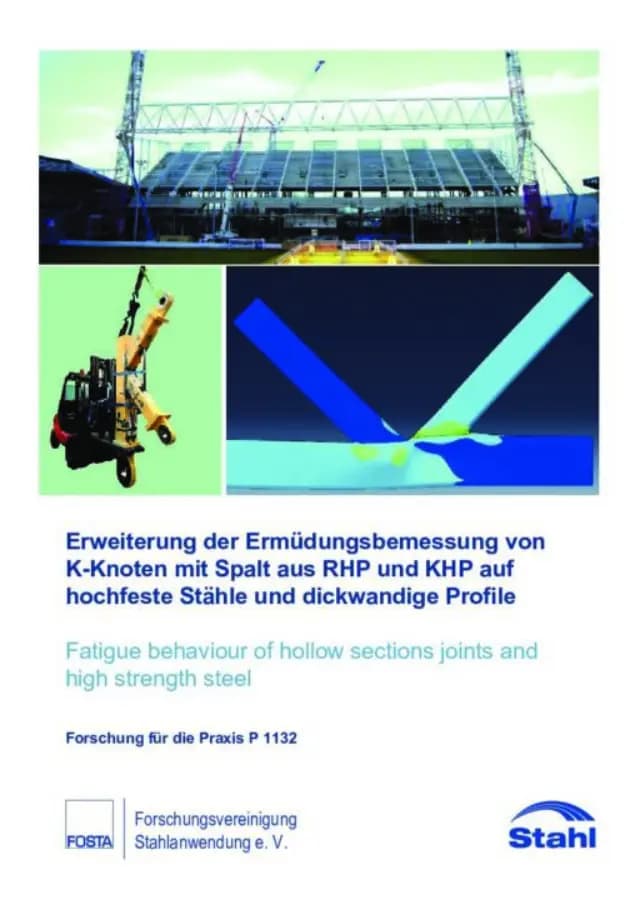
P 1132 - Extension of the fatigue design of K-nodes with gap made of RHP and KHP to high-strength steels and thick-walled sections Fatigue-stressed structures are increasingly being manufactured from high-strength steels in order to realise lightweight construction. In truss construction, the K-node with gap is the favoured node configuration. To facilitate the application and design of such nodes made of high-strength steel grades and with greater wall thicknesses, the existing design rules must be adapted and extended. The test programme carried out for this purpose comprises a total of 55 fatigue tests on K-nodes made of rectangular hollow sections (RHP) and circular hollow sections (KHP) of different dimensions made of S355, S500 and S700. K-knots of smaller dimensions are tested at TNO in Delft, Netherlands, on a test rig with individual cylinders. K-knots with large dimensions are tested at KIT in Karlsruhe on a specially manufactured test frame. The experimental tests are analysed according to the nominal stress concept of EN 1993-1-9 (2010) by creating Wöhler curves. In particular, the tests on small KHP K nodes with a welded gap show that the fatigue strength depends not only on the node dimensions and geometric parameters but also on the weld design and geometry. This is not taken into account in the design rules, but can be used for the design of fatigue-compliant structures. For example, the fatigue strength of KHP K nodes with a welded gap can be increased by two notch classes from 71 to 90. In contrast, the small RHP K-nodes investigated are manufactured with weld start and end points in the corners of the strut profiles, which means that the weak point of the weld seam coincides with the hot spot of the geometry. The test results of these test specimens therefore represent a lower limit for the fatigue strength. The fatigue strength of K-nodes depends heavily on the wall thickness of the components and their ratio value <span class="fontstyle3">t</span>. The classification for the nominal stress approach is therefore rightly based on the inverse wall thickness ratio 1/<span class="fontstyle3">Τ = t0 / Τi. The results of the fatigue tests on large RHP and KHP K-nodes made of S355 and S700 with 20 mm wall thickness fit well into the existing notch classes and can be categorised according to CIDECT Design Guide 8 or EN 1993-1-9 (2010) without wall thickness reduction. In parallel, numerical calculations are carried out to extend the scope of validity. The finite element models are calibrated using strain measurements in verification tests. Volume elements are used for this purpose and the weld seams are also modelled in order to enable an exact representation of the local stresses in the weld seam. A parameter study is carried out to extend the parameter range under consideration and to identify the influence of individual geometric parameters such as chord slenderness 2<span class="fontstyle3">y, wall thickness ratio <span class="fontstyle3">t, width or diameter ratio ß or strut inclination angle O<span class="fontstyle3">. For RHP K-nodes, 72 different node configurations are calculated, each with 4 separate load cases. KHP K-nodes are calculated in 16 different dimensions with 3 load cases each, so that a total of 336 FE models are created, calculated and analysed within the parameter study. In addition, stress concentration factors are determined on the basis of the strain measurements in the test. These are then used together with the results of numerical parameter studies to validate or adapt existing SCF formulae. For RHP K-nodes, a re-evaluation of previous and new data for the load case "Axial loading of the strut (AX)" is carried out and suitable formulas with a slight modification of existing CIDECT formulas are provided. For RHP K-nodes with gap under in-plane strut bending (IPB), no formulae are given in CIDECT. A new set of equations has been developed for this purpose. The evaluation of the structural stresses of KHP K-nodes under axial loading of the struts shows that the SCFs according to CIDECT formulas often provide very conservative values compared to the SCFs according to DNV GL-PR-C203 (2016) and from FEA. Since DNV GL-PR-C203 (2016) has a wider range of application and provides SCF formulas for the IPB and out-of-plane bending (OPB) load cases, it makes sense to use these formulas. Only the formula for SCFs for the belt under IPB is modified so that the SCFs are on the safe side. As the fatigue strength of hollow section connections is heavily dependent on the non-dimensional parameters, this should be taken into account at the planning stage by selecting suitable parameters. Through careful planning and execution, fatigue-resistant hollow section structures can be realised, even when using high-strength steels. Publication: March 2020 Authors: Dr.-Ing. S. Herion, Dr.-Ing. Hrabowski, Prof. Dr.-Ing. T. Ummenhofer, Dipl.-Ing. P. Ladendorf, Dr. ir. R. Pijpers
available anytime
€50.00
excl. VAT
Payment by card (Stripe) or invoice (DE, AT, CH). Download link by email: automatically after ordering by card, after order approval for invoice (valid for 30 days). Terms